Summary
Vendor transitions can expose hidden documentation debt and reliance on tribal knowledge in software products. Learn how structured knowledge transfer, technical documentation, recorded walkthroughs, and question-driven onboarding help preserve engineering continuity and reduce transition risks.
Changing software vendors or transferring responsibility to a new development team can reveal problems that have remained hidden for years. On a decade-old software product, critical knowledge often resides with experienced engineers rather than in reusable documentation. When those engineers leave the project, the incoming team must reconstruct the context behind architectural decisions, specialized modules, and established workflows while also trying to maintain delivery.
The consequences extend beyond onboarding. What appears to be a difficult handover may actually expose a deeper issue: the organization has accumulated documentation debt and become dependent on knowledge that was never formally captured. This was the challenge we’ve encountered in one of the projects where a client had an enterprise application platform.
Why Documentation Debt and Tribal Knowledge Create Hidden Continuity Risks
Documentation debt develops when software evolves faster than its supporting technical documentation. Features change, modules accumulate dependencies, and architectural decisions become embedded in the code without their original reasoning being recorded. Over time, the software may remain functional while the documentation becomes incomplete, outdated, or too general to support practical maintenance.
In established projects, this gap can remain invisible. Experienced engineers compensate for missing documentation because they already understand the system’s history. They remember why a component behaves unexpectedly, which integrations depend on a particular implementation, and which workarounds are necessary to avoid breaking existing functionality.

This knowledge is valuable, but when it exists primarily in people’s memory, it creates a tribal knowledge problem. The organization relies on specific individuals to explain how the product works and why it was built that way.
The risk becomes more apparent when a team changes. A new developer may understand the programming language and framework used in the software product but still lack the context required to modify a specialized module safely. An architecture diagram might show how components connect without explaining their behavioral constraints or the reasoning behind their dependencies.
For CTOs and engineering managers, this is an engineering continuity risk rather than simply a documentation inconvenience. It can affect several areas:
- Knowledge retention: Critical system knowledge may leave with experienced engineers.
- Technical onboarding: New specialists need additional guidance before working independently.
- System maintainability: Undocumented dependencies and assumptions make changes harder to assess.
- Delivery continuity: Routine maintenance and development may slow while knowledge gaps are resolved.
Tribal knowledge is not inherently a problem. Tacit knowledge is a normal part of engineering expertise, and not every detail needs to be documented. The challenge is identifying which knowledge is essential for maintaining, troubleshooting, and extending the product, then making it available beyond the people who originally acquired it.
Read Also Why Product Knowledge Should Not Depend on One Developer
Why Handover Calls Are Not Enough for Engineering Knowledge Transfer
Handover meetings are useful for introducing a system, demonstrating workflows, and discussing open questions. However, a sequence of calls does not automatically create a sustainable knowledge transfer process.
A development team can explain a module clearly during a live session, but that explanation may be difficult to reconstruct weeks later. New engineers might not remember every dependency, and other team members may not have attended the meeting. If the explanation is not recorded or documented, the incoming team must schedule another session or rely on someone else’s notes.
This becomes particularly challenging when the product contains specialized modules, a long development history, legacy and newer front-end technologies, and large interactive interfaces. A general overview may introduce the architecture without giving engineers enough context to troubleshoot a specific component or implement a change safely.
Effective engineering knowledge transfer therefore requires more than presenting the system. It must give the receiving team materials that support real implementation and maintenance work. Useful handover activities include:
- Demonstrating important workflows and specialized modules;
- Explaining dependencies, constraints, and non-obvious behavior;
- Answering concrete implementation questions;
- Recording explanations that engineers may need to revisit;
- Linking each explanation to relevant technical documentation.
The distinction is important: meetings help people to exchange knowledge, while reusable artifacts help to preserve it. Both have a role, but neither should be treated as a substitute for the other.
How XB Software Made Project Handover Effective
During the enterprise platform transition handled by XB Software, the incoming contractor team repeatedly requested clarifications and detailed guidance. Some topics required explanations close to step-by-step walkthroughs. This didn’t necessarily indicate a lack of engineering competence but showed that the receiving team needed more specific information than a general-level overview could provide.
A successful software project handover should leave the incoming development team with a practical set of materials, not just a calendar of completed meetings. The objective is to reduce the need for repeated explanations and give engineers a reliable starting point for independent work.
In XB Software’s project experience, the transition became more structured through several complementary activities.
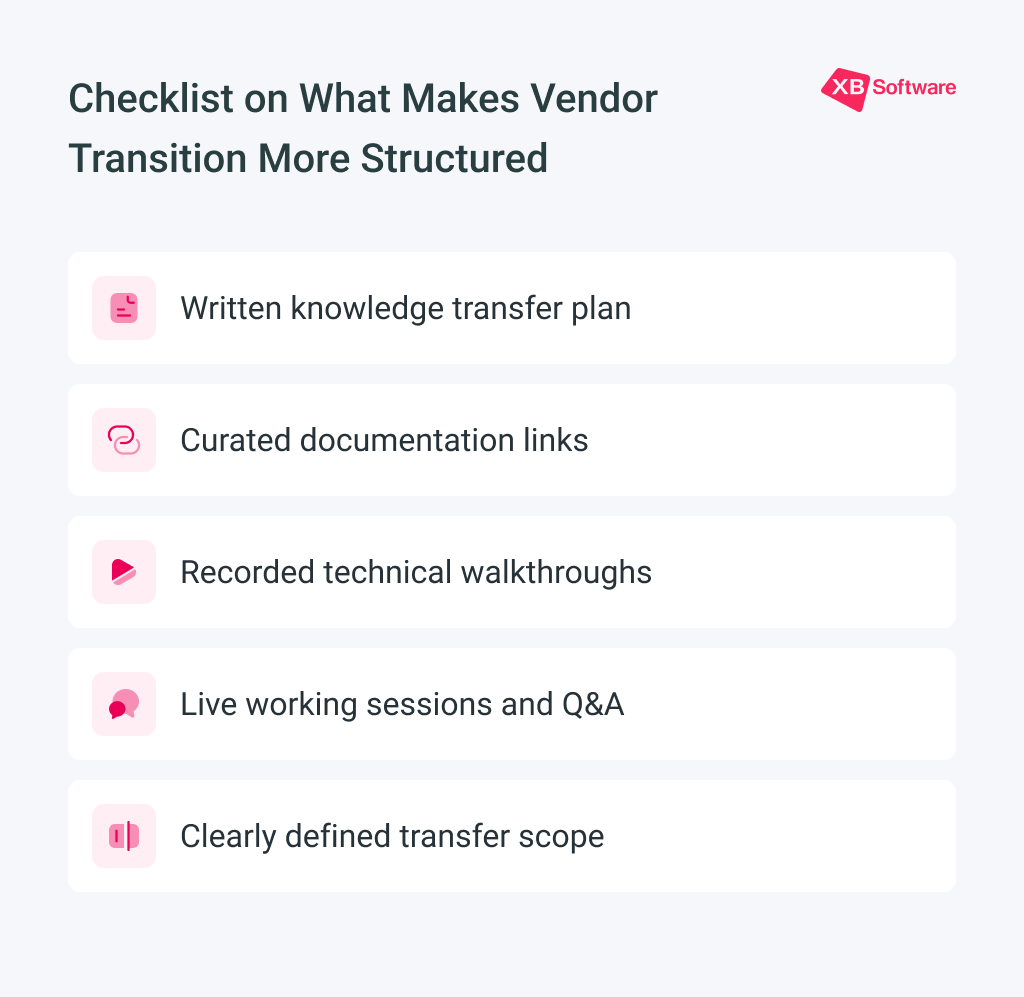
A written knowledge transfer plan. A transfer plan identifies the areas that need attention, the sessions or materials required, and the questions that remain unresolved. It also helps the teams to track progress rather than assuming that a topic has been transferred simply because it was discussed.
Curated documentation links. A collection of relevant resources makes existing information easier to find. Instead of asking engineers to search across repositories, shared folders, and project tools, the handover can point them toward the right materials for each module or workflow.
Recorded technical walkthroughs. Some topics are easier to explain through a demonstration than through text alone. Short recordings allow the receiving team to revisit complex behavior, follow a sequence of actions, and review explanations without arranging another meeting.
Live working sessions and Q&A. Direct interaction remains important because it exposes misunderstandings and gives incoming engineers an opportunity to ask follow-up questions. These sessions are most effective when they address specific topics and produce reusable follow-up materials.
A clearly defined transfer scope. Not every part of an application needs the same level of explanation at the same time. Prioritizing critical modules, current development needs, and known knowledge gaps helps to focus the effort where it matters most.
The value comes from how these materials work together: the plan provides structure, links provide access, recordings preserve explanations, and live sessions resolve questions that cannot be anticipated in advance. The goal is to make essential knowledge available in forms that engineers can use when they need it.
Read Also What to Check Before Switching Your Software Vendor
Why Question-Driven Knowledge Transfer Works Better Than Generic Documentation
Generic documentation often describes the system broadly without answering the questions that block a developer’s next task. A module overview might explain a component’s purpose, for example, but not clarify why it behaves differently under a particular condition or which other parts of the application depend on it.
Question-driven knowledge transfer addresses this problem by starting with the receiving team’s actual needs.
Instead of trying to explain everything at once, the team collects questions about implementation, architecture, workflows, dependencies, and troubleshooting. Those questions reveal where understanding breaks down and help to determine which explanations or artifacts should be created first.
A useful question-driven transfer process follows a simple cycle:
- Collect questions from the incoming development team;
- Group them by module, workflow, or technical topic;
- Prioritize questions according to operational importance and current delivery needs;
- Answer them through a walkthrough, written explanation, documentation link, or recording;
- Confirm that the resulting material is accessible and useful, and identify any remaining gaps.
This approach offers practical advantages.
First, it helps to prioritize critical system knowledge. Questions about a core component that the incoming team must maintain are generally more urgent than questions about a feature outside the current scope.
Second, it makes better use of senior engineers’ time. Experienced specialists can focus their explanations on specific knowledge gaps instead of repeating broad overviews for different people.
Third, it produces more actionable knowledge transfer documentation. A question about a component’s dependencies can lead to an updated architecture diagram, a focused technical walkthrough, or a written explanation of the relevant constraints. The result is a resource that can help future engineers facing the same issue.
Finally, it makes progress easier to evaluate. Teams can track which questions have been answered, which materials have been created, and which gaps still prevent independent work.
This method does not eliminate the need for general system documentation but complements it by connecting architectural knowledge to real engineering tasks. The receiving team gets both a broader understanding of the product and targeted answers that help it to move forward.
How Architecture Documentation Supports Technical Onboarding
Technical onboarding becomes more difficult when new engineers can see the code but cannot reconstruct the reasoning behind it. Useful software architecture documentation bridges this gap by connecting the system’s structure to its behavior, constraints, and operational context.
Architecture diagrams are a good starting point. They can show major components, integrations, data flows, and dependencies. However, diagrams alone rarely provide all the information required to maintain an established application. They need supporting explanations that clarify how the system behaves and where changes may have consequences.
Effective technical architecture documentation should address several questions:
- Component responsibilities: What does each module do, and which responsibilities belong elsewhere?
- Dependencies and integrations: Which services, APIs, databases, or shared components does it rely on?
- Architectural decisions: Why was a particular approach chosen, and what constraints influenced it?
- Known limitations: Which areas are fragile, difficult to modify, or dependent on legacy behavior?
- Operational workflows: How does the component behave during normal use, failures, or unusual conditions?
System architecture documentation should also distinguish current behavior from planned improvements. Otherwise, an incoming team may treat an outdated design description as an accurate representation of the production system.
For specialized modules, module documentation can provide the detail that broader architecture documents cannot. It may describe important business rules, configuration requirements, testing considerations, and examples of common changes. Links between these materials help engineers to move from a high-level view to the details relevant to their task.
The same principle applies to developer onboarding documentation. An onboarding checklist can identify access requirements, development setup, testing procedures, repositories, and key contacts. A practical onboarding path should also guide new engineers through the system in a useful order, beginning with essential workflows before moving into less frequently used components.
No documentation set can capture every detail of a complex product. So, the objective is to make the system understandable enough for engineers to investigate problems, ask better questions, and make changes with appropriate confidence.
How to Preserve Engineering Continuity During a Vendor Transition
A successful vendor transition starts before responsibility changes hands. If critical knowledge has accumulated informally over years, a short handover period may not be sufficient to reconstruct it. Technical leaders can reduce this risk by making knowledge retention part of regular engineering practice.
The following measures help organizations to prepare for team changes and maintain continuity as products evolve.
1. Identify Knowledge Concentrated in Individuals
Determine which modules, integrations, or operational workflows depend heavily on a small number of specialists. Repeated requests for the same explanations are a useful signal that knowledge should be captured.
2. Maintain Documentation Alongside the Code
Update architecture diagrams, module descriptions, API references, and operational instructions when meaningful changes occur. Documentation is more useful when it reflects the current system rather than an earlier stage of development.
3. Establish a Repeatable Knowledge Transfer Process
Define what a handover should cover, which artifacts are expected, how unresolved questions are tracked, and who is responsible for maintaining the materials. A reusable knowledge transfer plan can be adapted to the size and complexity of each transition.
4. Use Multiple Formats
Written documentation, architecture diagrams, recorded walkthroughs, and live technical sessions serve different purposes. Combining them makes knowledge more accessible to engineers with different tasks and levels of familiarity.
5. Validate Readiness Through Practical Work
A completed checklist doesn’t prove that the incoming team can operate independently. Where appropriate, ask engineers to follow a documented workflow, investigate a representative issue, or make a controlled change. Their questions can reveal gaps that need further attention.
6. Keep the Transition Focused on Continuity
A vendor change involves more than transferring files and repository access. The teams also need to clarify responsibilities, establish communication paths, identify open technical risks, and agree on how ongoing development and support will be handled.
Organizations engaging external engineering partners can also benefit from defining expectations for documentation and knowledge sharing from the start. XB Software’s software development outsourcing services can be relevant when evaluating an external delivery model, while a dedicated development team may suit projects that require sustained collaboration and ongoing product development.
Regardless of the engagement model, continuity depends on making essential system knowledge accessible to the people responsible for the product. You should remember that engineering continuity is not a one-time deliverable produced at the end of a contract. It is a capability developed throughout the software lifecycle.
Read Also How We Modernized a Legacy System With Almost No Documentation
Conclusion: Engineering Continuity Is More Than a Documentation Task
Vendor transitions expose the weaknesses of knowledge practices that have evolved informally. When architectural reasoning, module behavior, and operational context remain concentrated in a few people, even an experienced incoming team can struggle to take responsibility for an old product.
For CTOs and engineering managers, you need not to forget that the priority is to treat continuity as part of normal delivery rather than an emergency activity triggered by a team change. Maintain architecture and module documentation, capture critical tacit knowledge, and make onboarding materials useful for real engineering work.
A system becomes easier to transfer when its knowledge isn’t tied exclusively to the people who built it. That is the foundation of sustainable engineering continuity. So, if you need to prepare for a software vendor transition or are looking for a reliable software development partner who can take over your current project, contact us.