Summary
PostgreSQL upgrades in SaaS are an executive risk decision, not just a regular tech task. Using a blue-green strategy on AWS RDS and testing the entire service ecosystem in pre-production uncovers configuration issues (like SSL) early, ensuring a seamless, low-downtime cutover.
A PostgreSQL upgrade becomes a business decision when the database supports processes that customers and employees depend on. An interruption may prevent sellers from updating inventory, delay background imports, or leave an integration unable to process new data. For business owners that is not an IT problem, it is a revenue and operations problem, because every minute of downtime carries a measurable cost to the business.
Before approving the change, a CTO needs clear answers to three questions: which workflows could be interrupted, what evidence shows they will recover, and what the team will do if problems appear after the switch. Blue-green deployment provides a way to prepare and validate the upgraded database while the existing environment continues serving production. Its value depends on how well that preparation addresses the business processes surrounding the database, not just the technical migration itself.
PostgreSQL Upgrade Strategy for Uptime-Sensitive SaaS Products
Treating a PostgreSQL upgrade as routine technical housekeeping creates blind spots. In modern web applications, database tables support search indexes, catalog management, customer onboarding flows, transactional billing subsystems, and administrative dashboards. A failure in the database engine ripples across every dependent service immediately.
When engineering teams evaluate a database migration strategy, the conversation often centers on schema changes, index creation times, and query execution plans. However, executives must focus on database operational risk and database reliability. A minor version update usually applies bug fixes and security patches without altering on-disk storage formats. Major version upgrades can change internal system catalogs, update query planner heuristics, and alter binary storage structures.
If a background worker or payment gateway integration fails to connect after the database restarts, the resulting outage damages brand reputation and revenue. Safe platform evolution requires an engineering strategy that evaluates application layer dependencies, connection settings, and system resilience alongside core database metrics. Executing a successful database modernization effort means validating the entire application ecosystem long before live traffic is redirected.
How Blue-Green Database Deployment Reduces Upgrade Risk
To minimize production disruption during major platform updates, engineering teams adopt a blue-green deployment strategy. Under this model, the infrastructure maintains two separate environments: the blue environment (the current active source environment handling production traffic) and the green environment (the target environment running the upgraded database engine). Logical replication supports near-real-time DML (Data Manipulation Language) synchronization with lag monitoring, keeping both instances closely aligned.
Understanding how blue-green deployment works helps evaluate its strategic trade-offs. The primary benefits come from complete environment isolation. Engineers can upgrade the green database engine, apply configuration parameters, and run automated validation suites without affecting active users. If validation succeeds, traffic switches to the green environment with minimal switchover time. These preparations reduce the amount of unmanaged complexity that reaches the live cutover.
However, teams must also address blue-green deployment challenges. Managing replication lag during high write volume, handling schema alterations during replication, and maintaining parameter group alignment require disciplined planning. Despite these complexities, the overall benefits of blue-green deployment make it a reliable mechanism for maintaining system availability during critical database transitions.
Read Also How to Plan Data Migration Without Putting Production Data at Risk
How XB Software Prepared the PostgreSQL Upgrade on AWS RDS
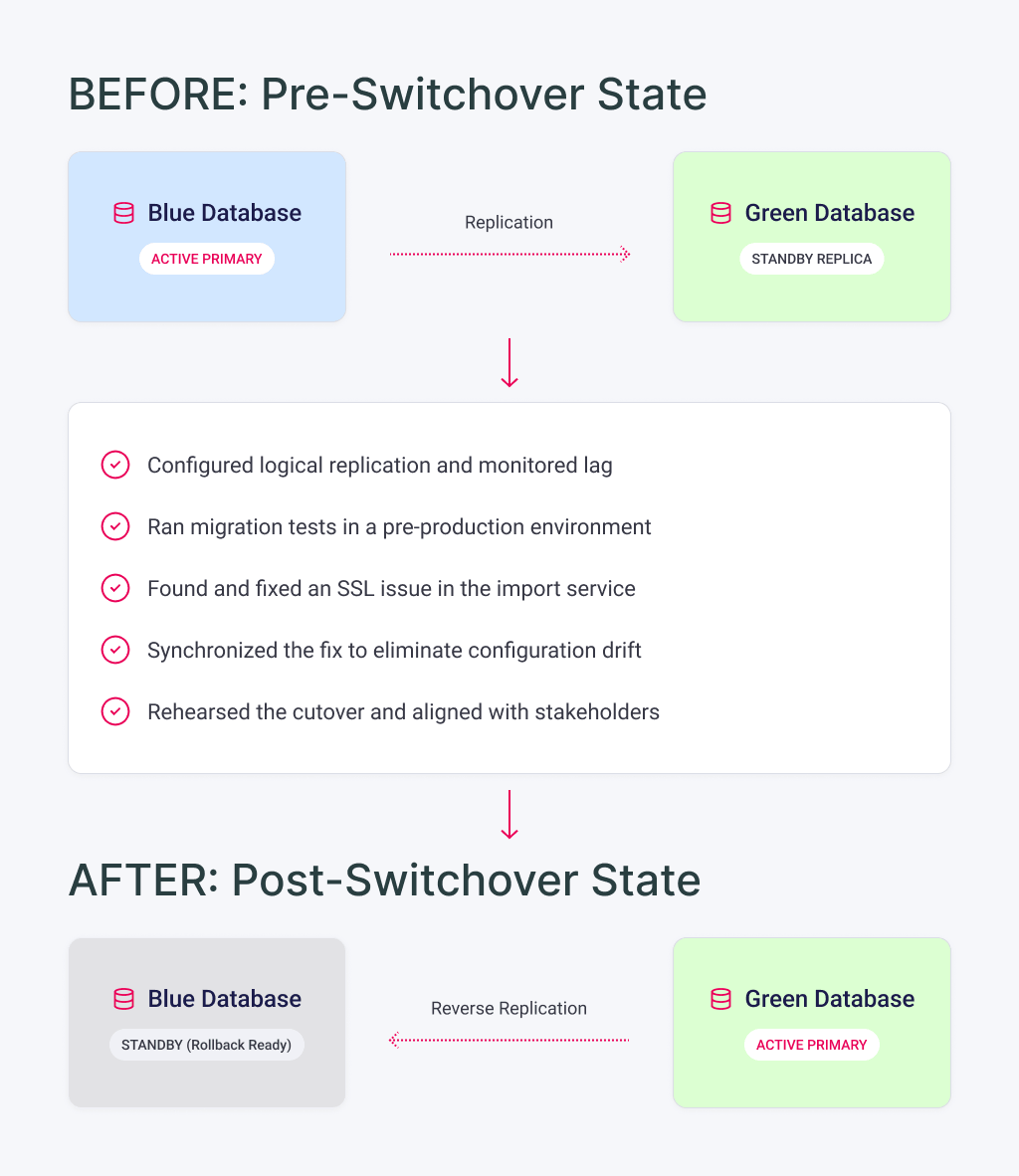
XB Software used a blue-green deployment model during a major platform upgrade for an enterprise multi-seller marketplace. The client needed to upgrade PostgreSQL in a live marketplace while maintaining platform availability, product imports, and inventory synchronization. These workflows depended on the database, so the upgrade could disrupt individual services even if the database itself started successfully. The application relied on PostgreSQL hosted on Amazon RDS, supporting catalog data, seller management workflows, import pipelines, and external commerce integrations. The backend architecture combined Node.js/NestJS services, search infrastructure, and background job queues running across multiple runtime environments.
To maintain operational continuity throughout the upgrade, the team implemented an AWS RDS blue-green deployment. Our engineers provisioned an isolated clone of the production database, prepared the parameters required for logical replication, checked its status, and established a staging environment for validation. Supporting this complex environment required specialized AWS DevOps services to align infrastructure configurations, parameter groups, and deployment automation.
The team built a target environment that mirrored production settings while preserving a fast recovery path. If the target environment encountered unexpected query performance bottlenecks during testing, the production application remained safely connected to the source environment. This structured approach turned what could have been a high-stress maintenance window into an organized engineering workflow for PostgreSQL migration.
PostgreSQL Upgrade Testing in Pre-Production
Before modifying live production infrastructure, the engineering team executed comprehensive database migration testing in a pre-production environment. The primary goal was to validate application behavior across all connected services, not merely to confirm that PostgreSQL could start on a newer version.
Running a PostgreSQL version upgrade process in pre-production allows teams to trace every inter-service interaction. Using dedicated application testing services in production-like conditions helped expose mismatches between infrastructure changes and application expectations.
During these test cycles, engineers monitored database logs, query execution plans, and connection pool behavior. Testing under realistic transaction loads confirmed that background jobs and analytical queries performed predictably on the updated engine. Rehearsing the cutover sequence multiple times established timing baselines for the final switchover, ensuring that engineering teams and business stakeholders agreed on operational parameters.
The SSL Compatibility Issue That Could Have Broken the Cutover
To see how quickly hidden assumptions surface during validation, consider what happened during XB Software’s marketplace platform upgrade. During pre-production validation, detailed log analysis isolated a critical connection failure in an import service. Investigation revealed a configuration mismatch in the service’s PostgreSQL SSL connection parameters. Catching this configuration gap demonstrated the practical value of pre-production validation. Had this issue reached production, seller store updates and inventory synchronization would have failed silently. Resolving the connection settings during testing removed a severe migration risk before taking blue-green deployment with database changes to the live production stack.
Read Also When Legacy Software Modernization Becomes a Business Necessity
Why Environment Parity Mattered Before the Switchover
Discovering a missing SSL parameter in one background service highlighted the systemic danger of environment drift. If pre-production and production environments diverge in parameter groups, SSL requirements, or connection pool rules, pre-production validation loses its strategic value.
After identifying the SSL configuration gap, our development team synchronized the configuration fix across all deployment pipelines. Ensuring consistent environment parity meant the target environment in production mirrored the tested pre-production setup down to individual client libraries. Achieving consistent blue-green database synchronization requires aligning both table data and surrounding service configurations.
Reducing configuration drift helps prevent post-upgrade incidents. When connection strings, SSL parameters, and environment variables match across staging and production, engineering teams achieve PostgreSQL upgrade readiness. This discipline ensures that validated pre-production behavior directly reflects what will happen during the live switchover.
Why PostgreSQL Upgrade Compatibility Goes Beyond the Database
Many failed software migrations and upgrades stem from evaluating database compatibility in isolation. Major release notes highlight changed query syntax and deprecated functions developers must keep in mind. However, it won’t save engineering teams from application failures, since they often occur at the connection and transport layers.
Achieving a near-zero downtime database migration requires evaluating three distinct operational layers:
- The core database engine, including SQL syntax, system parameters, and index structures;
- The infrastructure configuration, covering network security groups, SSL parameters, and parameter group settings;
- The application layer, encompassing client libraries, ORM settings, and background job consumers.
If one of those layers is handled lightly, the migration risk simply moves rather than disappears.
Executing a controlled cutover with downtime within SLA limits depends on verifying every application component that interacts with the data store. Modern SaaS platforms rely on microservices, serverless functions, and third-party integrations. Applying proven minimal-downtime migration techniques means validating such aspects as connection configurations as core elements of the overall database migration scope.
What to Validate Before a Blue-Green Database Switchover
Before initiating a production cutover, executive and technical leaders must confirm PostgreSQL upgrade readiness. A structured validation process helps avoid cutover decisions based on optimistic assumptions. Teams evaluating an RDS blue-green deployment should verify key operational criteria prior to routing live traffic:
- Replication sync status. Confirm that logical replication lag between source and target instances remains within the agreed threshold under peak write loads;
- Parameter group parity. Verify that memory settings, connection limits, and statement timeouts in the target environment match tested standards;
- Connection pool resilience. Ensure connection poolers handle endpoint redirection cleanly, reconnect quickly and correctly, handle retries, avoid hanging, and avoid writing to the old environment;
- Service dependency verification. Validate that every API gateway, worker queue, and external commerce integration has passed connection checks against the target database;
- Rollback scenario readiness. Confirm that the blue-green deployment model maintains a fast recovery path if unexpected anomalies occur post-switchover.
Reviewing these objective criteria gives executives the technical evidence needed to approve the final production cutover.
Read Also Choosing a Safer Migration Strategy for Legacy Systems
Why Delaying PostgreSQL Upgrades Can Increase Migration Risk
Business leaders often postpone database upgrades because live systems make the downside feel immediate while the benefit feels abstract. In reality, delaying updates continuously shifts risk forward while accumulating technical debt.
As PostgreSQL releases major versions, older releases reach end-of-life status and lose security maintenance. The version gap widens, making future upgrade paths more restrictive. Over time, custom applications accumulate workarounds for legacy database behaviors, and underlying client libraries become unmaintainable. For organizations planning broader application modernization for legacy SaaS platforms, outdated database engines create major integration barriers.
Delaying a PostgreSQL upgrade also increases the likelihood of forced emergency migrations driven by compliance audits or cloud provider deprecations. Emergency upgrades lack the thorough preparation and rehearsal time of planned initiatives. Managing a PostgreSQL database migration proactively allows organizations to schedule validation cycles, reduce configuration drift probability, and execute transitions on their own schedule. Handling database migration as routine platform evolution preserves system resilience over time.
PostgreSQL Upgrade Checklist for Business and Technical Leaders
For executive leadership, approving a major infrastructure transition is about evaluating whether the engineering team has made the change sufficiently governable. Business leaders require operational continuity and predictable planning, while technical teams need precise system validation. Aligning these perspectives requires a shared database migration checklist that bridges infrastructure readiness and business exposure:
- Has the cutover sequence been fully rehearsed in a production-like pre-production environment?
- Are all background import jobs, queue workers, and external API integrations validated against the target engine?
- Is logical replication lag monitored continuously, with clear thresholds defined for the switchover window?
- Have SSL/TLS connection settings and client library configurations been synchronized across all runtime environments?
- Is there a documented rollback plan with an assessment of RPO/RTO and potential data divergence?
- Does the switchover plan keep blue-green switchover downtime well within agreed service-level agreements?
- Is executive leadership aligned on business impact, maintenance scheduling, and customer communication plans?
- Does the scheduled maintenance window avoid peak business hours, major marketing campaigns, or high-traffic sales periods to safeguard customer experience and revenue?
- Are critical business workflows (such as payment processing, seller onboarding, or inventory synchronization) included in post-switchover validation, rather than relying solely on technical database health checks?
- Has leadership weighed the compounding cost and risk of deferring the modernization against the controlled, predictable risk of executing a structured upgrade today?

Addressing every item on this checklist protects business continuity of database-dependent services and converts complex infrastructure changes into routine operational updates.
Database Modernization as Production Risk Reduction
Modernizing a SaaS database architecture is fundamentally an executive risk management decision rather than an isolated infrastructure task.
As XB Software demonstrated in its marketplace database migration project, adopting a blue-green mindset provides the space needed to catch configuration mismatches, verify background job processing, and ensure cross-environment alignment before touching live production traffic. However, this strong operational pattern does not absolve teams from checking connected services in depth.
For technical leaders planning a PostgreSQL upgrade in a live SaaS environment, the takeaway is simple: do not ask only whether the database can be upgraded safely. Ask whether every service that depends on it is ready for the new reality. If your validation cannot answer that, the migration is not finished yet.
To discuss how XB Software can help your organization plan and execute safe database upgrades or application modernizations, contact us today.