Summary
The article explores RAG vs. fine-tuning for enterprise AI applications, including technical differences, costs, latency, data requirements, and use cases. Learn how to choose the right approach, combine both methods, and evaluate trade-offs for your business.
Base AI models lack knowledge of internal company data, domain-specific terminology, and specialized operational workflows. To overcome these limitations, software engineers often rely on Retrieval Augmented Generation (RAG) and fine-tuning when building enterprise GenAI applications. These strategies dictate your application’s data pipeline design, operational maintenance overhead, inference speed, data security, and total cost of ownership. Integrating an external knowledge base into a query-time pipeline requires a different approach than modifying internal model weights through supervised training.
This guide explores the technical RAG vs fine-tuning trade-offs, examines how each method handles proprietary data, and lays out a practical decision framework for enterprise AI development.
What Is Retrieval-Augmented Generation (RAG) and How Does It Work?
At its core, Retrieval Augmented Generation is an architectural pattern that supplies external context to a model at query time. Rather than forcing a foundation model to memorize enterprise information, a RAG application retrieves pertinent facts from proprietary datasets and feeds them into the model’s context window alongside the user query.
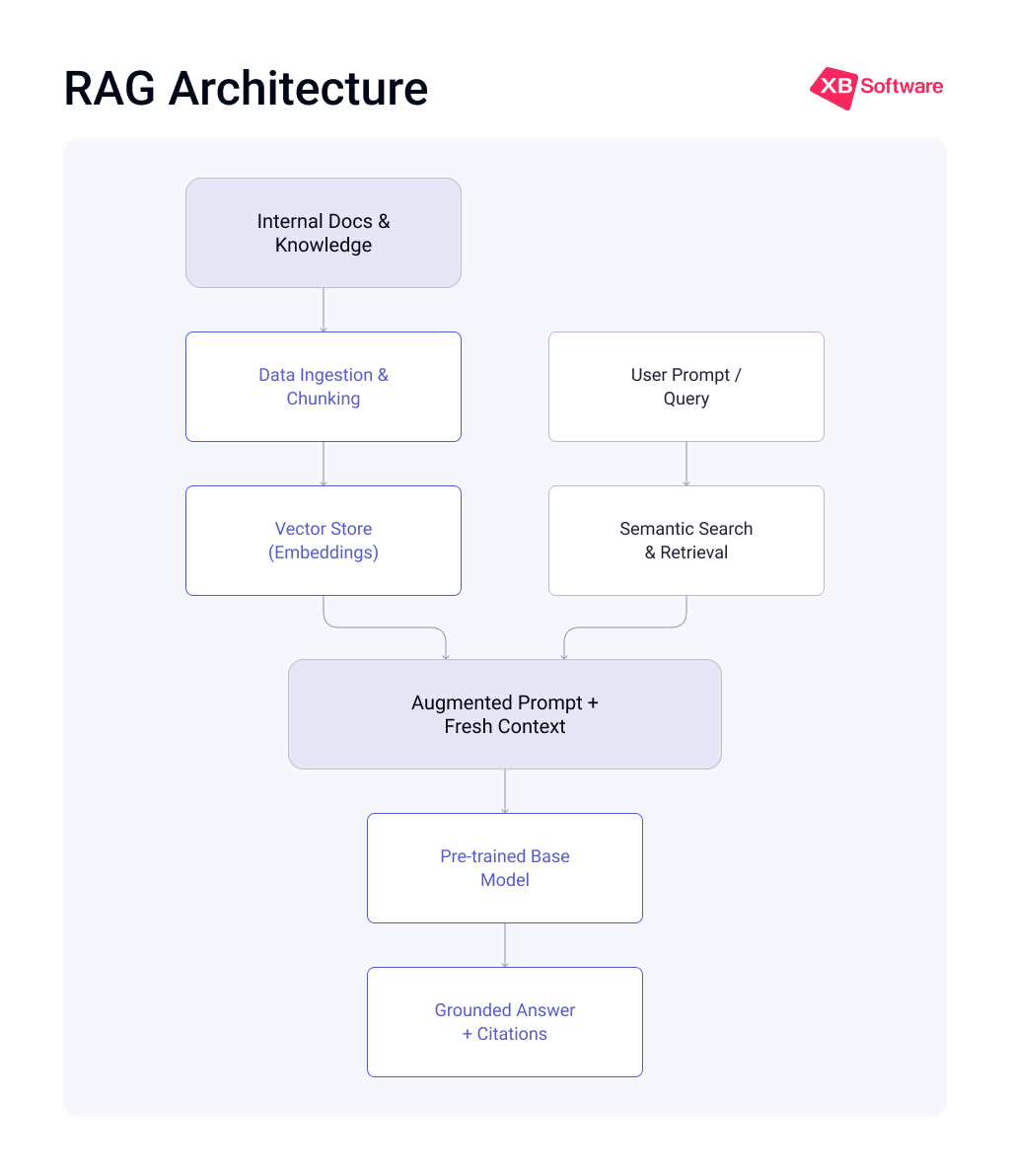
The standard RAG model architecture relies on an end-to-end processing pipeline:
- Data Ingestion and Document Chunking: Unstructured source documents (PDFs, wiki pages, database records) are broken into structured snippets or chunks;
- Vectorization: An embedding model converts these text chunks into numerical vectors (vector embeddings) that capture semantic context;
- Storage: The resulting vectors are indexed inside a specialized vector store or vector database;
- Query-Time Retrieval: When a user submits a prompt, the system vectorizes the query, performs a semantic search against the database, and extracts the top matching document chunks;
- Augmented Generation: The engine merges the retrieved snippets into the user’s prompt. The pre-trained base model reads this injected context and generates an answer intended to be grounded in the retrieved factual data. Grounding still depends on retrieval quality and prompt/model behavior.

The core benefits of RAG come from decoupling knowledge management from model training. By leaving the underlying pre-trained base model unaltered, a RAG system architecture lets developers add, remove, or modify underlying business documents instantly. This dynamic context injection delivers verifiable factual grounding and reliable source citations.
What Is LLM Fine-Tuning?
While RAG provides open-book context at runtime, LLM fine-tuning alters the internal parameters of the neural network itself. AI engineers take a pre-trained base model and subject it to further training using a curated, high-quality dataset of domain-specific instruction-response pairs.
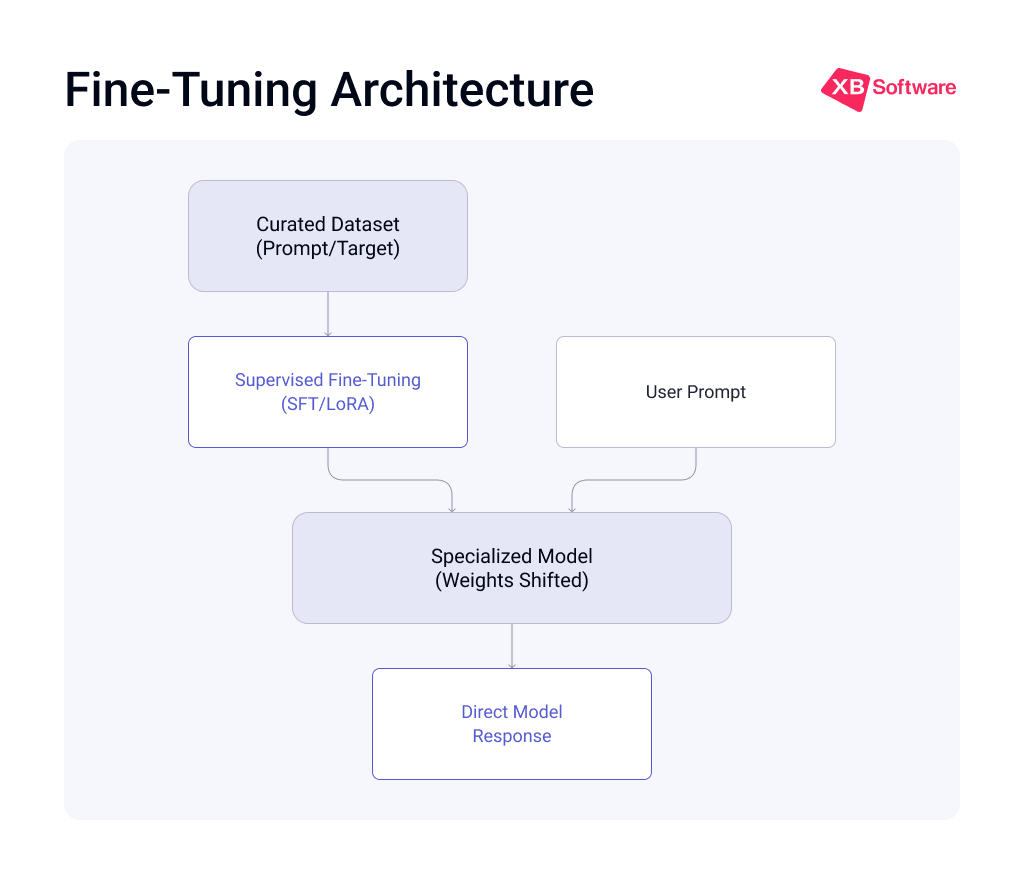
This training step adjusts the internal model weights, aligning the network’s internal representation with specific output patterns, terminology, or stylistic guidelines. Rather than searching an external index for factual information, a fine-tuned model responds based on instincts learned during its training phase.
This approach excels at shaping task-specific behavior, enforcing complex response formatting (such as strict, valid JSON or highly specialized domain syntaxes), and acquiring specific tonal nuances. When prompting alone cannot consistently steer a model’s operational style, fine-tuning hardcodes that behavior directly into the model.
RAG vs. Fine-Tuning: Key Differences
Choosing between RAG vs fine-tuning requires evaluating how each strategy impacts system mechanics, operational complexity, and output behavior. The fundamental distinction is pretty straightforward: RAG provides the model with an open-book source of reference material during runtime, whereas fine-tuning alters the model’s ingrained knowledge and answering habits through additional study.
| Architectural Dimension | Retrieval-Augmented Generation (RAG) | LLM Fine-Tuning |
| Primary Purpose | Dynamic knowledge retrieval and explicit factual grounding. | Adapting task-specific behavior, tone, and response formatting. |
| Data Requirements | Unstructured business documents, clean database exports, vector indexes. | Typically hundreds to thousands of high-quality instruction-response pairs. Parameter-efficient fine-tuning can reduce data and compute requirements. |
| Knowledge Currency | Real-time / near-instant update via database re-indexing. | Static snapshot bound to historical retraining cycles. |
| Traceability & Citations | Can support precise, verifiable source citations when retrieval metadata and citation logic are implemented. | Black-box parametric memory; direct citations are prone to hallucination. |
| Hallucination Risk | Lower than fine-tuning-only for factual recall when retrieval and grounding are well implemented. Not eliminated. | Moderate to high if used as a primary factual memory store. |
| Primary Cost Driver | Token consumption per query and vector store hosting. | Compute for initial/recurring training runs and specialized hosting. |
| Access Control | Enforces precise document-level permissions during retrieval. | Global; all fine-tuned knowledge is accessible to all model users. |
This structural comparison underscores why RAG vs fine-tuning comparison isn’t about declaring a single winner. Instead, it’s about matching your project’s technical requirements to the appropriate architectural pattern.
Data Requirements and Model Behavior
The process of RAG data preparation focuses heavily on structural ingestion pipelines. Teams clean raw source text, implement an appropriate document chunking strategy, compute vector embeddings, and manage vector database updates. Crucially, the source text remains human-readable. The application’s retrieval quality dictates performance: if the system retrieves the correct snippet, the base LLM reliably formats the final answer.
Conversely, fine-tuning data requirements demand rigorous, supervised data curation. Preparing hundreds or thousands of input-output pairs requires domain experts to review and label examples. Poorly curated dataset samples will degrade output quality across the board. While fine-tuning reliably changes how a model speaks, enforcing a distinct brand voice or specialized JSON schemas, it remains an unreliable mechanism for memorizing exact figures, shifting policy details, or dense tabular data.
Knowledge Freshness and Updates
For enterprise software, knowledge freshness is often non-negotiable. Standard operational policies, product catalogues, and inventory counts change constantly.
A well-designed RAG pipeline architecture can handle updates better, but it still requires reliable ingestion, re-embedding, index refresh, and cache invalidation. When a document is modified or added, the data ingestion worker processes the update, calculates new embeddings, and pushes them to the vector index. This automated re-indexing workflow runs continuously without interrupting the underlying model. The next incoming prompt immediately accesses the updated facts.
Fine-tuning alone is not suitable for real-time knowledge updates. It requires retraining/redeployment. Embedding new information into model parameters requires launching new retraining cycles, which incurs GPU execution expenses, dataset validation delays, and risk of catastrophic forgetting. Consequently, relying solely on fine-tuning for rapidly shifting business information introduces operational friction and risks serving outdated advice.
RAG and Fine-Tuning: Cost, Latency, and Maintenance
Evaluating RAG vs fine-tuning requires balancing initial setup costs against long-term maintenance overhead.
| Metric | Retrieval-Augmented Generation (RAG) | LLM Fine-Tuning |
| Upfront Costs | Low (prototype & basic vector setup) | High (dataset curation, GPU training) |
| Per-Query Costs | Higher per-query token/context costs | Lower per-query inference cost if it avoids long retrieved contexts (depends on model size and hosting) |
| Inference Latency | Higher due to retrieval step + longer context (caching, hybrid search, and smaller models can reduce it) | Lower (fast direct model evaluation) |
| Scaling Behavior | Costs generally scale with query volume, though caching and batching can change the slope | High initial fixed cost, lower cost per query |
The financial dynamics of a RAG application shift costs toward ongoing operational query handling. Upfront engineering costs are modest because teams avoid training custom weights. However, per-query costs scale directly with traffic. Because every request appends multiple retrieved context chunks into the context window, token consumption rises quickly. Additionally, enterprise teams must budget for vector store hosting, document parsing infrastructure, and maintenance of the data ingestion pipeline.
In terms of inference latency, RAG adds processing steps. Every request must wait for vector embedding creation, index searching, context assembling, and LLM processing over an expanded prompt. This multi-step process can introduce noticeable delay unless mitigated by clever caching or fast, sub-second base models.
The cost of fine-tuning large language models follows an inverted cost curve. Upfront expenses are high due to domain-expert data labeling and GPU compute cycles needed for training. Furthermore, deploying custom-tuned model weights often requires reserved GPU instances rather than serverless, pay-per-token API endpoints, driving up fixed monthly infrastructure fees.
However, fine-tuning excels at reducing ongoing operational latency. Because specialized behavior is embedded directly in the parameters, prompts stay short. This significantly reduces prompt token consumption, lowers inference overhead per request, and provides minimal end-to-end response delay, which makes fine-tuning ideal for real-time interactions.
From a technical maintenance standpoint, RAG’s operational overhead lies in maintaining software integrations, connector pipelines, and database search consistency. Fine-tuning’s operational burden centers on dataset versioning, detecting and preventing model degradation or regression, managing repeated training pipelines, and maintaining custom hosting environments.
To minimize financial risk, many organizations run an AI product validation phase before committing heavily to complex infrastructure. Building a quick, low-cost prototype lets you evaluate real-world usage patterns, measure context requirements, and accurately predict operational expenses before choosing between full-scale fine-tuning or a dedicated vector pipeline.
Combining RAG and Fine-Tuning for AI Application Development
Modern enterprise AI implementation projects don’t always force a binary choice. Advanced systems regularly combine both techniques to address distinct requirements within a single application architecture.
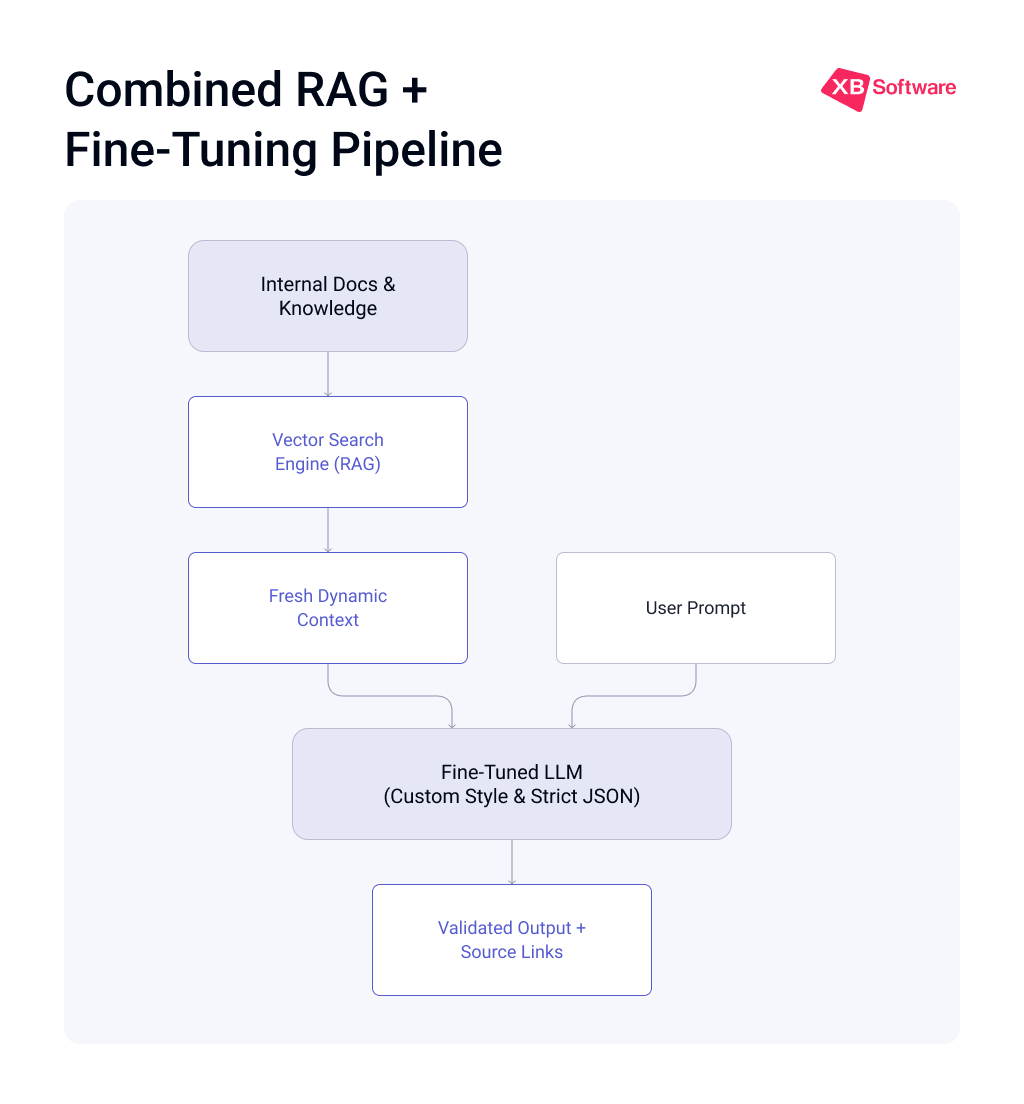
Consider an enterprise assistant built for a regulated legal or financial department. The application must generate responses in a strict, audited legal structure while referencing up-to-date regional regulations and internal company policies.
A standalone RAG setup might retrieve the correct regulatory clauses but struggle to consistently output complex, custom-formatted legal memos without lengthy, fragile prompt instructions. Conversely, a purely fine-tuned model would likely adhere more consistently to the structural format but risk citing outdated statutory rules.
Combining both techniques creates an optimal hybrid architecture:
- Fine-Tuning Layer: Adapts the base model’s internal parameters using historic company templates, training it to reliably output structured responses, adopt a formal legal tone, and apply internal categorization taxonomy;
- RAG Layer: Retrieves the latest contract terms, policy guidelines, and compliance rules at query time, injecting them directly into the fine-tuned model’s prompt;
This hybrid approach leverages fine-tuning to enforce task-specific behavior while relying on RAG for real-time knowledge retrieval, precise factual grounding, and verifiable inline citations.
RAG and Fine-Tuning Use Cases for Enterprise AI Applications
Understanding practical LLM fine tuning use cases alongside popular RAG use cases helps clarify where each approach belongs in an enterprise software portfolio.
| Use Case | Approach | Key Focus & Characteristics |
| Internal Knowledge Assistants | RAG |
|
| Enterprise Document Search | RAG |
|
| AI-Powered Customer Support | Hybrid
(RAG + fine-tuning) |
|
Internal Knowledge Assistants
Setting up a RAG for an enterprise knowledge base solution is standard practice for centralizing internal HR manuals, engineering wikis, and operational procedures.
In a large company, different employees have varying access permissions. An HR manager can view sensitive compensation guidelines, whereas an engineering contractor should only access project documentation.
Building a RAG for enterprise context allows developers to integrate document-level permissions directly into the search index. When a user submits a query, the retrieval layer filters documents based on that employee’s active access token before passing context to the LLM. This helps enforce robust security and precise knowledge retrieval while avoiding data leaks across departmental boundaries.
Read Also Building an AI Assistant: From Model Selection to Deployment
Enterprise Document Search
Large enterprises often maintain huge document repositories containing legal contracts, legacy technical manuals, and audit histories.
A RAG architecture delivers fast search and synthesis across millions of unstructured records. Instead of guessing keywords, staff ask natural language questions. The RAG pipeline architecture queries the vector index, extracts relevant paragraphs, and generates a clear answer accompanied by direct source citations.
Because the system returns citations derived from retrieved document metadata, domain experts can quickly verify facts, satisfying internal compliance standards.
Read Also How AI-Powered Search Handles Unstructured Business Data
AI-Powered Customer Support
Customer-facing AI agents must sound professional, maintain brand voice, strictly follow support escalation steps, and output valid API payloads for ticketing systems. Fine-tuning the base model on historical support transcripts helps it speak in the company’s established tone and follow standard operating workflows.
At the same time, product specs, pricing plans, and policy rules change frequently. Connecting the fine-tuned customer support model to a live RAG pipeline gives the agent real-time access to the latest help desk articles and inventory records. The resulting system maintains consistent brand behavior while giving customers accurate, up-to-date answers.
Read Also Generative AI Chatbots in Customer Support and Business Operations
How to Choose the Right Approach for Your AI Application
To decide when to use RAG vs fine-tuning, run your application requirements through a systematic decision framework:
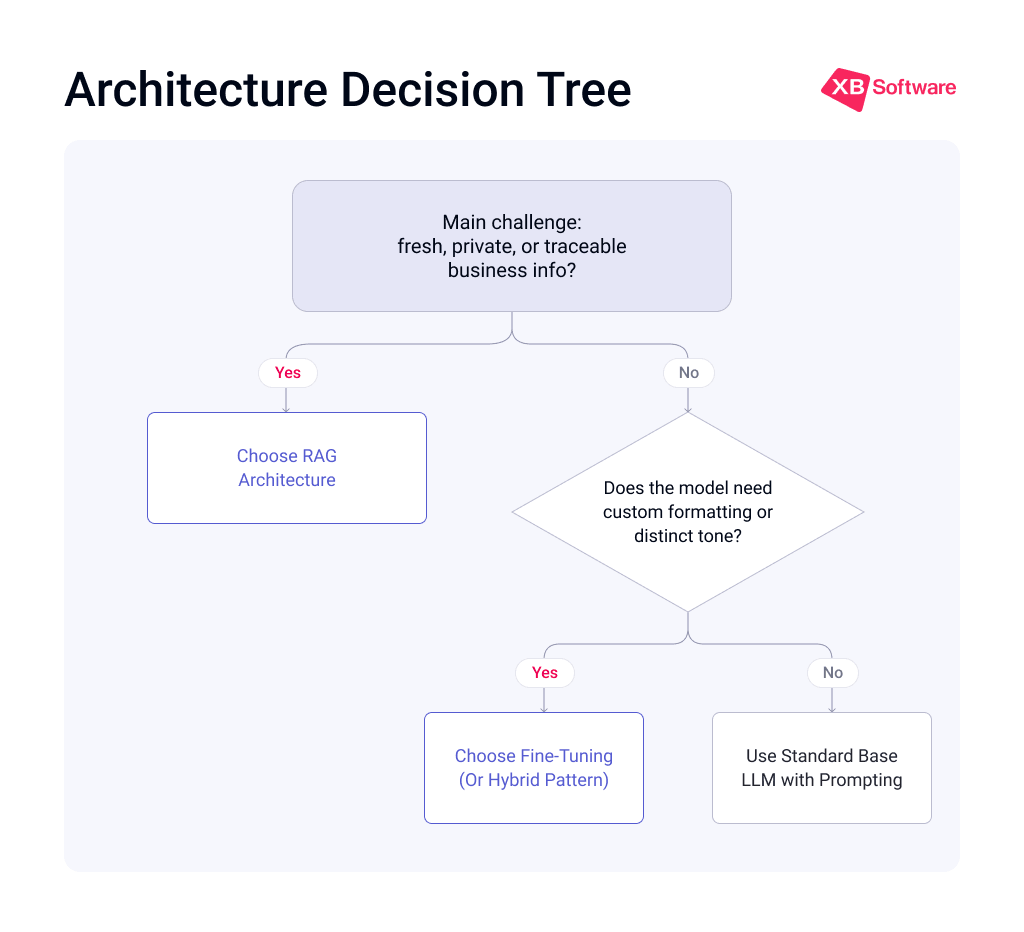
- Evaluate Knowledge Volatility. If your underlying data changes daily or weekly, choose RAG. Fine-tuning simply cannot keep up with high update frequencies without running into cost and maintenance bottlenecks;
- Determine Need for Citations. If your application requires verifiable links back to original sources (e.g., for legal, medical, or audit compliance), RAG is necessary;
- Assess Structural & Behavioral Requirements. If your base LLM regularly fails to follow complex output formats, violates tone guidelines, or ignores prompt rules, fine-tuning provides the structural discipline you need;
- Inspect Security & Permission Granularity. If users should only access data based on individual system roles, RAG allows you to enforce user-level access controls during retrieval. Fine-tuning bakes knowledge globally into model parameters, making document-level access control within the model impossible;
- Review Budget & Infrastructure Capacity. If you want to avoid high initial training investments and GPU hosting costs, start with a RAG MVP. If high request volumes make per-token costs prohibitive, a fine-tuned smaller model can lower long-term operational expenses.
Navigating these architectural options requires practical, production-grade software expertise. Whether you need to build an enterprise knowledge engine, design custom RAG pipelines, or integrate AI into legacy business tools, XB Software provides comprehensive AI software development services to help you design, validate, and deploy scalable intelligent applications.
Have questions about choosing the right AI strategy for your business? Contact us today to discuss your project with our engineering team.