

Summary
Spec-Driven Development (SDD) offers a structured approach where clear, machine-readable specifications become the source of truth, guiding AI to generate code that is consistent, testable, and aligned with business goals. In this article, we explore how this approach works step by step, review tools like GitHub Spec Kit and BMAD, and share our team’s real-world experience using specs to build better software, showing you how to move from chaotic velocity to controlled, high-quality delivery.
AI coding assistants have made developers incredibly fast since the start of the AI boom, but this new speed often comes at a hidden cost. The IT industry is realizing that generating code is the easy part. The real challenge is building systems that are coherent, maintainable, and actually do what they were supposed to do.
This is where Spec-Driven Development (SDD) comes in. This methodology shifts the focus from vibe coding to following the general intent, using specifications as the new source of truth for AI-assisted engineering.
Why Vibe Coding Isn’t Built to Last
The term “vibe coding” perfectly captures the current experimental phase of AI-assisted development. You describe what you want, get a block of code back, and if it looks right and seems to work, you move on. This approach is undeniably powerful for prototypes and small scripts, allowing for unprecedented velocity. However, when applied to serious, mission-critical applications, the cracks begin to show:
- The code might compile and even function, but the underlying architecture becomes an afterthought;
- New features create unexpected conflicts;
- Documentation is sparse or non-existent;
- The codebase transforms into a collection of disjointed components that are hard to maintain, debug, and evolve.
The problem isn’t the AI’s coding ability. It’s rather the workflow where developers treat AI like a search engine when they should be treating it like a literal-minded, but exceptionally talented, pair programmer who needs unambiguous instructions.
Read Also How to Build a Custom Scheduling App Faster with Lovable AI and DHTMLX Scheduler
What Is Spec-Driven Development
Spec-Driven Development is the practice of writing clear, structured, and testable specifications before a single line of code is generated. In the context of AI-assisted development, SDD provides the blueprint that guides AI agents to generate code that is consistent, architecturally sound, and perfectly aligned with business goals.
Unlike traditional waterfall requirements that gather dust, an SDD spec is a living, executable artifact. It becomes the shared source of truth for both humans and AI, driving development, software testing, validation, and even documentation. By moving architectural decisions, constraints, and clarity upstream, SDD directly addresses the shortcomings of vibe coding. It replaces guesswork with a clear contract for how your app should behave.
How Spec-Driven Development Works: A Step-by-Step Guide
The SDD process is structured into distinct, sequential phases. Each phase produces a key artifact that feeds into the next, ensuring a clear, traceable path from a high-level idea to production-ready code.
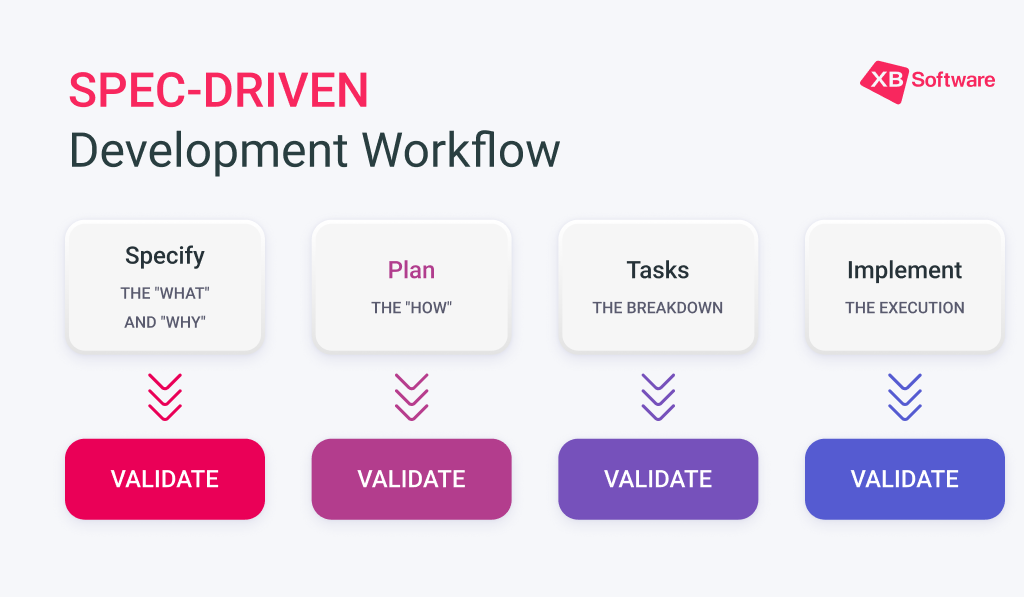
- Specify (The “What” and “Why”). You start with a high-level description of what you’re building and why. The AI then generates a detailed functional specification. This phase is purely about business intent: user journeys, success criteria, and edge cases. It explicitly excludes technical details, forcing clarity on the problem before jumping to a solution;
- Plan (The “How”). With the functional spec locked in, you provide the AI with your desired stack, architecture, and constraints. The AI generates a comprehensive technical plan, including technology choices, system design, integration patterns, and security considerations. This ensures the new code feels native to your project and aligns with your technical strategy;
- Tasks (The Breakdown). The AI takes the spec and plan and breaks them down into small, reviewable, and actionable tasks. Each task is specific enough to be implemented and tested in isolation, like “create a user registration endpoint that validates email format.” This decomposition prevents the “big bang” coding approach that overwhelms both AI and reviewers;
- Implement (The Execution). Finally, the AI tackles the tasks one by one. Instead of reviewing thousand-line code dumps, developers review focused changes that solve specific problems, verifying that the implementation matches the specification.
Read Also AI as a Co-Pilot, Not an Autopilot: Guidance on Risk Management and Realistic Performance
A Quick Look at the Tools Enabling SDD
The SDD ecosystem is maturing rapidly. While GitHub’s Spec Kit is a powerful open-source example, other platforms offer different interpretations of the model:
Spec Kit
An open-source CLI and template-based toolkit that integrates with your existing AI assistants like Copilot, Claude Code, and Gemini CLI. It introduces the concept of a constitution.md, a file that encodes your project’s immutable principles, such as stack versions, naming conventions, and architectural patterns.
Kiro
An agentic AI with an IDE and CLI that add structure to an existing editor. Kiro has SDD built directly into its core. When starting a new feature, its agents automatically generate requirements, design documents, and create task lists, guiding the developer through an opinionated workflow. It’s designed for developers who want a deeply integrated, automated, and context-aware environment for moving from concept to code.
BMAD Method
An open-source framework that simulates an entire agile team using specialized AI agents. With over 12 distinct agent personas, including a Product Manager, Architect, Scrum Master, etc., it manages the entire project lifecycle.
XB Software’s Experience: Putting Spec Kit to the Test
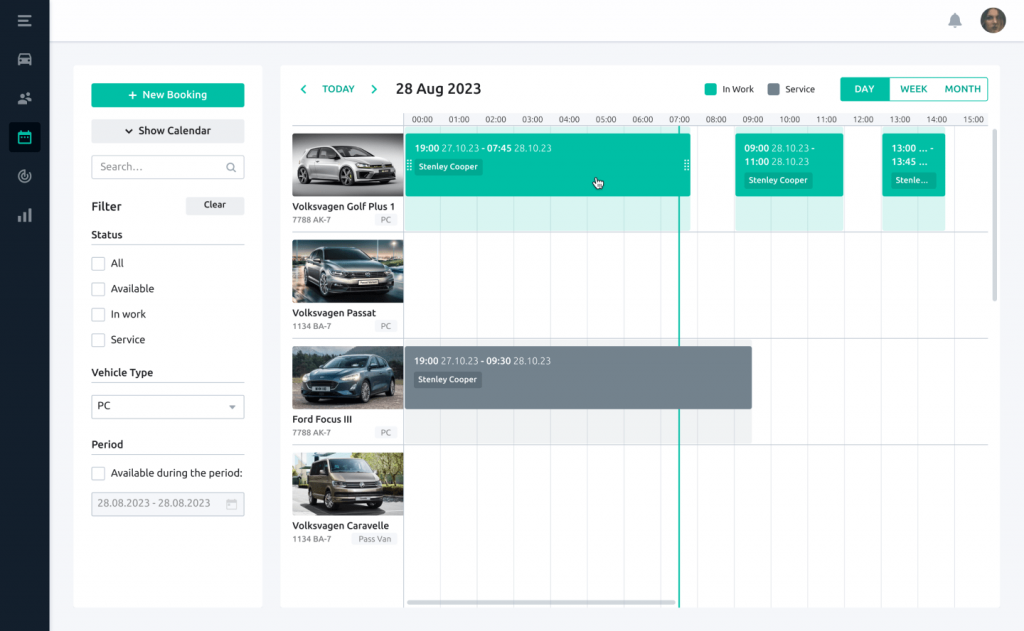
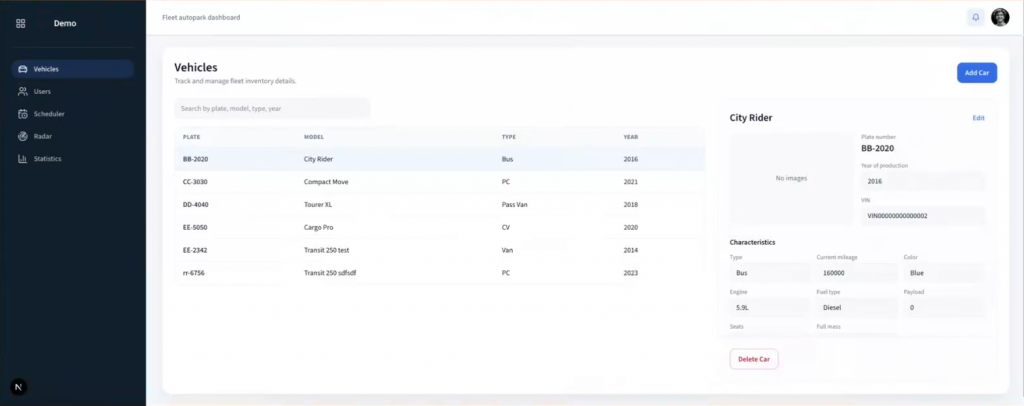
Theory is one thing, but practice is where the real lessons are learned. Our team recently dove into GitHub’s Spec Kit to understand its practical applications and limitations. Here’s what we found trying to recreate the app shown below. It’s a small fleet management dashboard with a scheduler, a map, and vehicle tables:
- /constitution:
- When to use: At the very beginning of a project.
- Purpose: Establishes your project’s foundational rules, defining the tech stack, architectural patterns, and coding conventions that AI-generated code must follow.
- /specify:
- When to use: After the constitution is set.
- Purpose: Takes your high-level, plain-language description of a feature (the “what” and “why”) and expands it into a detailed functional specification.
- /plan:
- When to use: After the specification is reviewed and approved.
- Purpose: Generates a technical implementation plan based on the spec and the project’s constitution, defines frameworks, libraries, etc.
- /tasks:
- When to use: After the plan is finalized.
- Purpose: Breaks down the specification and plan into a list of small, concrete, and actionable tasks. Each task is designed to be implemented and tested independently.
- /implement:
- When to use: After the tasks are defined.
- Purpose: Instructs the AI agent to start writing the actual code, working through the generated task list one by one.
Our web development team started by testing the limits of the process. The first attempt was to generate a complete demo application, in one go. The high-level description was fed into the /specify command, and the results quickly revealed the AI’s contextual limitations. The application generated by Spec Kit was a mess: the scheduler rendered strangely, filters didn’t work, and the statistics pulled random data not connected to the users or vehicles:
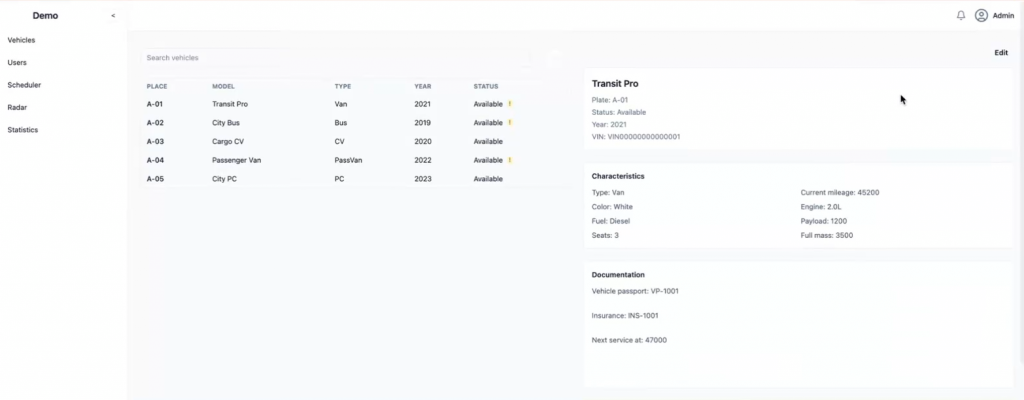
This shows that feeding too much information at once simply overwhelms the model. It gets confused and starts losing track of early requirements halfway through implementation.

You shouldn’t feed a neural network a very large amount of data at once because it will get confused
The failure illustrated a core principle of SDD: decomposition is not optional. The AI’s context window, while large, has finite capacity. Handling a complex, multi-page application in one go leads to forgotten requirements and inconsistent results.
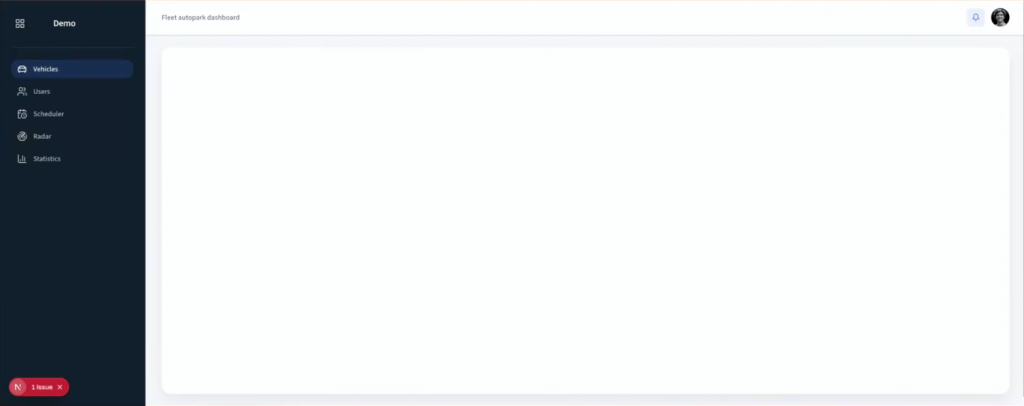
A better strategy is to build the project feature by feature. On the second attempt, our team started with the core layout (the header and collapsible menu) with a highly detailed spec that included exact styles and components:
Next came the “vehicles” page, specified down to the placement of inputs, instructing the AI to match the layout of a provided demo. While it wasn’t perfect, and the AI still decided to paint a button a different color, it was a manageable, high-quality chunk of work that could be easily corrected with a follow-up prompt or a quick manual tweak.
The final step was a tiny, well-scoped feature: adding sorting to two columns in an existing table. The simple command create client-sorting for type and year columns on Vehicle Stable proved perfectly suited for the SDD workflow, demonstrating that the methodology’s value extends to changes of any size, ensuring even small updates are implemented correctly and consistently:
Our experiments with Spec Kit revealed that successful AI-assisted development hinges on proper decomposition. Attempting to generate an entire application in one pass overwhelmed the model and produced unusable results, while breaking the project into small, well-scoped features consistently delivered high-quality, reviewable code. The key insight: specifications must match the size of the task, ensuring AI can maintain focus and consistency throughout implementation.
When SDD Makes the Most Sense
It is not a silver bullet for every coding task, but it provides immense value in specific scenarios:
- Enterprise & Production Systems. For long-lived applications where maintainability, stability, and compliance are critical;
- Complex Architectures. For projects with multiple services, APIs, and integration points where a lack of clarity can lead to catastrophic failure;
- Team Development. When multiple developers (and AI agents) need to collaborate on a shared codebase, a central source of truth is invaluable;
- Legacy Modernization. When rebuilding an old system, you can use SDD to capture the essential business logic in a modern spec before letting AI regenerate a clean, new implementation.
Conclusion: From Code-Centric to Spec-Centric Thinking
We are moving from an era where “code is the source of truth” to one where “intent is the source of truth.” AI is making specifications executable, turning our documented intent directly into working software. Spec-Driven Development allows small teams to build robust systems and large organizations to move with coherence and speed.
Have a project in mind? Contact us to discuss how we can help you harness AI-assisted development without sacrificing quality or control.
FAQ
It’s a way of building software where you first write a detailed “spec” (specification) of what you want to build. An AI then uses this spec as a blueprint to write the actual code. The spec becomes the single source of truth for the project.
No, it transforms the role of the developer. Instead of manually writing every line of syntax, developers become architects and validators. They focus on designing the system, writing clear specifications, and reviewing the AI-generated code to ensure it meets the intent.
No, it’s for any team or individual that wants to build higher-quality software with AI. For a solo developer, a good spec can act as a detailed to-do list and prevent them from getting lost in their own project. For a large team, it’s a crucial communication tool.
Yes, that’s the core premise of SDD. By using structured specifications, modern AI coding assistants can generate high-quality, consistent code that aligns with your project’s architecture and business rules.
Based on our observations, teams usually achieve a 12-15% reduction in overall delivery time. The impact comes from reducing hidden friction in the process: fewer clarification loops, fewer rewrites because requirements are validated upfront, and smoother context switching thanks to having a single, well-defined source of truth guiding development.