Summary
AI-assisted development can speed up SaaS execution, but it does not eliminate the need of thinking how to integrate, ensure QA, or avoid delivery risk. This guide explains why AI delivers realistic efficiency gains of 12–15%, how traditional estimation models fail with AI, and how functional slice–based planning keeps timelines predictable. It’s a practical framework for using AI without gambling on quality or deadlines.
AI-assisted development — commonly called “vibe coding” — is already part of modern SaaS development. Tools like GitHub Copilot, ChatGPT, and Claude are embedded into daily engineering workflows, influencing how quickly code is written and features take shape.
However, faster code generation does not automatically translate into faster product development. Many teams discover that projects built with AI can still have unpredictable delivery dates, expanding QA phases, growing integration complexity, and unclear progress visibility.
At XB Software, we’ve analyzed hundreds of hours of real SaaS development using AI-assisted workflows. The result is a clear, data-backed conclusion:
AI improves delivery efficiency by 12-15% on average — not 50-70%.
Therefore, in this guide, we explain why AI breaks traditional estimation logic, how functional slice-based planning keeps development predictable, where AI genuinely speeds up development, where it introduces new risks and overhead, and how to estimate AI-assisted SaaS projects responsibly. It is written for CTOs, founders, and product leaders who want to use AI without gambling on timelines or quality.
The AI Estimation Paradox: Rising Expectations vs. Delivery Reality
Artificial Intelligence has fundamentally changed how businesses perceive software development speed. With AI-powered coding assistants now part of everyday workflows, stakeholders often expect that features can be built almost instantly, fewer developers are required to deliver the same scope, and project timelines will shrink dramatically once AI is introduced.
On the surface, these assumptions seem justified. In real projects, AI-assisted development does accelerate early stages, particularly during UI prototyping, boilerplate generation, and initial feature scaffolding. Teams can visualize ideas faster and produce working demos earlier than before.
However, as the project moves beyond prototypes and into production-ready development, a different reality emerges.
Where AI Adds the Most Value
In practice, AI delivers the strongest impact in execution-heavy areas of software development. It excels at:
- rapid prototyping, generating UI layouts and interface components,
- creating repetitive CRUD logic and scaffolding,
- suggesting architectural patterns and implementation options,
- speeding up exploratory development and proof-of-concept work.
These capabilities significantly reduce time spent on mechanical tasks and help teams to move faster during early phases, especially when shaping the initial version of a SaaS product.
Where AI Acceleration Starts to Break Down
At the same time, AI does not replace the responsibilities that ultimately define delivery success. It cannot take ownership of:
- product thinking and requirement clarification,
- cross-feature system design and coherence,
- validation of complex business rules and edge cases,
- UX decisions tied to real user behavior and workflows,
- accountability for production readiness and long-term maintainability.
In real-world projects, AI-generated code often looks correct at first glance. Yet it still requires experienced human review to ensure it truly fits the system, scales as expected, and aligns with business goals. As software systems grow in complexity, teams commonly encounter:
- longer and more complex integration cycles between features,
- additional QA rounds to validate AI-generated code,
- increased code refactoring to align implementations with real business logic,
- unexpected inconsistencies across workflows, data handling, and user states.
Development may still feel fast on a task-by-task level, but overall delivery becomes harder to predict. What looked like a rapid acceleration early on turns into schedule volatility later in the project.
This is the core AI estimation paradox:
execution speeds up, while delivery certainty decreases.
For businesses, this creates a gap between expectations and outcomes — one that often leads to missed deadlines, budget pressure, and difficult conversations late in the software development cycle.

Early prototyping with AI can feel fast, but the real value comes when those prototypes are validated against business logic, system design, and performance expectations.
Why Traditional Software Estimation Models Fail with AI
Most classic software estimation models were designed long before AI-assisted development became mainstream. They typically focus on counting artifacts, such as:
- screens or UI views,
- front-end or back-end components,
- story points, tasks, or tickets.
AI excels at producing these artifacts quickly. A component, screen, or even a full feature skeleton can be generated in minutes. But speed at the artifact level does not equal system readiness.
What AI does not guarantee is:
- architectural consistency across the application,
- correct and predictable data flows,
- strict alignment with business rules and edge cases,
- stable, end-to-end user journeys that hold up under real usage.
This imbalance — fast execution paired with unresolved complexity — is precisely why AI must be accounted for carefully in estimation, rather than treated as a blanket multiplier for speed.
As a result, estimation models based purely on artifact counts become increasingly unreliable in AI-assisted projects. Teams may deliver more “output” faster, yet still struggle with integration, testing, and long-term maintainability.
In practice, this means that traditional estimation methods underestimate risk, especially in SaaS products, enterprise platforms, and data-driven systems where coherence matters more than speed in isolation.

Estimation is a business decision, not a technical guess. When product owners treat it as a strategic dialogue rather than a checkbox, the project becomes predictable and manageable.
XB Software Estimation Approach: The Backbone of Predictable Delivery
Considering this paradox, we approach AI-assisted development estimation from a different angle, following a functional slice-based estimation framework.
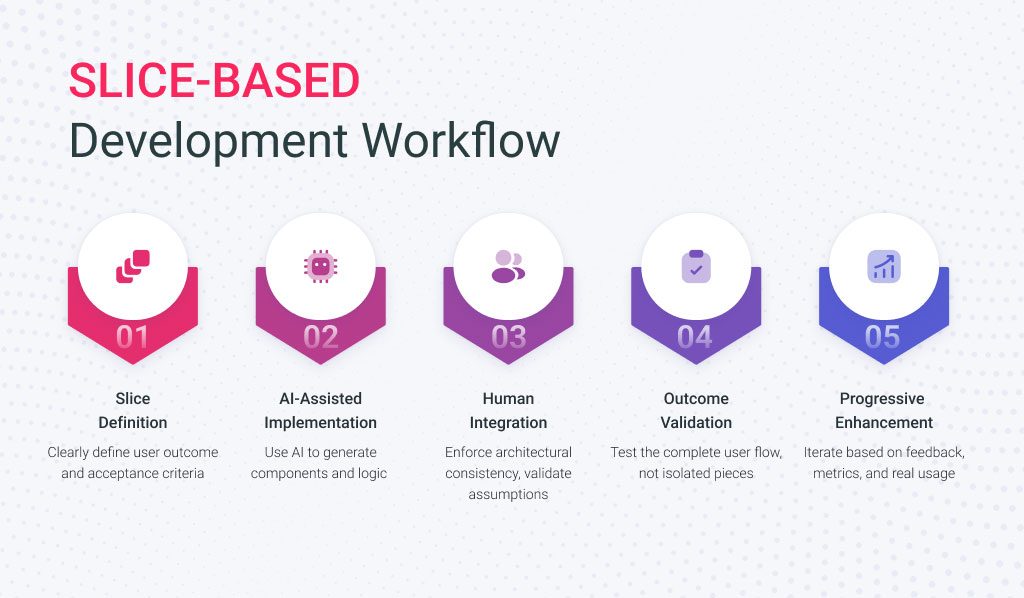
So, what do we mean by a functional slice?
A functional slice is a complete, user-valuable capability that can be used independently. For example:
- user authentication with role handling,
- managing a business entity from UI to database,
- dashboards with real-time data,
- account configuration with permissions.
Each slice includes:
- UI and interactions,
- business rules,
- backend integration,
- validation and error handling,
- cross-slice compatibility.
What We Do
We shift the focus away from how much code will be written toward what the system must actually do. Instead of estimating effort based on screens or components, we estimate business outcomes — complete, user-facing capabilities that deliver measurable value.
This approach remains stable whether AI is involved or not. And when it is involved, it is treated as a copilot, not an autopilot.
By anchoring estimation to outcomes rather than artifacts, we can:
- keep development timelines realistic,
- account for integration and QA effort upfront,
- reduce late-stage surprises,
- give clients clearer visibility into progress and risks.
Engineering judgment, product ownership, and accountability remain central to success. And the result is faster development with predictable delivery, which is what matters most from a business perspective.
Read Also How to Build a Custom Scheduling App Faster with Lovable AI and DHTMLX Scheduler
Why Functional Slices Work With AI
AI is strong at generating pieces of functionality in isolation. Slices ensure those pieces contribute to a meaningful user outcome, integrate correctly with the rest of the system, and can be tested end-to-end.
Because slices are defined by outcomes, not implementation details, they remain stable estimation units even when AI changes how code is written.
Establishing a Reliable Baseline Estimate
Software development hasn’t completely changed with the rise of AI, so it’s essential to understand what “normal” delivery actually looks like.
Before introducing Artificial Intelligence into the estimation process, we deliberately start with a traditional, non-AI baseline estimate. This step is critical. Without a stable reference point, AI-related efficiency gains quickly turn into guesswork rather than controlled improvement.
The baseline represents how the same SaaS product would be delivered using a standard, well-established development process without relying on AI acceleration. The following breakdown reflects a typical mid-size SaaS product (1600 hours) with a reasonably defined scope at the input stage.
| Activity | % of Effort | Hours | Description |
| Requirements & Coordination | 15% | 240h | Stakeholder alignment, scope clarification, decision-making |
| UX & UI Decisions | 15% | 240h | User flows, interaction design, prototyping |
| Architecture & Setup | 10% | 160h | Tech stack selection, infrastructure, foundational patterns |
| Implementation (Coding) | 35% | 560h | Component development, logic implementation |
| Integration & State Wiring | 10% | 160h | Feature connectivity, state management, data flow |
| QA, Bug Fixing, Polish | 15% | 240h | Testing, refinement, performance optimization |
This structure reflects how SaaS products are actually built in real projects, not how they are often imagined.
A key insight for decision-makers is that this breakdown represents just over one-third of the total effort. This is exactly why AI impact must be evaluated per activity, rather than applied as a blanket “speed multiplier” to the entire project.
Read Also AI MVP vs Traditional MVP: Key Differences, Benefits & Use Cases
AI does not affect all development activities equally. Based on real project data, its impact is uneven and highly context-dependent.
| Activity | AI Impact | Rationale |
| Requirements & Coordination | 0-5% time reduction | AI can assist with documentation, meeting summaries, and requirement drafts, but cannot replace stakeholder alignment, decision-making, or ambiguity resolution. Human coordination effort remains largely unchanged |
| UX & UI Decisions | 0-5% time reduction | AI helps to generate wireframes, UI variants, and design suggestions, but final UX decisions depend on user behavior, business constraints, and validation, limiting real efficiency gains |
| Architecture & Setup | 10% time reduction | AI assists with pattern generation and setup automation, but human oversight remains critical |
| Implementation (Coding) | 35% time reduction | Significant acceleration in component creation and logic implementation |
| Integration & State Wiring | 20% time reduction | AI helps with wiring patterns but cannot ensure system-wide coherence |
| QA, Bug Fixing, Polish | 10% time increase | AI-generated code often requires additional validation and refinement |
Important Note to Mention
One of the most commonly underestimated effects of AI-assisted development is its impact on quality assurance. AI tends to generate plausible but imperfect code — solutions that look correct but may fail under real-world conditions. This increases validation effort, especially in areas such as:
- edge case handling,
- performance optimization,
- cross-browser and cross-device compatibility,
- security and access control.
As a result, QA effort does not shrink with AI adoption. In many cases, it slightly increases.
Read Also Earned Value Management (EVM): How to Forecast Project Outcome and When Does EVM Help?
The Revised Estimation Model: Turning AI Impact into Predictable Numbers
With a stable baseline and activity-specific AI factors in place, we can now calculate a realistic revised estimate.
Step-by-Step Calculation
Baseline total: 1600 hours
AI efficiencies applied:
- Architecture: 160h × 10% = 16h saved
- Implementation: 560h × 35% = 196h saved
- Integration: 160h × 20% = 32h saved
- QA: 240h × 10% = 24h added
Net savings: 244h saved − 24h added = 220h net reduction
AI-generated code still requires review, refactoring, and correction. We account for this explicitly:
AI overhead: 12% of AI-affected effort
244h × 12% = 29h
1600h − 220h + 29h = 1409 hours
AI delivers a 12% overall efficiency gain — a realistic, sustainable improvement that preserves quality, predictability, and delivery confidence.
The 50% Fallacy: Why We Avoid Aggressive AI Discounts
Claims of 50-70% faster delivery with AI are appealing, especially at the budgeting stage. However, in real SaaS projects, these promises rarely hold once development moves beyond demos and prototypes.
Such aggressive discounts typically rely on assumptions that do not survive real-world SaaS development:
- Integration is treated as “automatic.” AI can generate individual features quickly, but it does not guarantee that those features will work together as a coherent system. Data consistency, state management, cross-feature dependencies, and error handling still require careful engineering. Ignoring this complexity leads to underestimated timelines and late-stage rework.
- Quality assurance effort is underestimated or excluded. AI-generated code often looks correct, but subtle issues emerge during validation: edge cases, performance bottlenecks, security gaps, and inconsistent behavior across devices and browsers. These realities expand QA cycles rather than shrinking them, especially in production-grade SaaS products.
- Requirements are assumed to be perfect from day one. High AI discounts often assume no clarification, no iteration, and no evolving understanding of business rules. In practice, requirements mature as stakeholders see working software. AI accelerates execution, but it does not eliminate the need for discovery, alignment, and decision-making.
- Risk is silently shifted to the development team, and ultimately to the client. When estimates are overly optimistic, teams are forced to compensate later by cutting scope, compressing QA, or absorbing unplanned effort. This creates pressure late in the project and increases the likelihood of delays, budget overruns, or compromised quality.
In short,
aggressive AI discounts do not remove risk, they hide it until the most expensive phase of the project.
Conclusion: Using AI Without Losing Control of Delivery
AI-assisted development is already shaping how SaaS products are built. The real question for businesses is not whether to use AI, but how to use it without sacrificing predictability, quality, or trust.
For CTOs, founders, and product leaders, the takeaway is simple:
AI works best as an accelerator within a disciplined development framework, not as a shortcut around engineering fundamentals. When estimation is treated as a business decision — grounded in outcomes rather than artifacts — AI becomes a strategic advantage instead of a source of late-stage surprises.
At XB Software, this approach lets us combine faster development with delivery confidence, which, in the end, is what successful SaaS products actually depend on. So, contact us if you want to develop or modernize your product fast without losing quality and resources.