Summary
This article explores how XB Software is evolving the Disciplined Agile Delivery (DAD) framework to integrate AI and Spec-Driven Development (SDD) without abandoning Agile principles. By shifting from a code-centric to a spec-centric model, we introduce new governance roles and structured phases to ensure AI agents deliver consistent, maintainable results while keeping human oversight on architecture and intent.
Before, we’ve relied on the Disciplined Agile Delivery (DAD) framework to bring structure, predictability, and scalability to our software projects. DAD has helped us balance agility with discipline, especially in complex, multi-team outsourcing environments where clarity and control are non-negotiable.
With the rise of AI-augmented development, particularly through Agentic SDLCs and Spec-Driven Development (SDD), the traditional Agile and DAD practices we’ve trusted are being challenged. Some even say that “AI is reshaping Agile.” Does that mean DAD is obsolete? Not at all. But it does mean we must evolve or risk being left behind.
How We Used Disciplined Agile Delivery Before AI
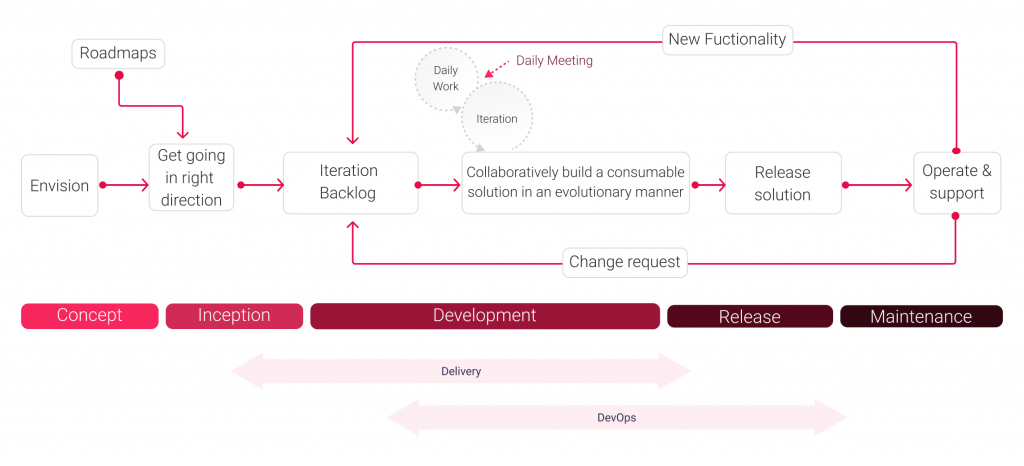
Disciplined Agile Delivery (DAD) is one of our core methodologies. It gives us structure and predictability, especially on our complex, multi-team projects. Rather than diving straight into code, we break work into clear phases aligned with our Discovery, Development, and Deployment practices. In each phase, we coordinate specialized roles and deliverables as follows:
- Inception (Discovery). We begin by aligning all stakeholders on the vision, scope, and architecture. In this phase we gather requirements and produce key artifacts, such as a Software Requirements Specification (SRS), an initial UI/UX prototype, and a detailed development plan with estimates. Our business analysts, designers, and project managers collaborate closely to ensure every requirement is clear and agreed before any code is written;
- Construction (Development & Testing). Next comes iterative development. Our cross-functional teams work in short sprints. Developers manually implement features from the approved specifications, while QA engineers unit-test each component as it’s built. We also integrate new modules frequently to form a complete system, and conduct daily standups and peer code reviews to maintain quality. This lets us deliver working increments to stakeholders regularly, adapting to feedback on the fly;
- Transition (Release & Maintenance). Finally, our deployment team, including PMs, developers, and DevOps, launches the solution into the working environment. We configure and customize the system, perform final acceptance tests, and train users as needed. Once live, we move into maintenance, monitor the software, fix any post-launch issues, and add enhancements to improve usability. This stage ensures the delivered product remains stable, effective, and aligned with the business goals.
This structured lifecycle has served us well by balancing agility with governance. However, with AI-assisted development emerging, we needed to evolve our approach.
Why Agile and DAD Must Change in the Age of AI
The Agile Manifesto famously prioritizes:
- Individuals and interactions over processes and tools;
- Working software over comprehensive documentation;
- Customer collaboration over contract negotiation;
- Responding to change over following a plan.
These values have served us well in human-driven development. But when AI enters the picture, the balance shifts.
1. Processes and Tools Are Essential
In an AI-augmented workflow, the tool you choose defines your development process. Whether you’re using Claude Code, Replit, GitHub Copilot, or custom agentic frameworks, each tool behaves, interprets context, and produces outputs differently.
Without a clear, well-defined process, AI agents will drift, hallucinate, or generate inconsistent results. In DAD terms, this means we must formalize our “toolkit” and process boundaries more explicitly than ever before.
2. Documentation Is Your Source of Truth
The old Agile preference for “working software over documentation” falls apart when AI is involved. As the “AI coding” trend has shown, generating code is the easy part. The real challenge is building systems that are coherent, maintainable, and actually do what they were supposed to do. AI doesn’t understand intent. It needs clear instructions.
Spec-Driven Development (SDD) becomes critical here. Clear, structured, and unambiguous specifications act as the single source of truth that AI agents follow. In this model, artifacts like a Product Requirements Document (PRD) and an agents.md file (outlines specific technologies, project structure, code style examples to follow, etc.) are the executable blueprints that bridge human intent and AI execution. Without SDD, you’re left with just “vibe coding”, where AI produces something that looks right but may be fundamentally flawed, unscalable, or packed with hidden technical debt.
Read Also 8-Step Plan for Reducing Your Technical Debt Without Disrupting the Workflow
3. Collaboration Still Matters, But with Clear Boundaries
Customer collaboration remains vital, but AI requires precision. Vague requirements lead to vague outputs. In our outsourcing context, this means we must work even more closely with clients to refine requirements into AI-executable specs.
We also need to define context boundaries for AI agents: what they should and shouldn’t change, which libraries to use, which patterns to follow, etc. Without these guardrails, AI can refactor itself into confusion, corrupt its own context, and create unmaintainable code.
How We’re Adapting DAD for AI-Augmented Delivery
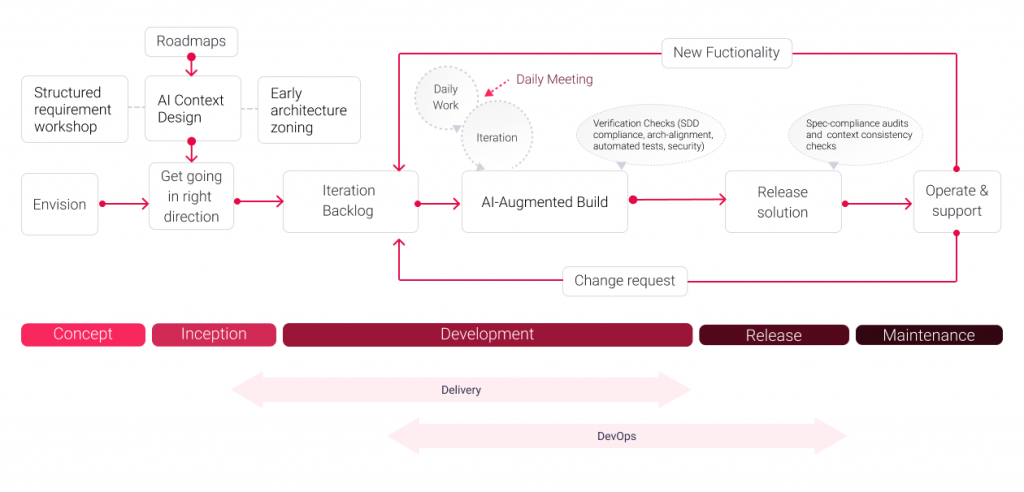
At XB Software, instead of abandoning DAD, we’re adopting it to the new reality. Here’s how our approach works.
Phase 1: Inception. From Vision to AI-Ready Specs
In the Inception phase, we now include:
- Structured requirement workshops focused on producing SDD artifacts (OpenAPI specs, behavior-driven scenarios, structured acceptance criteria);
- AI context design, defining which agents will handle which parts of the system, and how they’ll communicate;
- Early architecture zoning that prevents context corruption and hallucinations.
This phase is about establishing the “constitution” of the project and formulate the immutable rules that even AI must follow. It’s where we define the tech stack, patterns, and conventions that ensure all generated code feels native to the codebase.
We’ve also introduced new roles:
- Specification Steward ensures specs are clear, consistent, and AI-readable;
- AI Context Manager sets and maintains boundaries for AI agents throughout the lifecycle. This role is crucial for managing the agents.md file and ensuring the AI has the architectural brain of the system at its disposal.
Phase 2: Construction. Shorter Cycles, Stronger Gates
AI can produce working code in hours. That means we’ve compressed our iteration cycles while increasing validation checkpoints. We need to ensure the AI can maintain focus and consistency, delivering high-quality, reviewable code chunks. Every AI-generated deliverable is verified against:
- SDD compliance. Does it match the spec?
- Architecture alignment. Does it fit the intended context zone?
- Quality gates. Automated tests, security scans, and performance checks.
We still demo to stakeholders frequently, but now we also show spec-to-code traceability, proving that what AI built is what was agreed upon.
Phase 3: Transition. AI-Assisted Validation and Handover
Before deployment, AI agents run spec-compliance audits and context consistency checks. We also use AI to generate end-user documentation from the same SDD artifacts, ensuring consistency across deliverables.
Post-release, our retrospectives now include AI behavior reviews:
- Did agents stay within their context?
- Were specs clear enough?
- Where did hallucination or drift occur?
This feedback loop improves both our AI governance and our SDD practices over time.
The Role of Spec-Driven Development (SDD) in DAD
SDD isn’t just another documentation exercise. In an AI-augmented DAD process, it serves three crucial functions:
- Control Mechanism. SDD specs act as executable contracts between human intent and AI execution. They remove ambiguity and reduce the “interpretation gap” that leads to rework;
- Validation Baseline. Every AI output is validated against the spec. This shifts the focus from “does it run?” to “does it do what we specified?” This becomes even more critical when you consider the data from our estimation guides: AI can reduce time spent on coding by ~35%, but it can also increase QA effort if the output isn’t tightly controlled. The spec is our tool for that control;
- Future-Proofing Artifact. Clear specs make it easier to refactor, migrate, or scale systems later, because the intent is preserved separately from the implementation.
Read Also Code Rewrite vs Code Refactoring. Choosing the Best Code Transformation Tactics
What This Means for Our Clients
If you’re already working with us or just considering it, here’s what you can expect in this new AI-augmented DAD model:
- Faster delivery cycles, but with more upfront clarity needed in requirements;
- Greater transparency through spec-driven traceability;
- Reduced risk of AI-generated technical debt, thanks to strong governance and validation;
- Continuous adaptation as we learn which specs and contexts work best for different project types.
We are moving from a code-centric world to a spec-centric one. By treating intent as the source of truth, we allow AI to handle the execution, while our expert teams focus on architecture, validation, and delivering true business value. Our approach remains rooted in the same discipline that’s always defined the way we work. But now we’re using AI to accelerate it intelligently.
The Future Is Hybrid
The future of software development is a hybrid approach, where structure supports creativity. That’s why we’re evolving our DAD practice to be AI-ready without losing the control, predictability, and collaboration that our clients rely on. We see a future where:
- Disciplined processes (like DAD) provide the governance and predictability needed for complex systems;
- Clear specifications (following SDD) act as the shared language between humans and AI;
- AI agents handle the heavy lifting of code generation, freeing our engineers to focus on higher-value design and validation work.
Contact us if you’re exploring AI-augmented delivery and want a partner who understands both agility and discipline. We’re building the future of software delivery, one spec, one agent, one disciplined iteration at a time.