Summary
This article explores how construction and energy operations are rapidly converging, creating a demand for unified, intelligent software that traditional off-the-shelf project management tools can’t support. It outlines real-world challenges caused by fragmented systems, highlights the core features needed in modern construction-energy platforms, and illustrates how custom solutions deliver operational clarity, compliance continuity, and predictable outcomes with emerging trends.
Construction sites today look less like traditional job sites and more like tech-enabled ecosystems. Solar and wind developers operate like general contractors. And the companies building homes, drilling infrastructure, or assembling renewable energy assets now manage data, compliance, crews, schedules, and budgets with the complexity of a full-scale energy operation — a demand that often calls for a dedicated construction platform for energy projects instead of generic tools.
This shift isn’t theoretical, it’s happening on the ground. And not quietly. Energy and construction professionals aren’t lacking skills, they’re lacking unified, reliable tools. That is why, it is important not only for businesses to understand which systems they need, but also for software development vendors to know which solutions would be suitable for both industries.
The Real-World Challenges Where Construction Meets Energy
The research from Digital Construction Today shows that up to 40% of delays in construction-energy projects come from misaligned data or disconnected systems, not from labor shortages or weather, but simply from broken information flow. This is exactly the kind of gap a well-built construction platform for energy projects is meant to eliminate.
At XB Software, we’ve seen this firsthand in projects where building a well isn’t just about drilling but about orchestrating data, teams, equipment, compliance, and safety in real time. In solar and wind development, the same dynamic applies: you aren’t just “constructing”; you’re navigating tax credits, procurement cycles, engineering changes, and environmental documentation.
And that’s exactly where custom construction software development becomes not just helpful, but transformative.
Ask any project owner today about their biggest challenges, and you’ll likely hear the same themes, like fragmented tools, reporting delays, compliance pressure, data that exists everywhere and nowhere, or workflows that don’t connect with each other. Whether you’re building a residential development, a solar farm, or a hybrid energy installation, the pain points all sound familiar because today’s infrastructure ecosystem is deeply interconnected:
- Fragmented Project Oversight: Contractors, subcontractors, engineers, inspectors, and regulators often work in siloed tools. Because of that, they get inconsistent schedules, outdated documents, and miscommunication.
- Compliance Overload: From OSHA requirements to environmental reports and renewable energy incentives, compliance consumes hours of manual work, often spread across emails, spreadsheets, and PDFs.
- Resource Chaos: Crew scheduling, equipment allocation, and procurement workflows commonly run through spreadsheets. It works, until it doesn’t.
- Slow Communication Loops: Field teams update progress at the end of the day. HQ makes decisions the next morning. By afternoon, the data is outdated again.
- Data Lost Between Phases: Construction data rarely flows into operational systems, and energy operations tools don’t always integrate with construction ERPs or scheduling systems.
Read Also How to Finish a Construction Project on Time, Within the Budget, and not Run Out of Resources
When Custom Software for Construction and Energy Steps In
When construction teams start building for the energy sector (solar farms, wind projects, substations, grid upgrades, EV infrastructure, etc.), the complexity instantly multiplies. Suddenly, you’re not just dealing with construction timelines and resource planning. You’re juggling energy regulations, engineering specs, commissioning requirements, ITC-driven deadlines, and asset lifecycle tracking on top of your usual workload.
This is exactly why off-the-shelf tools like Smartsheet, Asana, or generic construction PM software struggle. They assume one industry, one workflow, one set of constraints. Hybrid infrastructure projects, on the other side, demand cross-industry logic that only a robust energy construction management software can support.
Generic project management tools fail because they can’t handle:
- Construction sequencing along with energy commissioning workflows;
- Regulatory requirements from two industries at once;
- Multi-phase dependencies between civil work, electrical work, and energy asset installation;
- ITC-driven timeline tracking tied to procurement, delivery, and field execution;
- The exact equipment, crews, and approval chains that make construction-for-energy approach unique.
Custom construction & energy software fills that gap by bringing everything into one unified environment, built around your processes, your compliance needs, and your hybrid operational model. With bespoke development, it becomes possible to unify:
- Site operations;
- Compliance and regulatory data;
- Crew and subcontractor scheduling;
- Equipment utilization and procurement;
- Budget and cost control;
- Document and permit management;
- Renewable energy milestones and ITC timelines.
When construction and energy workflows live organically and seamlessly in the same platform, everything changes. Handovers stop breaking. Deadlines stop slipping. Teams stop guessing. And the clarity needed for fast, confident decision-making finally appears across engineering, field ops, finance, and energy compliance.
10 Key Features Every Construction-Energy System Needs
The construction-energy sector sits at the intersection of heavy field operations, strict safety regulations, complex asset management, and long-term project planning. Any digital platform serving this industry has to support all of these layers simultaneously. That means the software must not only streamline day-to-day work but also provide the visibility, traceability, and forecasting necessary to keep multimillion-dollar assets operating safely and efficiently.
So, let’s look at the core features a modern construction-energy platform must include to deliver real value.
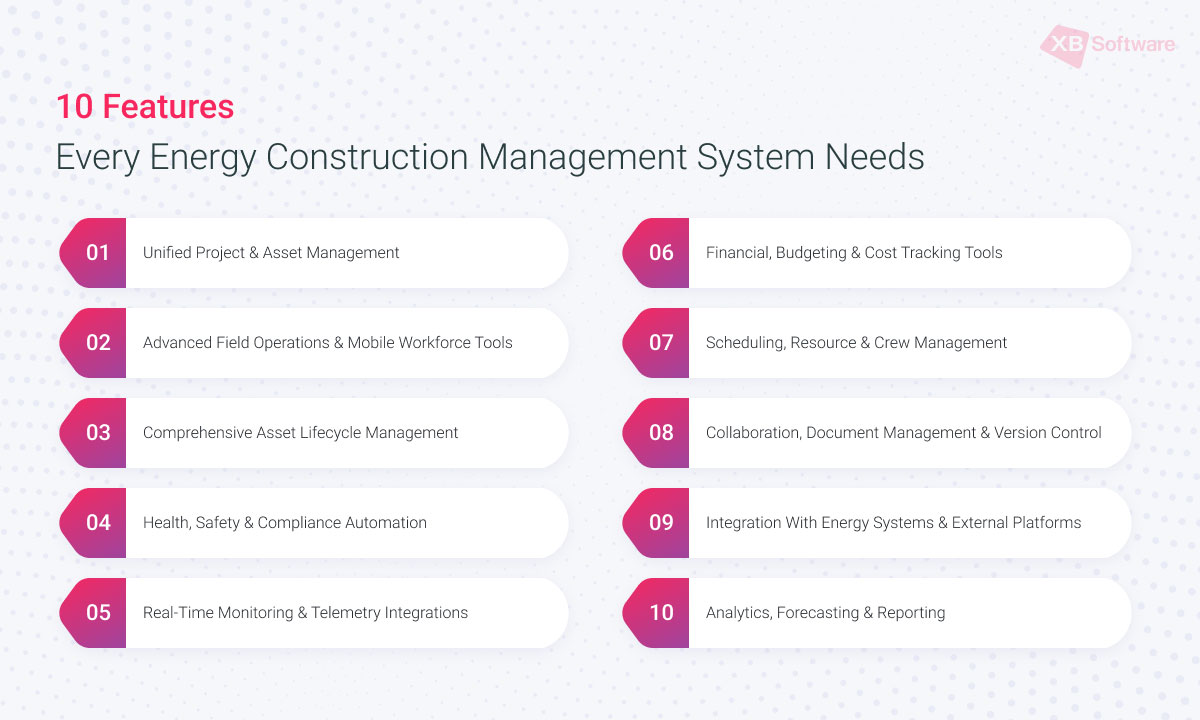
Hybrid construction-energy projects involve interconnected workflows: site preparation, installation, inspections, grid connections, maintenance scheduling, and more. A unified platform brings all of this together by providing:
- A single source of truth for all project tasks and milestones;
- Real-time updates from field teams, contractors, and supervisors;
- Linked assets, documents, and work orders;
- Gantt charts, Kanban boards, and resource calendars.
This consolidation eliminates the fragmentation that typically arises when teams use separate systems to manage construction progress, equipment, and workforce operations.
Most work happens in the field — on wind farms, solar installations, substations, or construction sites. Your system must provide tools that operate reliably offline and sync seamlessly when connectivity returns. That includes:
- Mobile apps for field reporting, checklists, and inspections;
- Digital forms with photos, GPS, and e-signatures;
- Offline-first capabilities;
- Instant incident reporting and safety alerts.
These tools reduce reporting delays and ensure that real-time operational data is fed back into the system as soon as possible.
Energy and construction companies rely on expensive, long-lifespan assets, such as turbines, inverters, heavy machinery, transformers, and structural components. Therefore, an effective platform should support:
- Full asset histories from installation to retirement;
- Condition monitoring and sensor data integrations;
- Predictive maintenance powered by analytics or AI;
- Automated service reminders and warranty alerts.
Better asset visibility translates into reduced downtime, longer service life, and more predictable maintenance costs.
Safety and compliance obligations in construction-energy projects are strict and constantly evolving. Your custom software must help teams to stay ahead of requirements by providing:
- Safety checklists and digital permit-to-work workflows;
- Compliance tracking for OSHA, ISO, NEC, NFPA, environmental standards, etc.;
- Automated documentation generation for audits;
- Training and certification tracking.
This ensures not only safety on-site but also the ability to prove compliance during inspections or certification renewals.
Modern energy assets generate continuous operational data. A strong platform supports direct integration with SCADA, IoT devices, meters, and sensors:
- Live performance dashboards;
- Automated alerts for anomalies;
- Weather data overlays for solar/wind forecasting;
- Historical trend analytics.
This helps operators to identify performance drops early and optimize energy production.
Construction energy projects run on tight margins. Custom software should help leaders to maintain financial control across long project timelines:
- Budget creation and baseline tracking;
- Cost forecasting tied to progress data;
- Procurement and contract management;
- CapEx (capital expenditures) and/or OpEx (operating expenses) dashboards.
This financial visibility helps teams to prevent cost overruns and justify spending with clear audit trails.
Resource coordination is one of the biggest bottlenecks in projects that cover both construction and energy spheres. A robust platform should include:
- Crew scheduling and shift planning;
- Equipment and vehicle allocation;
- Skills-based assignment matching;
- Real-time workload analytics.
This ensures that the right specialists and equipment arrive on-site at the right time.
Construction-energy workflows generate huge amounts of documentation: drawings, technical specs, permits, installation guides, inspection reports, change orders, and more.
Essential capabilities include:
- Centralized document storage;
- Version tracking for technical drawings;
- Approval workflows;
- Collaboration tools for engineers, contractors, and clients.
This prevents outdated documents from being used on-site — a common source of costly mistakes.
Companies that cover construction and energy needs rarely rely on a single tool. Therefore, your custom construction and energy system must integrate seamlessly with:
- ERP systems;
- GIS and mapping tools;
- SCADA and EMS;
- BIM systems;
- CRM systems;
- Financial software.
Open APIs and modular architecture ensure your platform becomes a hub rather than a silo.
Finally, decision-makers need clear insights rather than raw data. A good system must offer:
- KPI dashboards for project, asset, and energy performance;
- Predictive analytics for scheduling, maintenance, and output;
- Automated reporting for stakeholders and regulators;
- Forecasting models using historical and real-time data.
These insights help companies to optimize operations, avoid downtime, and plan future investments.
Besides that, custom construction project management software can be tailored with the technologies, frameworks, and UI libraries that not only help to connect with the existing systems the business uses, but also can speed up the development or app modernization process. For example, we often use UI components and technologies like Webix, DHTMLX, and React that allow the construction teams to get real-time clarity.
Real-Life Example: Cloud-Based Drilling Management Platform
When one of our clients came to us, they were managing drilling sites across multiple locations, but their processes were fragmented and error-prone:
- Dozens of spreadsheets, Word docs, emails, and shared drives instead of a unified system;
- Disconnected planning tools, manual reporting, and no reliable way to see the true status of operations;
- Delays caused by miscommunication, permit bottlenecks, and inefficient resource mobilization.
They lacked a single source of truth: no centralized view of schedules, no real-time progress tracking, no unified reporting or compliance data. And absolutely no way to coordinate crews, vendors, equipment, and field updates across phases.
What We Built: A Unified SaaS Platform for Well Construction & Drilling Management
To solve those challenges and cover up the need for effective energy construction management software, we developed a full-cycle cloud-based drilling management platform, designed for both internal efficiency and as a scalable SaaS product for other operators.
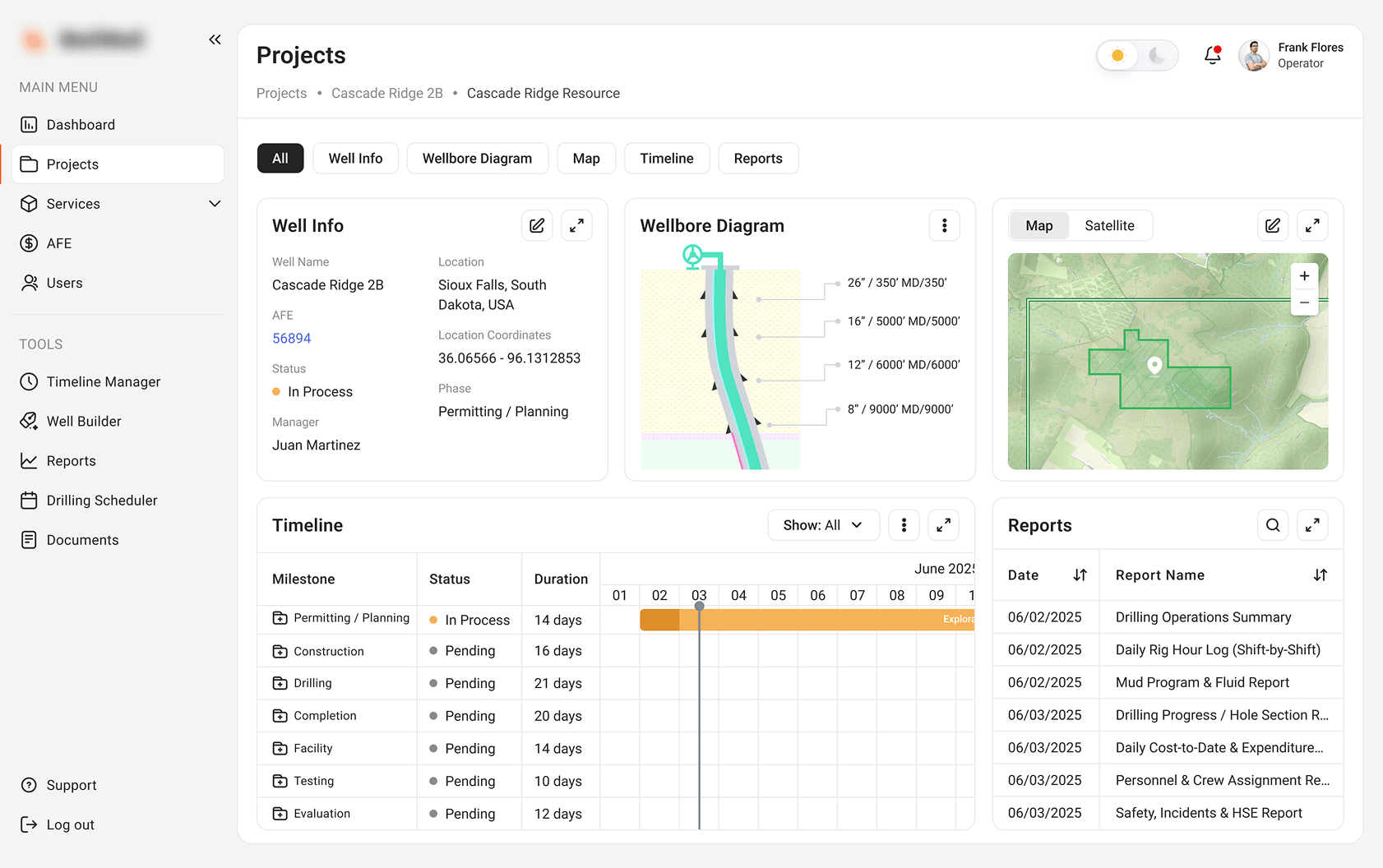
Case Study: Cloud-Based SaaS Platform for Well Drilling & Construction Management
What It Changed: Real Impact and Qualitative Wins
After implementing the platform, our client saw drastic improvements across their operations:
- No more juggling spreadsheets, disconnected tools, or manual reporting — everything is centralized and synchronized.
- Dynamic scheduling and automated workflows minimized delays between phases, reduced idle time, and made crew mobilization predictable.
- Transparent financial visibility: planned budgets vs actuals, instant cost tracking, and clearer forecasting.
- Better communication and coordination between HQ teams, field crews, and contractors — everyone works from the same live data, decisions are faster, issues surface earlier.
- Compliance and documentation became audit-ready: permits, certifications, reports, service contracts — securely stored and easily accessible.
- Field data gets logged on the spot (even offline), driving faster reporting cycles and reducing administrative burden on crews.
This wasn’t just a one-off fix. The cloud-based drilling system became a foundation, a repeatable, scalable model that influenced how we build custom project management and infrastructure software across energy, construction, and hybrid sectors.
Future Trends at a Glance: Where Construction-Energy Software Is Heading
As construction and energy projects grow more interconnected, the software behind them has to evolve just as quickly. From AI-driven scheduling to digital twins and automated compliance, here are the trends already reshaping the way complex infrastructure gets built — with evidence to prove what’s coming next.
Construction platforms for energy projects will shift from reporting problems to actively recommending schedules, predicting delays, and automating risk mitigation. According to the recent Datagrid analysis, 56% of construction investors plan to increase AI spending, showing intent to adopt AI-driven tools for scheduling, safety, and resource optimization.
Construction and operational data will merge into unified digital replicas for real-time planning, QA, and asset performance forecasting. According to Quick Market Pitch, the market for digital twins is rapidly expanding, which is a sign of increasing trust in virtual replica systems.
Drones, IoT sensors, heavy equipment telemetry, and AR tools will feed into one ecosystem with automated insights and updates. According to 360 Research Reports, in 2025, IoT-based monitoring and cloud-linked site systems accounted for a fast-growing share of the construction-technology market.
Whether it’s safety, permitting, environmental compliance, or equipment maintenance, hybrid infrastructure projects benefit enormously from embedded, automated workflows that ensure nothing falls through the cracks. In the renewable energy sector, many companies are embracing digital transformation: about 62% of wind farms now use IoT sensors for predictive maintenance to reduce downtime, as stated in the Gitnux report.
The broader construction software market is growing fast: many firms report cost savings, efficiency improvements, and better collaboration once they integrate digital tools across project phases. For long-term assets like wind turbines, solar farms, or multi-phase residential infrastructure, a custom, integrated platform pays off not only during construction, but over the full lifecycle, from installation through planned maintenance and upgrades.
Conclusion: Building Effective Hybrid Infrastructure Starts With the Right Software
Construction and energy are merging into a single, complex ecosystem, and outdated, disconnected tools simply can’t keep up. Delays, data gaps, and misaligned workflows aren’t signs of poor management; they’re signs that the software wasn’t built for the realities of modern infrastructure. When platforms unify scheduling, field operations, compliance, engineering data, and energy-specific workflows, teams stop reacting and start operating with clarity, predictability, and confidence.
Custom software is quickly becoming a strategic advantage. So, if you need an experienced vendor that can provide you with the solution suitable for your infrastructure, contact us, and we will help you to develop a smarter, integrated system.
Frequently Asked Questions
Because they’re built for a single industry’s logic. Hybrid energy-construction projects require interconnected workflows across civil engineering, maintenance planning, commissioning, compliance, grid integrations, procurement, and long-term asset management — capabilities that generic PM tools do not support.
If you’re juggling multiple tools, losing data between phases, struggling with compliance workflows, or working on projects that span both construction and energy operations, custom software is usually the only way to unify those complex processes into one ecosystem.
Timelines vary based on scope, integrations, and platform complexity. On average, an MVP can take 2-4 months, while a full end-to-end ecosystem may take 4-8 months or more with iterative releases.
AI plays a crucial role by automatically generating data on work activities, intelligently categorizing tasks, and detecting errors or inconsistencies before they escalate. It enhances scheduling accuracy, evaluates timelines and risks, predicts delays, and supports proactive decision-making. AI can also connect field telemetry to automated insights, optimize asset maintenance, and integrate seamlessly with your CRM to unify project, client, and operational data.
We’ve built platforms for cross-industry infrastructure operations (well drilling and construction, solar farm construction and management, and more) as well as construction-specific and energy-specific companies. Many of these systems are now scalable SaaS products used across multiple clients and sites.