Summary
This article explores how XB Software built a healthcare knowledge management platform for a regional healthcare network. It shows how business analysis uncovered workflow bottlenecks, leading to practical UX, scalable architecture, and lightweight compliance features that improved operational visibility and coordination.
In healthcare operations, internal knowledge base management problems rarely appear suddenly.
More often, they develop gradually through years of operational growth, fragmented communication practices, and inconsistent administrative processes that were initially manageable at smaller scale.
That was exactly the situation faced by a regional healthcare network (under NDA) operating across multiple clinics and departments. Here’s how, in practice, our client saw the importance of business analysis in identifying the actual perfect solution for your project.
What Knowledge Management Actually Means in Healthcare
But first, let’s start with the basics: what is knowledge management in healthcare really?
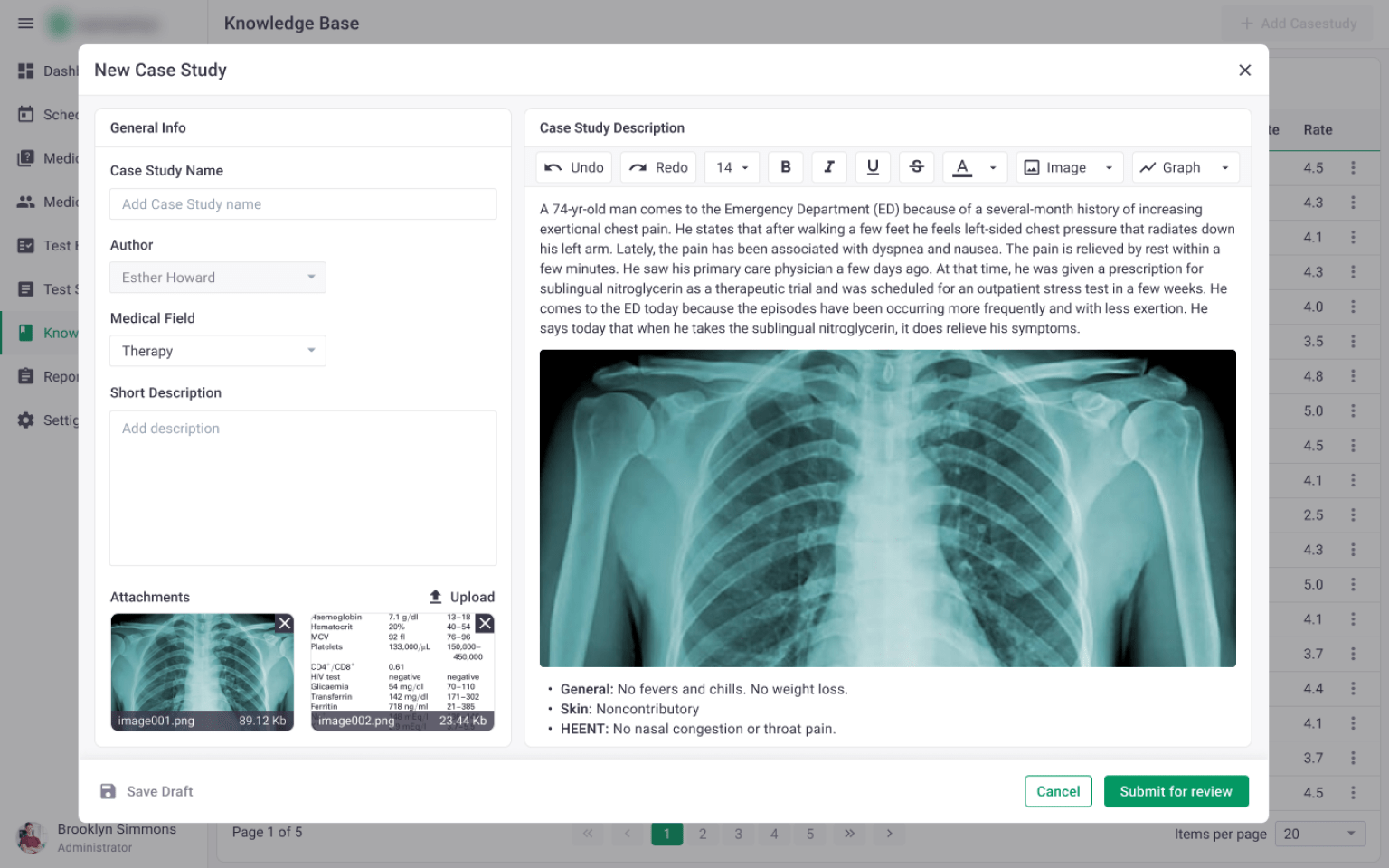
Case study example: Medical Professional Testing System
Knowledge management in healthcare is often misunderstood as simply storing documents in one place. In reality, it is much broader. The challenge is not whether procedures, policies, and guidelines exist. Most healthcare organizations already have plenty of documentation. The real issue is ensuring that operational knowledge moves consistently across departments and reaches the people who need it at the right time.
Healthcare knowledge management includes much more than article repositories or shared folders. It encompasses how organizations:
- distribute procedural updates,
- maintain version control,
- track acknowledgments,
- and ensure that critical information remains visible throughout daily operations.
In practice, knowledge management software in healthcare supports the lifecycle of viable information. New procedures need to be communicated consistently. Existing instructions need to be updated and redistributed. Employees need clear responsibilities, while managers need visibility into whether important materials have actually been reviewed.
As healthcare networks grow, these processes become increasingly difficult to coordinate manually. Different departments naturally develop their own methods for sharing information. Some teams rely on email chains, others maintain spreadsheets, while verbal communication often fills the gaps between systems.
Over time, fragmented knowledge workflows create operational risks. Employees may work with outdated procedures, managers lose visibility into acknowledgment status, and compliance preparation becomes heavily dependent on manual follow-up.
This is why healthcare knowledge base software is no longer viewed simply as a document repository. Increasingly, healthcare organizations approach it as an operational coordination platform that helps to maintain consistency, accountability, and visibility across multiple departments and locations.
The Challenge of Managing Procedural Knowledge Across Departments
Now, getting back to one of our custom healthcare software development projects.
At first glance, the problem looked like a typical “need a medical knowledge base” request. But after discussing all the details with the client, we found out that the organization already had documentation and maintained a growing internal knowledge base for medical procedures, compliance instructions, and clinical coordination policies.
The actual issue was the absence of healthcare management process visibility, accountability, and centralized coordination around how procedural knowledge moved across departments. All of that existed across shared folders, spreadsheets, email attachments, and chat conversations. Different healthcare departments maintained their own versions of documents, while managers relied heavily on manual coordination to distribute updates and track acknowledgments.
However, the existing approach was largely passive. Managers could distribute materials, but they could not reliably answer simple questions:
- Who actually reviewed mandatory updates?
- Which departments still had incomplete acknowledgments?
- Which employees started reviewing materials but never finished?
- How should updated procedures be redistributed consistently?

The situation was much more complex. So, the project ultimately became less about document storage and more about designing a workflow that aligned with how healthcare operations actually functioned day-to-day.
How Thorough Business Analysis Changed the Course Before the Software Design
One of the most important parts of the engagement happened before interface design or development architecture discussions even started. Instead of immediately proposing functionality, the discovery phase focused heavily on understanding operational behavior inside the organization.
From a purely technical perspective, replacing those flows with “a portal” would have been relatively easy.
From an operational adoption perspective, however, that approach would likely fail.
A major insight during workshops was that employees were not resisting digitalization itself, but they were against workflows that introduced additional friction into already overloaded administrative routines.
That distinction became critical.
Instead of treating the project as a traditional healthcare document management implementation, the business analysis phase reframed it as a coordination and accountability problem.
This directly influenced both UX decisions and backend workflow design later in the project.
Read Also Where Is the Line Between Identifying Client’s Needs and Interrogating?
From Document Storage to Operational Control: Where Business Analysis Made the Difference
Before starting UI design or software architecture, XB Software analyzed how procedural updates were distributed, acknowledged, and revised inside the healthcare organization. This showed that the client did not need only a healthcare document management system. They needed a controlled workflow for healthcare communication, employee acknowledgment, and article lifecycle management.
During discovery, business analysts identified several fragmented processes:
- Some managers distributed updates through email;
- Others tracked acknowledgments manually in spreadsheets;
- Some departments used messengers or verbal follow-ups;
- Leadership had limited visibility into who had reviewed critical updates;
- Managers spent extra time on reminders and manual control;
- Compliance evidence was difficult to collect and verify.
This changed the project direction. Instead of building a basic content portal, XB Software designed a healthcare workflow management solution focused on:
- Accountability;
- Usability;
- Operational control;
- Compliance readiness;
- Reduced manual follow-ups.
Two key bottlenecks shaped the final platform.
1. Acknowledgment Reliability
Simple “mark as read” confirmations did not give leadership enough confidence that employees had actually reviewed important procedures. At the same time, the client did not want invasive employee monitoring.
XB Software proposed a lightweight validation model based on:
- Article progress;
- Reading duration;
- Quiz completion;
- Final acknowledgement.
This helped create more reliable traceability without adding unnecessary friction for employees.
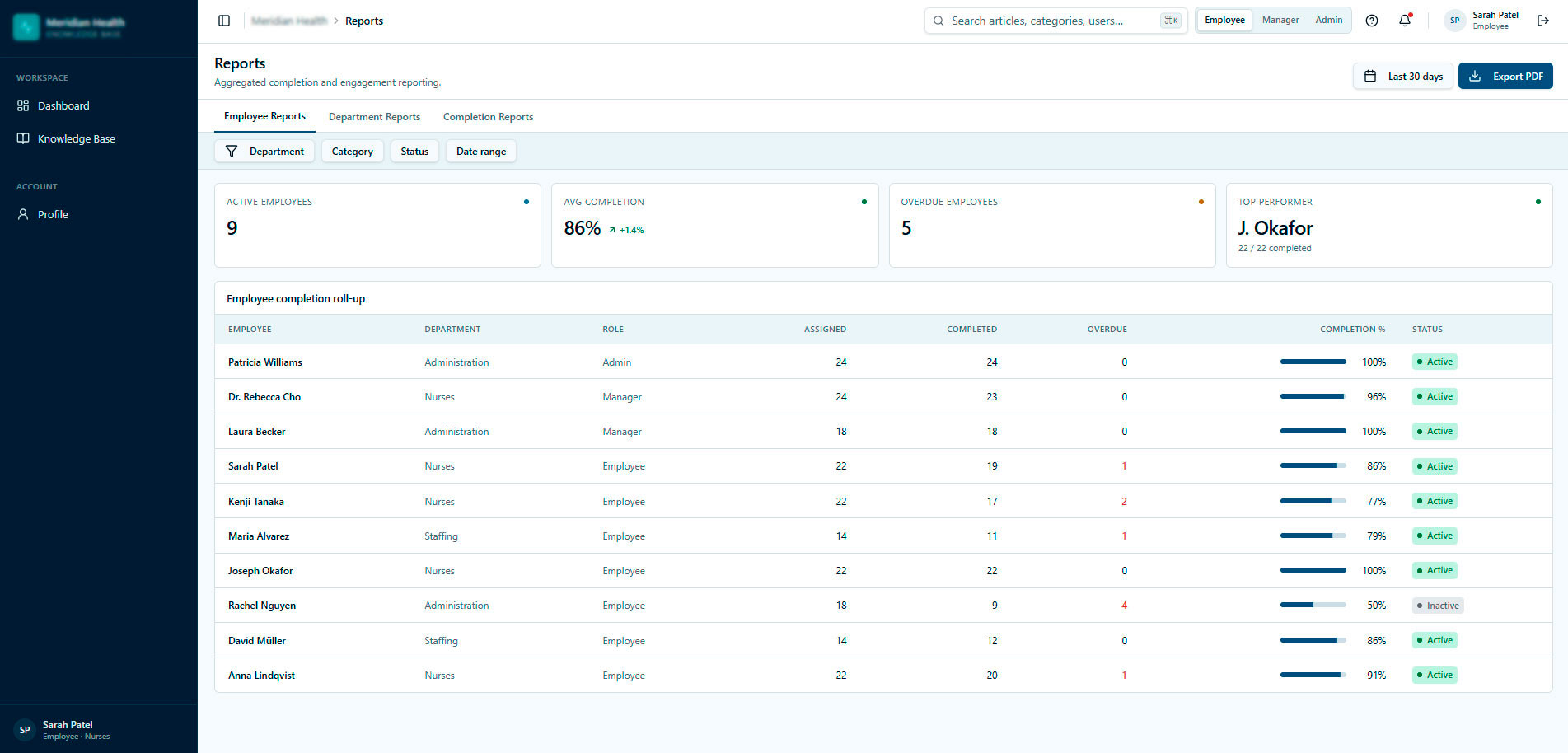
One of the initial design prototypes for client to understand the possible interface and architecture
2. Article Lifecycle Management
Healthcare procedures change regularly, so article completion could not remain valid after content updates. The system needed to support ongoing review cycles instead of one-time confirmations.
The solution was proposed :
- Article version control;
- Updated article statuses;
- Reassignment workflows;
- New review cycles after procedure changes.
When a procedure changed, the system could automatically assign the updated version to the right employees for review.
As a result, the platform became more than a healthcare article repository. It turned into a practical healthcare workflow management system that improved procedural communication, strengthened compliance readiness, reduced manual follow-ups, and gave managers clearer control over updated content.
The Process of Designing and Building a Healthcare Knowledge Management Platform
The next challenge was translating those findings into a platform that people would actually use. The project required balancing usability, accountability, scalability, and long-term maintainability without introducing unnecessary complexity.
Rather than treating UX, architecture, and compliance as separate disciplines, the team approached them as parts of the same problem. Many of the design and engineering decisions that followed were driven directly by the realities uncovered during the evaluation.
The direction of UX/UI development and design was intentionally shaped around operational simplicity rather than feature density.
One common mistake in internal enterprise platforms is overengineering workflows before validating how employees actually interact with the software.
The project deliberately avoided that trap.
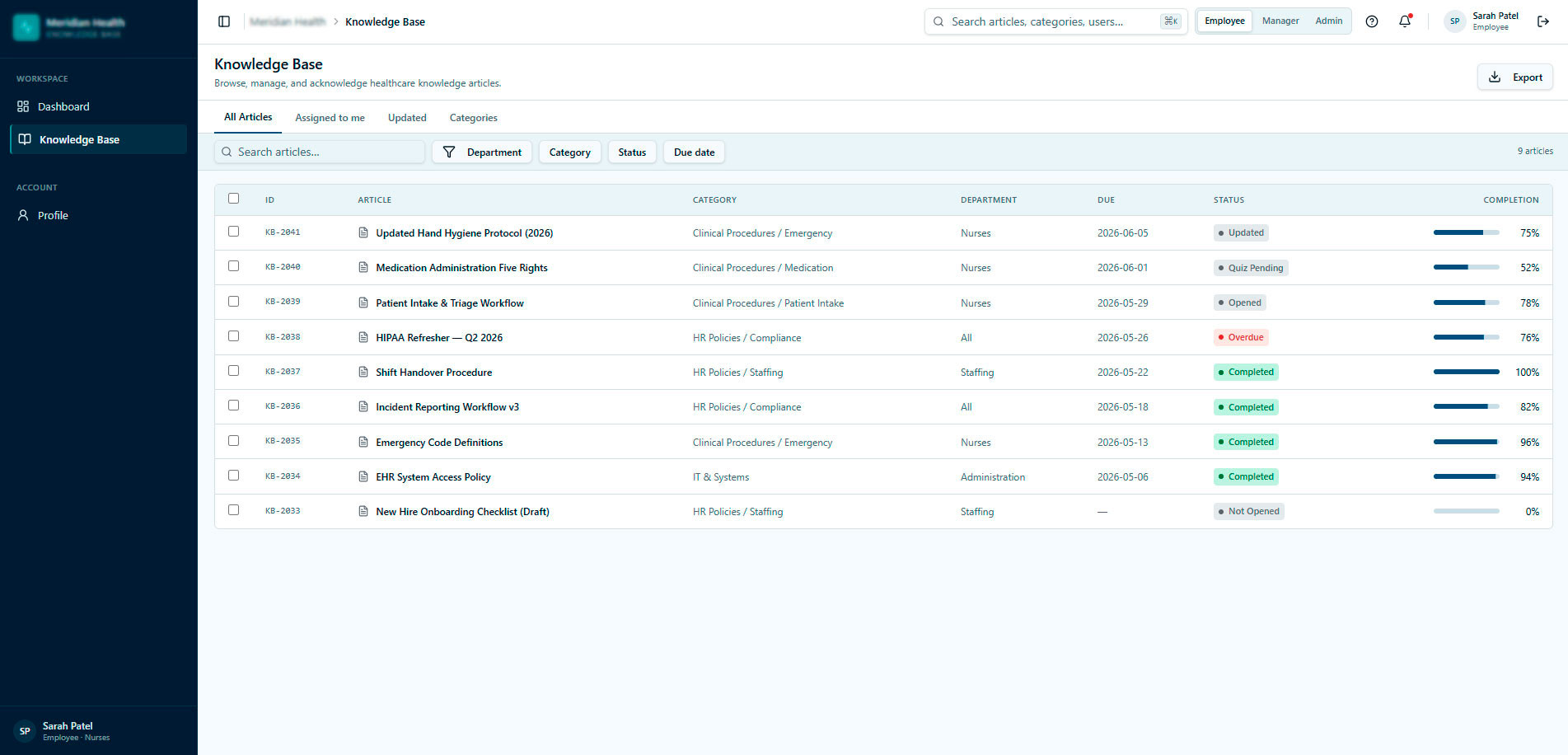
Simple UX/UI for Knowledge Base module shown in initial prototype
The employee experience focused on reducing interaction friction as much as possible:
- open assigned article,
- read content,
- complete lightweight quiz,
- confirm acknowledgment,
- finish assignment.
No collaborative editing, unnecessary social features, or overloaded dashboards.
That decision came directly from the analysis rather than visual design preferences.
On the other hand, operational managers required visibility rather than content interaction. Their dashboards prioritized:
- overdue acknowledgments,
- unread articles,
- department completion rates,
- updated procedural materials,
- reminder activity.
This separation between employee simplicity and managerial visibility became one of the strongest UX decisions in the entire healthcare software development project.
From the engineering side, the healthcare knowledge management system required much more than building CRUD pages around articles.
Several architectural decisions were directly influenced by business process analysis.
For example, the article assignment workflow was designed around department-based structures such as Nurses, Administration, and Staffing. This allowed managers to distribute procedural materials at organizational scale without manually selecting employees one by one.
Nested category architecture was another example of practical engineering aligned with client needs.
Healthcare organizations naturally accumulate large amounts of procedural documentation over time. Without structured categorization, the knowledge base would eventually become difficult to navigate and maintain.
The engineering team introduced hierarchical category management specifically to support long-term scalability of procedural content.
The reporting architecture also reflected priorities uncovered during discovery sessions.
Managers did not need abstract analytics dashboards filled with vanity metrics. They needed immediate answers to practical questions:
- Who has not reviewed mandatory material?
- Which departments are overdue?
- Which updated procedures still require acknowledgment?
As a result, the reporting system emphasized operational visibility instead of decorative analytics.
One of the more important implementation principles throughout the custom knowledge base software project was resisting unnecessary complexity.
Several early discussions included ideas around:
- advanced scoring systems,
- behavioral analytics,
- automated compliance ranking,
- AI-assisted procedural validation.
Technically, many of those features were possible. Practically, however, they would have introduced complexity without solving the organization’s immediate coordination problems.
The final version of the software intentionally remained lightweight, and the quiz system was simple:
- 3 manually configured questions,
- 3 answer options per question,
- acknowledgment checkbox,
- completion confirmation.
That simplicity was a deliberate product decision driven by workflow evaluation and long-term maintainability considerations.
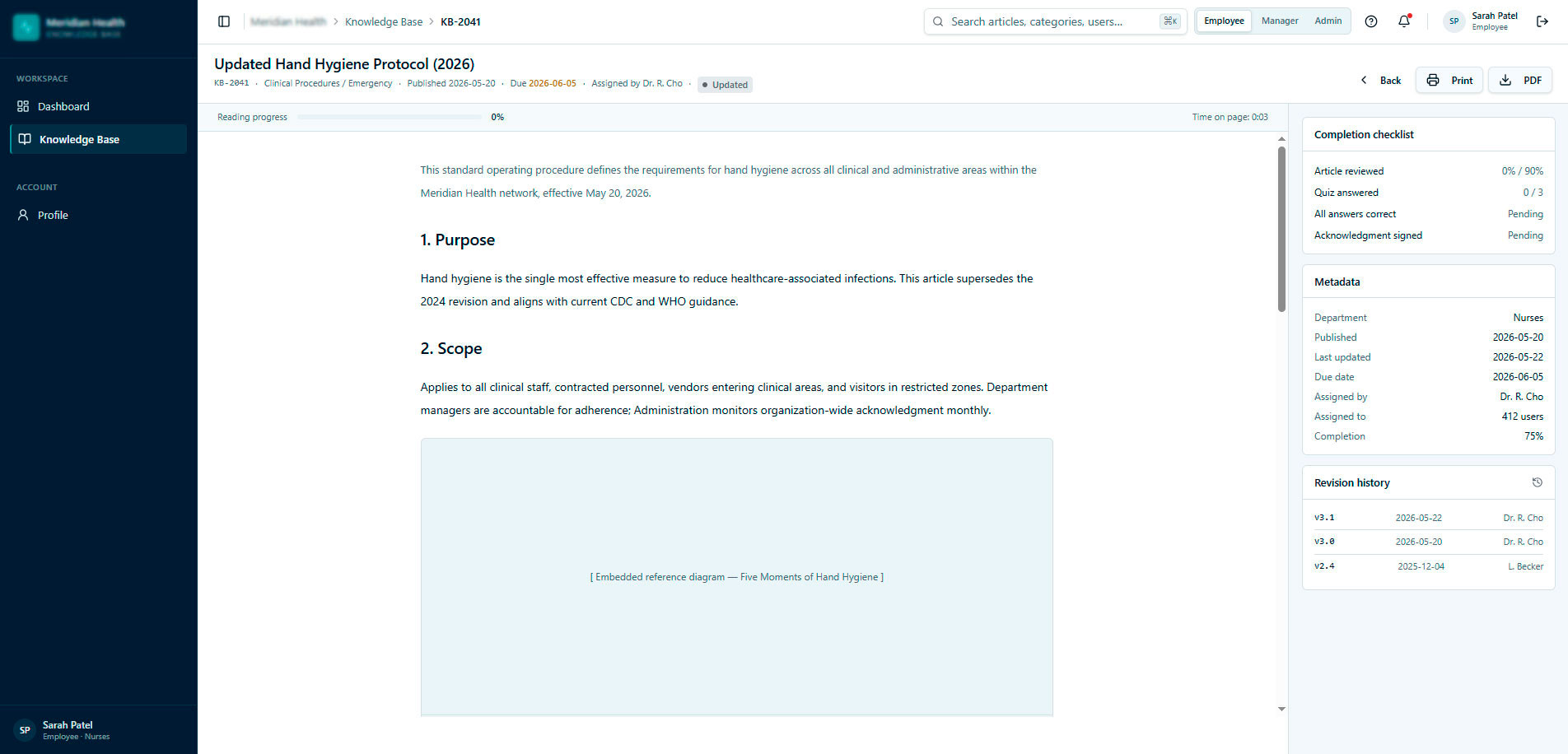
Knowledge Base article with detailed info on reading process, completion checklist, metadata, and revision history
The same philosophy applied across the entire platform.
The goal was not building a massive enterprise LMS. We just needed to build a system that employees would actually use consistently.
Read Also Healthcare Data Security: How to Protect Data in Clinical Systems by Design
Conclusion: Operational Impact After Rollout
After implementation, the client gained something more valuable than centralized document storage ー operational visibility.
- Managers no longer spent hours manually following up on procedural acknowledgments through spreadsheets, emails, and chat conversations.
- Employees received a more predictable workflow for mandatory updates and procedural reviews.
- Compliance-related preparation also became substantially easier because article interaction history, quiz completion, and acknowledgment status became centralized and traceable.
- Equally important, the platform reduced ambiguity around updated procedures.
The project demonstrated how internal workflow systems become significantly more effective when business analysis and engineering decisions evolve together instead of independently. So, if you need a qualified expertise for your healthcare management software project, contact us, and our team will offer you a suitable solution.