Property Inspection Software with AI-Powered Scheduling
Property inspection report software that combines workflow automation with AI-powered scheduling, workload forecasting, report summarization, and photo analysis to help inspection teams make more informed operational decisions.
Business Challenge
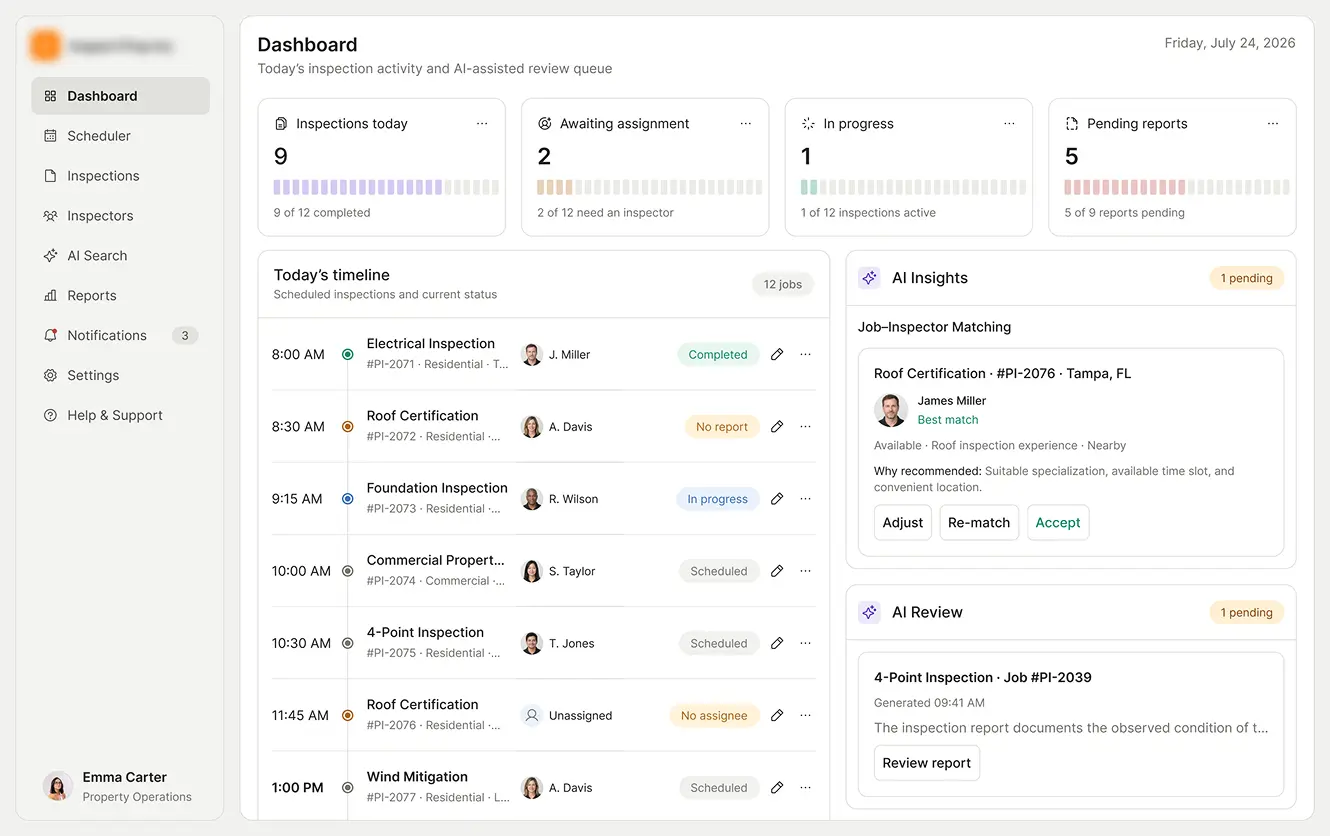
A company that coordinates residential and commercial property inspections across Florida requested our help in AI software development services. Employees relied on manual scheduling using shared calendars, spreadsheets, and phone coordination. Considering the inspection volume and the amount of accumulated inspection history (completions, durations, inspector assignments, inspection type distributions, homeowner/job-location relationships, etc.), it was decided to develop the system with the ML techniques to reduce the number of manual tasks and improve the services they provide.
The client needed a centralized platform to support inspection workflow automation while preserving the flexibility required for different inspection types and field operations. The client also wanted to make better use of historical inspection data to improve scheduling decisions, anticipate demand, and assist with report and photo review, without handing final operational or professional decisions over to AI.
Time-consuming inspector selection
Administrators needed to consider inspector availability, workload, location, and specialization when assigning jobs instead of relying on a centralized recommendation process.
Growing inspection data volume
As the number of inspections increased, manually reviewing historical records became less practical for identifying patterns and answering operational questions.
Manual coordination
Assignment changes, rescheduling, and status updates depended heavily on administrator intervention.
Limited operational insight
Historical inspection data was not being used systematically to estimate job duration, forecast demand, or support resource allocation.
Project in Facts
Industry
Real Estate / Commercial & Residential Inspections
Region
USA
Business
Medium-sized
Services
Key technologies
Solution
XB Software developed a custom inspection management platform with a centralized AI-driven analysis and scheduling interface. Rather than replacing the existing workflow and giving every task to AI, the developed real estate automation software was extended with decision support at key stages. Administrators retain control over assignments and planning decisions, while certified inspectors remain responsible for reviewing suggested findings and confirming professional conclusions.
The core goal wasn’t adding AI just for its own sake. We needed to identify the operational decisions where historical inspection data could reduce manual analysis while keeping administrators and certified inspectors responsible for the final outcome.
Ujin Kosy
Functional Manager / Software Engineer
AI-Enhanced Scheduling and Resource Intelligence
AI-Powered Visual Inspection and Report Summarization
Natural-Language Search Across Inspection Records
AI-Enhanced Scheduling and Resource Intelligence
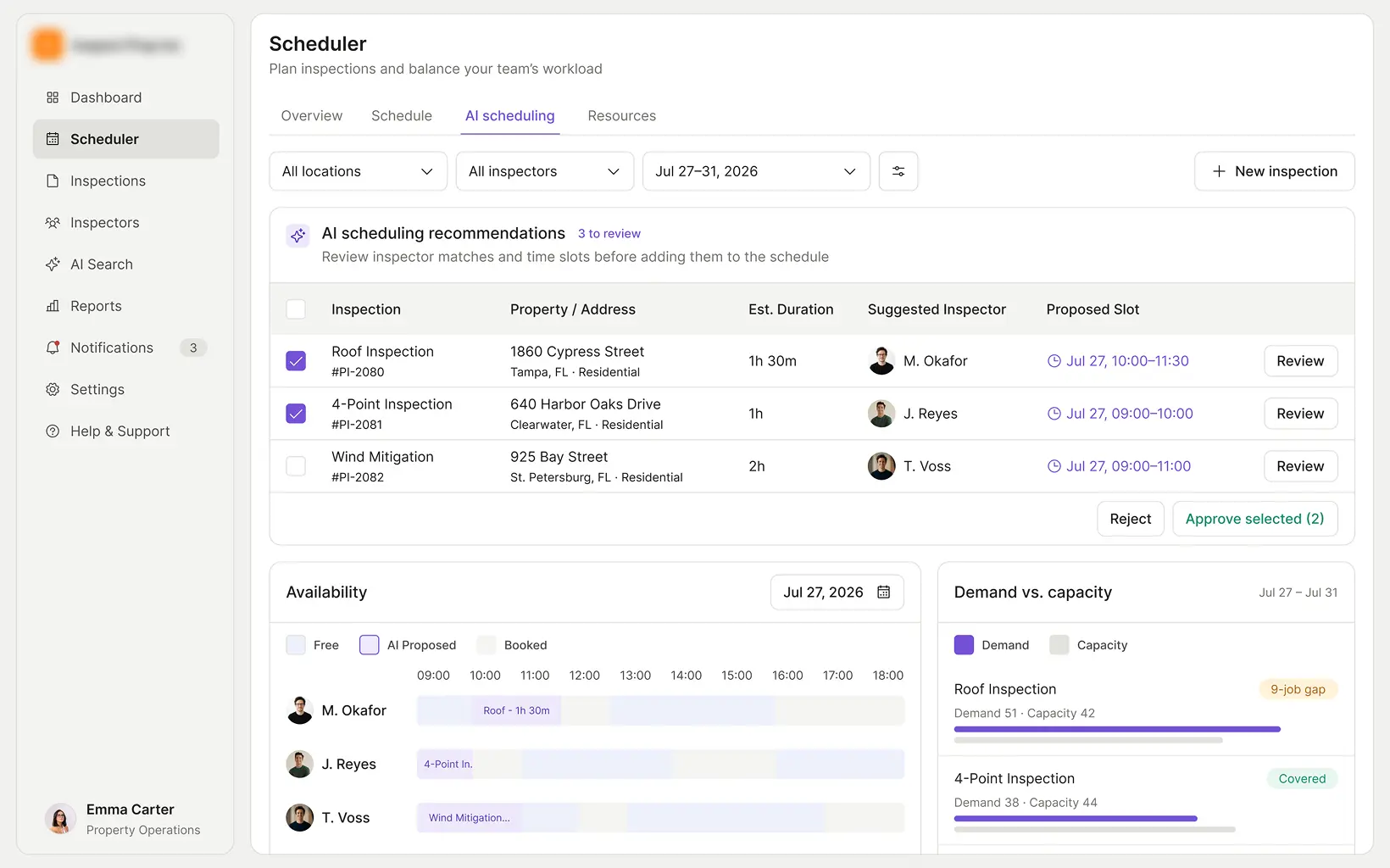
The AI-powered scheduling capabilities use historical inspection data to help administrators make more informed planning decisions. By considering various factors, the system can provide recommendations that go beyond fixed duration assumptions and manual calendar comparisons. These outputs support decision-making while leaving final assignments and scheduling choices to administrators.
Inspection duration prediction
Estimates likely job duration using historical data, inspection type, location, property characteristics, and actual time spent.
Inspector recommendation system
Suggests suitable inspectors based on availability, workload patterns, geographic proximity, inspection-type specialization, and certifications.
Human-in-the-loop planning
Presents AI-generated estimates and recommendations for administrators to review, adjust, or override.
AI-Powered Visual Inspection and Report Summarization
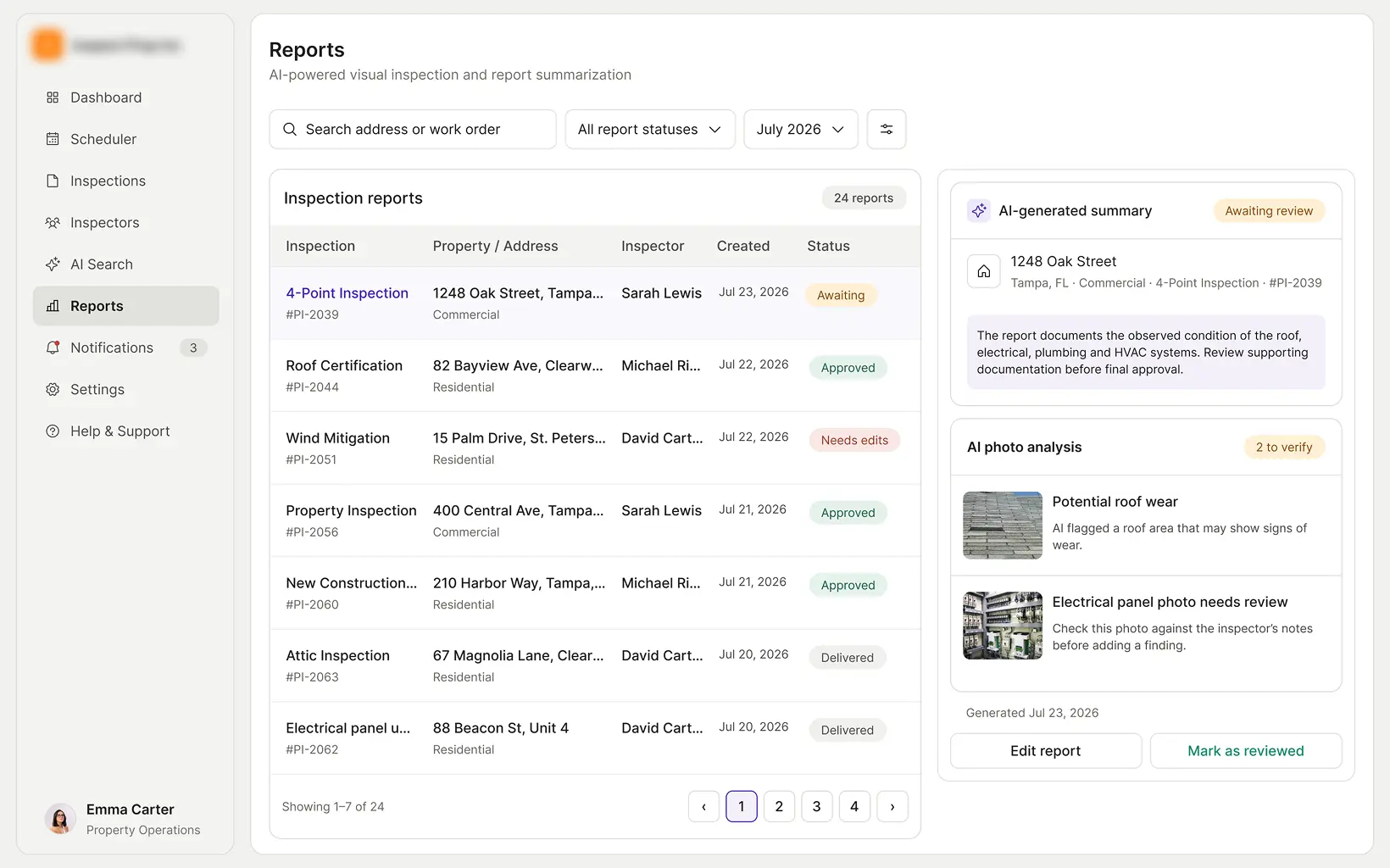
Inspection reports and photos contain important information, but reviewing and communicating their contents can require considerable manual effort. AI-based report processing and preliminary image analysis help teams work with this information more efficiently. The platform provides an AI-based visual inspection system that can flag potentially relevant conditions while keeping professional review in the loop.
Inspection report summarization
Extracts text from completed PDF reports and generates concise summaries highlighting key findings and inspection details for customer communication.
Computer vision inspection
Analyzes uploaded photos to flag potentially relevant visible conditions, such as roof wear, missing shingles, or cracked tiles.
Inspector review
Stores suggested findings for an inspector to confirm, correct, or reject before they affect reporting or customer communication.
Natural-Language Search Across Inspection Records
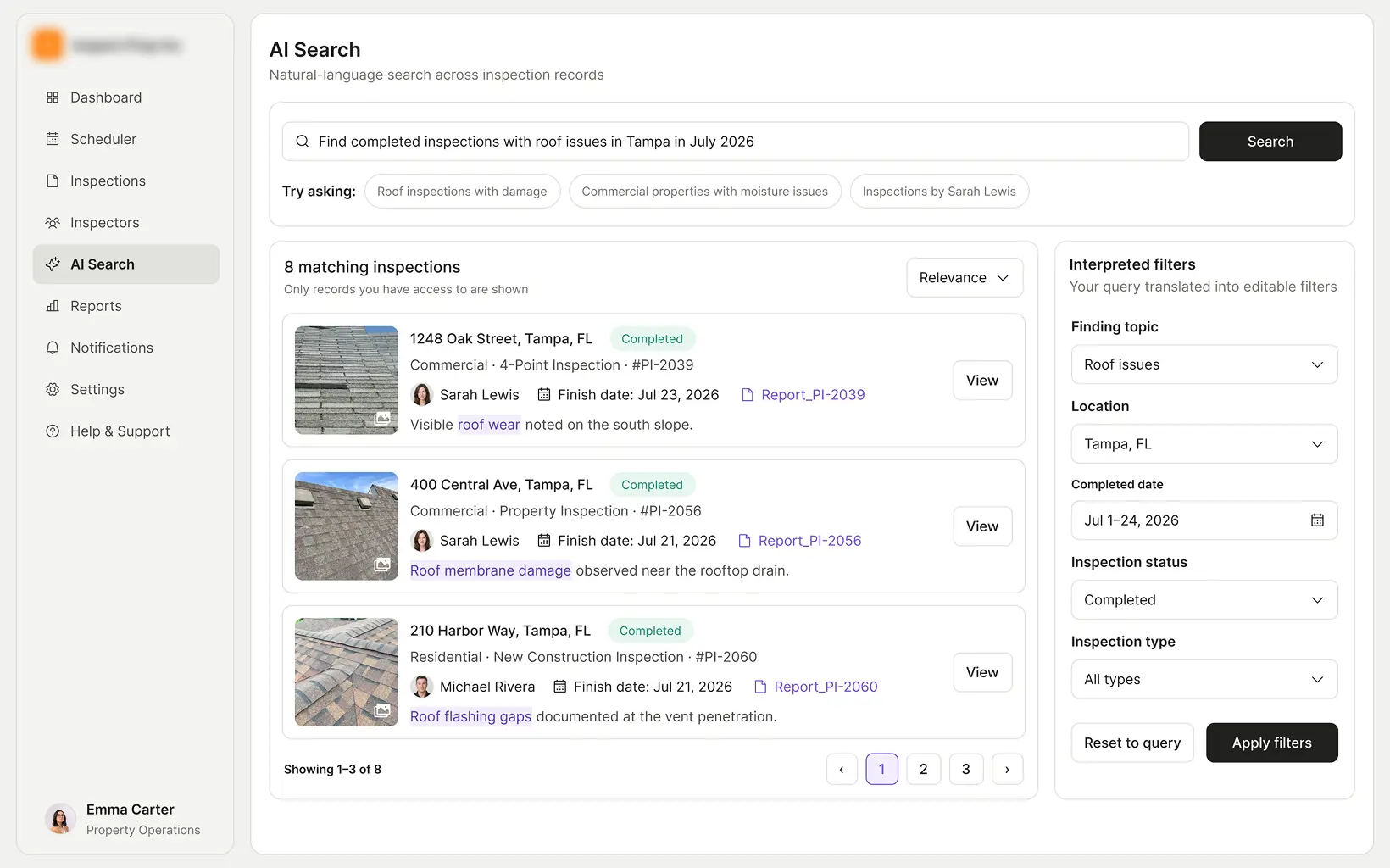
Finding relevant inspection records can become difficult as the volume of jobs and historical information grows. AI-powered search allows administrators to describe the information they need in natural language instead of manually combining multiple filters. This provides another way to retrieve records and investigate operational questions while preserving the existing access controls and supporting broader operational intelligence.
Natural-language queries
Administrators can describe the inspections they want to find using everyday language.
Semantic search and record retrieval
The search layer interprets requests and helps retrieve relevant inspection records or apply corresponding filters.
Permission-aware access
Existing role-based permissions continue to govern which records each user can access.
Tools and Technologies
This custom scheduling software combines a web-based inspection management application with integrated AI services. The core platform provides the reliable operational foundation required for scheduling, workflow automation, and record management, while the modular AI architecture extends the platform with AI visual inspection solutions and other data-driven capabilities as inspection data grows.
The backend uses Node.js and PostgreSQL to manage inspections, assignments, job locations, workflow rules, attachment metadata, permissions, and audit events. Server-side authorization ensures that inspectors can access only the inspections assigned to them. AI workflow automation handles status transitions, scheduling-overlap checks, and completion-email delivery.
Independent Python services, served through FastAPI, support the AI capabilities:
- XGBoost and scikit-learn: Inspection duration prediction and inspector recommendations;
- PyTorch: Machine-learning workloads, including demand forecasting and computer vision;
- Transformers and LangChain: AI-enabled report processing and language-based interactions;
- YOLO: Object detection for preliminary inspection photo analysis;
- FAISS: Retrieval across inspection records;
- Docker and MLflow: Service isolation, experiment tracking, and model versioning.
Keeping AI services separate from the core application allows models to be evaluated and updated independently while the inspection management workflows remain stable.
We also developed a progressive web app (PWA) for field inspectors to view assigned inspections, update job statuses, and upload property photos from their mobile devices while on site.
Interested in developing a similar solution or have your own idea in mind?
We are ready for any challenge, just contact us!
Result
XB Software delivered a centralized inspection management platform with a PWA for both desktop and mobile access, connecting office coordination with field operations.
- 20% less time spent on inspection assignments: Availability checks, overlap warnings, and AI-enabled inspector recommendations reduced manual effort in selecting inspectors and confirming assignments.
- 30% less time spent reviewing completed reports: AI-generated summaries helped staff identify key findings and prepare customer communications while keeping the original reports available for verification.
- Better-informed resource planning: Predicted inspection durations and demand forecasts supported workload allocation and staffing decisions.
- Mobile access for field teams: The PWA enabled inspectors to access the platform offline from their mobile devices.
- Human oversight maintained: Administrators retained control over assignments, while certified inspectors reviewed AI-suggested findings and approved professional conclusions.
Let’s Talk About Your Project
What's next?

Vitaly Hornik
COO at XB Software, Ph.D. in IT (Computer Science), PMP
We don’t just deliver projects — we build partnerships.
What's next?
Requirements
A sales manager will contact you to understand a vision.
01
Estimation
We provide a detailed plan, timeline, and cost estimate.
02
Agreement
We finalize the contract and begin working immediately.
03