Production Scheduling Software for Metal Fabrication
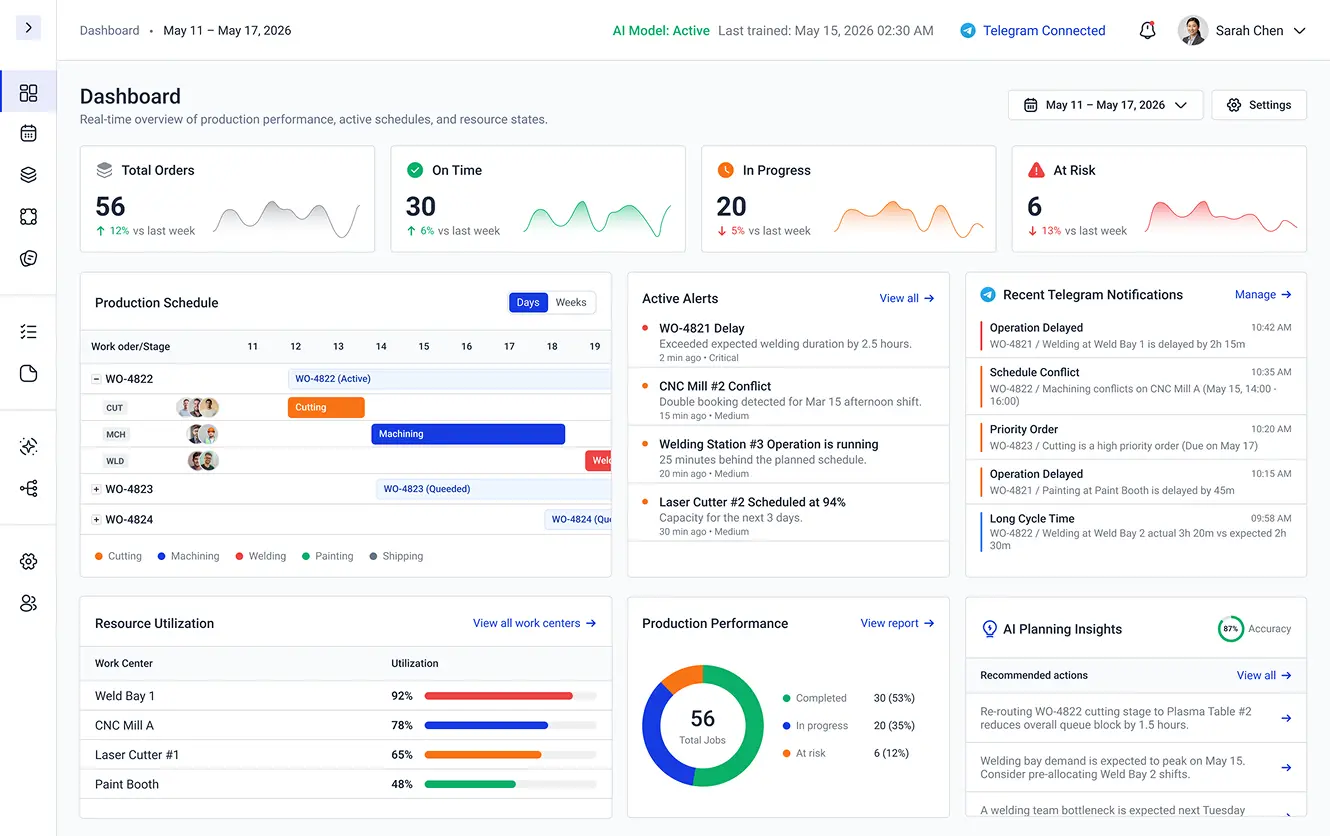
A custom production planning software for metal fabrication company to replace manual planning with a visual Gantt-based dispatching system, automate production workflows, and gradually introduce AI-powered scheduling optimization.
Business Challenge
A metal fabrication company with over 100 technicians and administrative staff producing custom steel structures relied on manual production planning using whiteboards, spreadsheets, and paper notes. Critical scheduling information existed mainly in the production manager’s head, making daily operations difficult to coordinate and limiting production scalability.
As the number of simultaneous projects increased, scheduling conflicts, resource bottlenecks, and communication delays became increasingly common. The company needed a centralized scheduling software for the steel fabrication shop floor that both office staff and shop-floor workers could use without extensive training while preserving the flexibility required for custom manufacturing.
Disconnected production planning
Production schedules were maintained separately by managers and workshop supervisors, resulting in inconsistent information and limited visibility across departments.
Machine scheduling conflicts
Machine conflicts frequently occurred because multiple production orders were assigned to the same equipment during overlapping time periods.
Manual coordination bottleneck
The production manager became the primary coordination bottleneck since most operational decisions depended on manual intervention.
Limited delivery forecast accuracy
Sales managers could not provide reliable delivery estimates because production progress and resource availability were difficult to track in real time.
Project in Facts
Industry
Manufacturing / Metal Fabrication
Region
Europe
Business
Medium-sized
Services
Key technologies
Solution
XB Software developed a custom single-page production scheduling platform centered around an interactive Gantt chart. The solution combined visual production planning, automated shop floor scheduling rules, real-time status updates, and AI-based production optimization within a single application. Rule-based automation handled operational control from the first day, while AI capabilities were introduced later after sufficient production history became available.
The biggest challenge was translating years of production expertise into software that employees could trust from day one, while leaving room for AI tools to improve planning, workforce scheduling, and resource allocation as operational data accumulated.
Vitaly Hornik
COO at XB Software
Visual Manufacturing Scheduling Module with Gantt Chart
Automated Production Control & Intelligent Notifications
AI-Powered Production Scheduling Module
Visual Manufacturing Scheduling Module with Gantt Chart
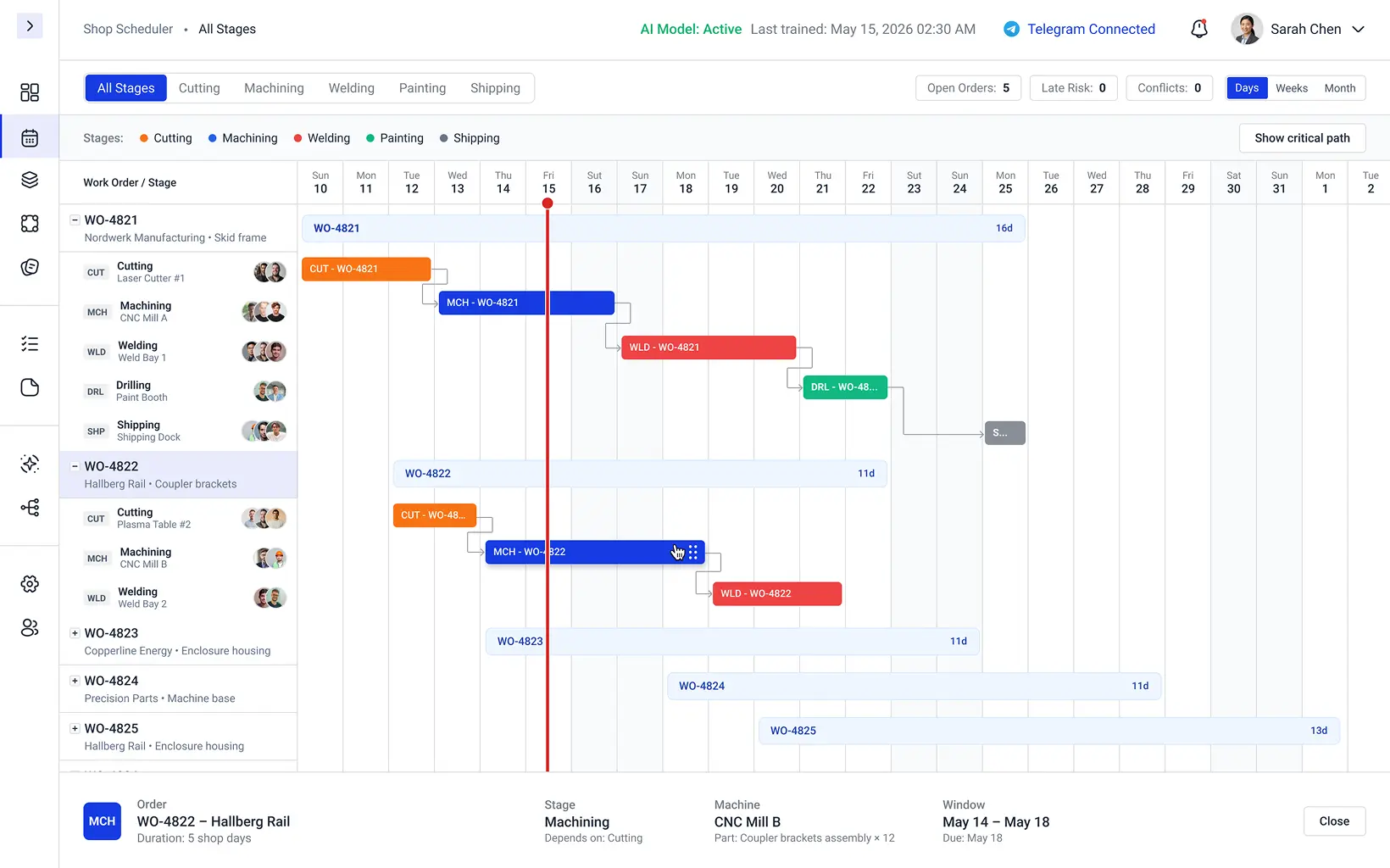
A customized Gantt-based production planner gave managers and workshop supervisors a shared, real-time view of every production order. Each customer order is represented as a parent task, while individual manufacturing stages (cutting, welding, machining, painting, shipping) are displayed as connected subtasks for bottlenecks identification and understanding of production dependencies before delays affect delivery commitments.
Multi-Stage Production Planning
Each manufacturing stage is automatically linked within the production workflow, allowing the system to visualize task dependencies and calculate the critical production path.
Resource Conflict Prevention
The planner validates machine availability before schedule changes are saved, preventing multiple production orders from being assigned to the same equipment simultaneously.
Familiar Production Interface
The interface was adapted to existing workshop terminology, color conventions, and daily workflows, allowing employees to begin using the system with minimal training.
Automated Production Control & Intelligent Notifications
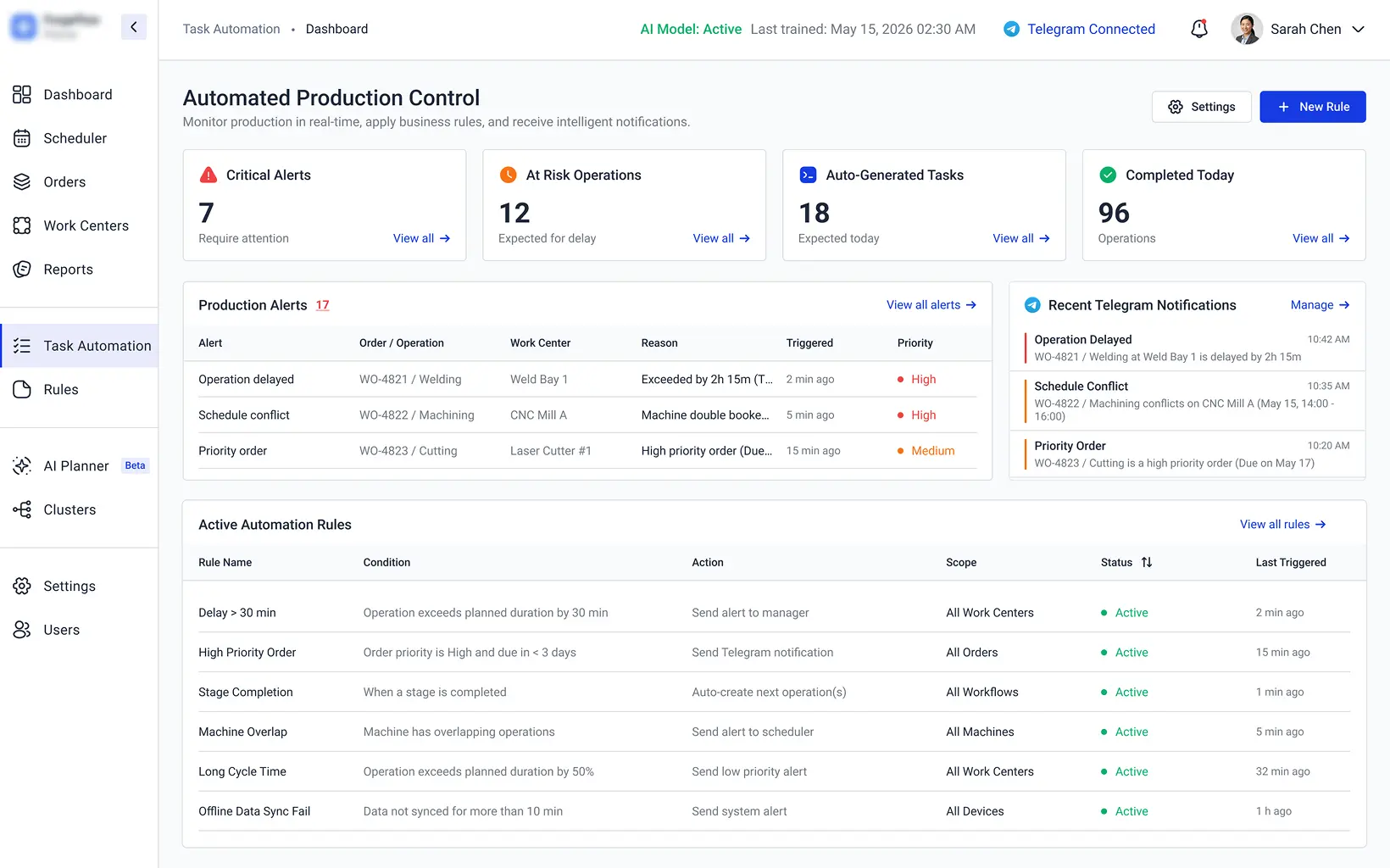
The platform supports automated shop floor scheduling by continuously monitoring production progress (duration, order priority, machine allocation, etc.) using configurable business rules. Instead of relying on supervisors to manually detect delays or scheduling conflicts, the system automatically evaluates production events and immediately alerts responsible employees when intervention is required.
Automatic Task Generation
When one production stage is completed, subsequent operations can be created automatically according to predefined manufacturing workflows.
Delay Monitoring
The platform continuously compares actual execution time with expected production durations and highlights operations that exceed configurable thresholds.
Telegram Notifications
Production managers receive instant Telegram notifications about schedule conflicts, delayed operations, and priority orders requiring immediate attention.
AI-Powered Production Scheduling Module
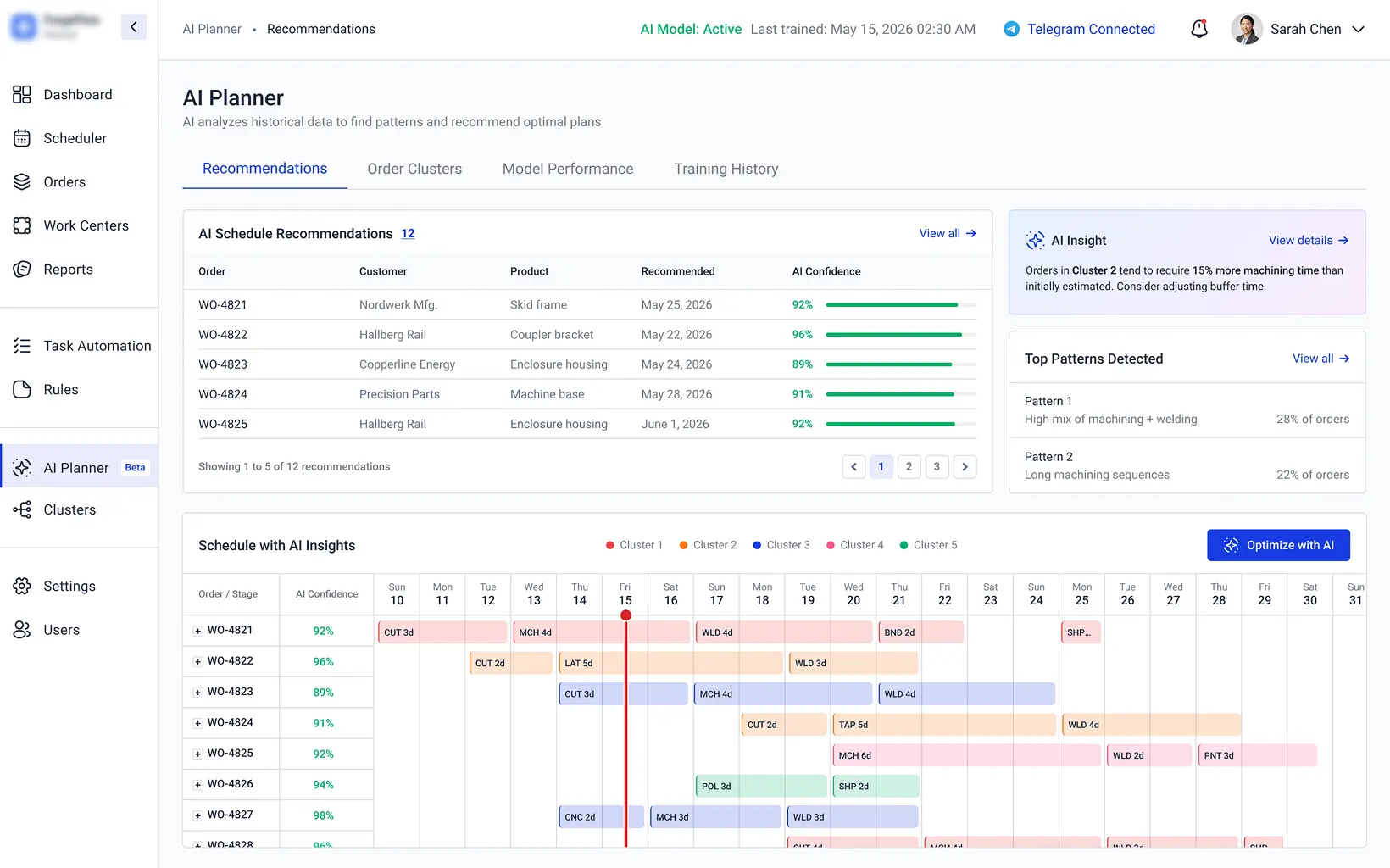
After several months, the platform had accumulated enough production history to begin applying machine learning techniques. As part of our custom AI software development services, we added the functionality of identifying recurring production patterns and recommended more realistic planning strategies for future orders without removing human control from the planning process.
Order Pattern Clustering
Machine learning automatically groups similar production orders based on manufacturing characteristics, allowing the system to recognize recurring workflow patterns.
Continuous Learning
The clustering model is periodically retrained using newly completed production orders, allowing recommendations to become increasingly accurate over time.
Visual Production Insights
Orders belonging to different production clusters are visually distinguished inside the scheduling interface, helping managers to quickly identify manufacturing characteristics and expected workflow behavior.
Tools and Technologies
Manufacturing environments require scheduling systems capable of handling frequent production changes while remaining easy for shop-floor employees to use. The manufacturing operations software solution XB Software developed therefore combines a highly interactive frontend with a scalable backend architecture and a modular AI component that could be introduced without disrupting daily operations.
The scheduling interface was built around DHTMLX, allowing us to implement complex production timelines, task dependencies, drag-and-drop scheduling, and real-time visualization without building these capabilities from scratch. Extensive customization aligned the interface with the client’s existing production terminology, color coding, and operational processes, significantly reducing user training requirements.
The backend was implemented with Node.js and PostgreSQL, providing a centralized environment for production planning, scheduling rules, resource allocation, and real-time synchronization between office staff and workshop personnel.
Rule-based automation was implemented directly within the backend, where configurable business logic continuously evaluates production events, detects scheduling conflicts, generates follow-up tasks, and triggers operational notifications.
Once sufficient production history became available, an independent Python microservice based on scikit-learn was introduced to perform monthly clustering of completed manufacturing orders. Keeping the AI module separate from the core scheduling engine allowed machine learning capabilities to evolve independently while maintaining stability of the production system.
Telegram Bot API was integrated to deliver operational alerts directly to managers, reducing response time when production issues occurred.


Interested in developing a similar solution or have your own idea in mind?
We are ready for any challenge, just contact us!
Result
The custom production scheduling software centralized planning for managers and workshop staff, boosting transparency, automating problem detection, and clarifying resource utilization and timelines. The AI manufacturing scheduling platform continues to scale as new production lines and manufacturing processes are added.
- Reduced production delays: Automated manufacturing production scheduling rules and better production visibility reduced overdue manufacturing orders by approximately 30% during the first six months.
- Higher shop floor throughput: Improved workload balancing increased production capacity by around 10% without expanding the workforce, followed by an additional 4% after introducing AI-driven planning.
- Faster response to operational issues: Real-time notifications reduced reaction time to production disruptions from several hours to approximately 10-15 minutes.
- More accurate delivery forecasts: AI-powered order clustering increased delivery date prediction accuracy for recurring production scenarios from 65% to 89%, allowing managers to provide customers with more reliable schedules.
Let’s Talk About Your Project
What's next?

Vitaly Hornik
COO at XB Software, Ph.D. in IT (Computer Science), PMP
We don’t just deliver projects — we build partnerships.
What's next?
Requirements
A sales manager will contact you to understand a vision.
01
Estimation
We provide a detailed plan, timeline, and cost estimate.
02
Agreement
We finalize the contract and begin working immediately.
03