Summary
While data encryption is standard, the real risk in healthcare systems comes from uncontrolled data flows and fragmented workflows. This article details four architectural solutions — from isolated infrastructure to real-time data capture — that keep sensitive data in controlled environments to reduce human error and prevent breaches.
Modern clinical systems generate and process vast amounts of sensitive information (documents, transcripts, lab results, and records), which makes data security and protection one of the biggest priorities in modern healthcare software development. But as data volume grows, control over it weakens.
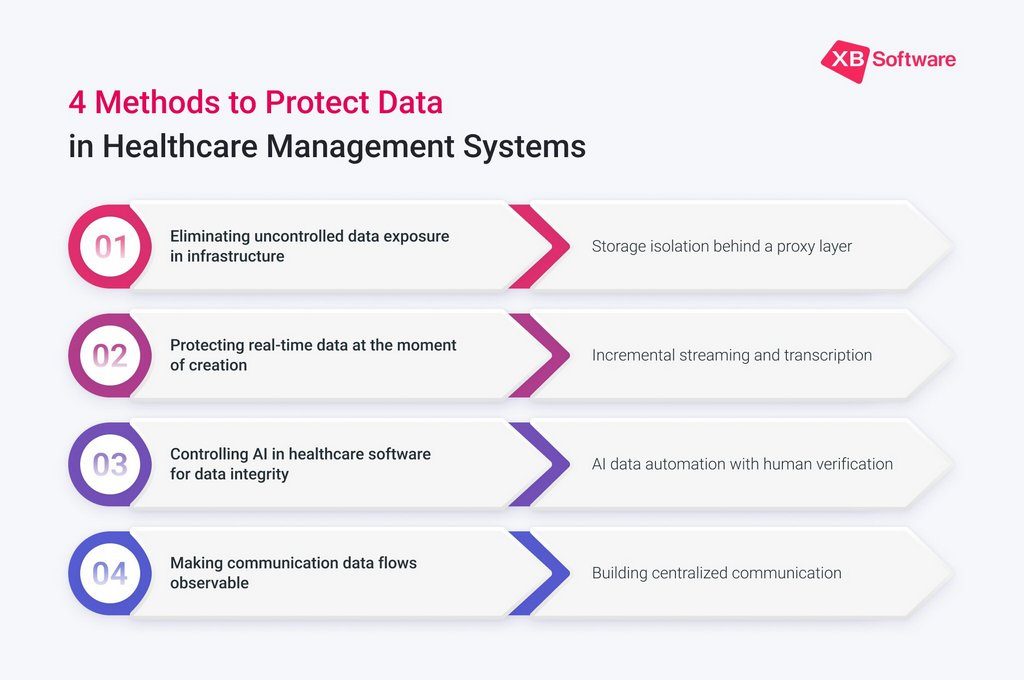
Missing encryption or misconfigured roles do bring issues, but most real-world risks emerge from data leaving controlled environments. That is why it is vital to understand how to design a clinical platform where data security is enforced at the architectural level. Here’s what we do to control data access, processing, and movement across the system.
Where Healthcare Data Protection Actually Breaks
Many healthcare IT security problems appear because workflow security becomes fragmented across multiple systems. Data leaks come from everyday system behavior: document is shared via a temporary link, transcription is processed hours after the consultation, an email is sent from an external account.
Each of these actions seems harmless in isolation. At scale, they form a pattern: data is moving without control.
Because of that, systems accumulate integrations, third-party services, temporary storage layers, external communication channels, and asynchronous workflows. As a result, sensitive information starts crossing multiple environments where visibility and control become fragmented. For example:
- patient files may temporarily exist in external storage during uploads;
- AI transcription services may process recordings outside the core infrastructure;
- lab results may pass through email notifications or third-party integrations;
- support teams may access records through poorly segmented admin panels;
- exported reports may remain downloadable long after they were needed.
Individually, none of these workflows necessarily looks dangerous. But together, they create dozens of uncontrolled data movement points and other healthcare data security challenges across the platform. That is why modern healthcare software security requires architectural decisions that minimize unnecessary data exposure from the start.
Read Also Safer AI Use in Mental Health Apps
Solution #1. Eliminating Uncontrolled Data Exposure in Infrastructure
One of the first things we look at in healthcare software development projects is where the system loses control over the encrypted data. A widely used pattern is to store documents in object storage and distribute them via pre-signed URLs. While convenient, this approach effectively bypasses application-level control once the link is generated. The link can be forwarded or accessed outside the intended workflow, often without a reliable audit trail.
We faced exactly this issue while working on a healthcare platform that processed clinical documentation, consultation records, and patient-related files across multiple user roles and departments. For a clinical system, that creates unnecessary exposure risks.
That is why we rejected this model entirely.
All storage was isolated inside an AWS Virtual Private Cloud (VPC), with no direct public access, supporting a more secure healthcare cloud solution architecture. Instead of exposing files, XB Software introduced a proxy layer based on Nginx that acts as the only gateway between users and storage.
When a document is requested, the system validates user identity and permissions before the proxy retrieves and streams the file internally. The document is not exposed publicly and all access goes through the application layer with full auditability.
For healthcare systems, this provides several important advantages:
- centralized access control,
- full auditability,
- reduced risk of accidental exposure,
- easier compliance support,
- and stronger control over sensitive workflows.
This changed the security model fundamentally: access is no longer something that can be shared, it must be verified every time. This approach also simplified role-based access control in the healthcare platform and improved support for HIPAA-compliant software requirements.
Read Also From Paper to Platform: How Pain Clinics Can Seamlessly Transition to EMR
Solution #2. Protecting Real-Time Data at the Moment of Creation
During one of our projects for a US-based healthcare organization focused on behavioral health services, we encountered a problem that is surprisingly common in clinical platforms: sensitive data was technically “secured,” but the transcription workflow itself still introduced risks.
How it works: audio is recorded, uploaded, processed, and reviewed later. This delay introduces a critical problem — data becomes dependent on human memory.
The client’s specialists conducted long remote consultations and therapy sessions that had to be documented in the system afterwards. On the surface, everything worked. But operationally, the process created several weak points. Medical professionals often had to verify transcripts hours after the consultation ended. Important context was partially lost, and documentation quality became inconsistent under heavy workloads.
Here’s what we suggested.
Instead of optimizing the existing delayed-processing pipeline, XB Software introduced real-time data streaming. Audio is streamed in real time using WebRTC, maintaining a persistent connection throughout the consultation. Transcription is processed incrementally, with results appearing immediately in the interface.
Real-time transcription in healthcare systems reduces delays between consultation and documentation, improving both accuracy and healthcare workflow security. According to a study from the National Library of Medicine, the usage of AI-powered Voice-to-text Technology (AIVT) alleviates the burden of documentation faced by healthcare professionals during medical consultations.
For the client, real-time transcription improved more than just system performance. It helped to:
- reduce documentation errors,
- improve consistency of clinical records,
- decrease administrative overhead,
- simplify verification workflows for specialists,
- and strengthen healthcare data security and overall control over sensitive patient information.
Most importantly, it changed how data reliability was approached inside the healthcare management platform. Instead of relying on people to reconstruct context later, the system captures and validates information at the moment it is created — when accuracy is naturally at its highest.
Solution #3. Controlling AI in Healthcare Software for Data Integrity
During another healthcare software development project, we worked with a platform that processed large volumes of medical documents, lab reports, and clinical forms coming from different providers and external systems. The client wanted to accelerate data extraction using Optical Character Recognition (OCR) and AI-powered automation, but there was one major concern: in healthcare, incorrect data is often more dangerous than missing data.
Automated extraction tools based on OCR and AI promise efficiency, but in practice they struggle with real-world variability: non-standard formats, incomplete tables, handwritten notes, and inconsistent document structures. The biggest problem is that these systems rarely fail loudly. Instead, they generate outputs that look correct while silently introducing inaccuracies into the workflow.
For healthcare organizations, this creates a serious operational challenge because small data inconsistencies can eventually affect reporting, workflows, clinical decisions, or compliance processes.
The client wanted to improve efficiency using AI-powered healthcare software and OCR without sacrificing data integrity. Instead of fully automating critical data extraction, we designed a more controlled AI-assisted healthcare workflow where automation accelerates processing without replacing human verification.
Documents are rendered locally in the browser using PDF.js, avoiding unnecessary exposure to external services and reducing the movement of sensitive files outside the controlled environment. When structured data needs to be captured, users interact directly with the document itself, selecting and mapping values into predefined fields inside the platform.
For the client, this approach provided several practical advantages:
- reduced risk of incorrect AI-generated records,
- improved trust in extracted clinical data,
- stronger auditability,
- more transparent workflows for specialists,
- and better data security and control over compliance-sensitive information.
Instead of treating AI as an autonomous decision-maker, we constrained it inside a controlled healthcare workflow where speed improves, but data integrity remains fully manageable.
Read Also General-Purpose AI vs. Medical AI: A Practical Guide for HealthTech Businesses
Solution #4. Making Communication Data Flows Observable
During a project for a Canadian healthcare service provider managing patient communication and clinical coordination workflows, we discovered that one of the biggest security risks was not infrastructure itself, but everyday communication processes happening around the platform.
Emails are sent from personal accounts, external tools are used inconsistently, and patient-doctor interaction history becomes fragmented. In such environments, even a simple mistake like entering the wrong recipient address can lead to a breach.
Instead of trying to “lock down” it completely, we focused on making all communication flows centralized, observable, and traceable.
All emails are sent through a controlled SMTP layer, tied to the clinic’s domain and user identity. This ensures that every message becomes part of a unified and auditable history. Sensitive credentials are handled through a secure vaulting mechanism using AWS Lambda, preventing exposure in application code or storage.
For the client, this architecture improved several critical areas:
- stronger auditability of workflows,
- less issues with uncontrolled external messaging,
- centralized history,
- improved compliance support,
- and better operational visibility across the organization.
The platform became a more secure healthcare communication system for patient-related workflows.
At the same time, it is important to recognize the limits of this approach. Entering an incorrect email address is still possible — no system can fully eliminate human error at this level. What changes is not the existence of risk, but its visibility. Every action is logged. Every message is traceable. Communication no longer happens outside the system’s control.
Read Also How Patient Identification Supports Reliable Clinical Workflows
Conclusion: Secure Healthcare Software Development Starts with Architecture
In healthcare, data protection is a part of the responsibility that comes with handling sensitive patient information. At the same time, it is important to be realistic: there is no such thing as a 100% secure system. Risks cannot be eliminated entirely. What can be done, however, is to significantly reduce them.
As a custom healthcare software development company, we help businesses modernize healthcare workflows while reducing operational and data exposure risks. So, if you need a secure healthcare management software solution, contact us, and we will develop the system that fits your criteria.