Summary
This article argues that software architecture should be treated as a critical business decision during project scoping, not delegated as a technical afterthought. It demonstrates how foundational architectural choices directly determine long-term costs, agility, risk, and strategic capabilities. By integrating architecture into initial planning, business leaders can ensure their technical investment is aligned with core objectives and built for sustainable growth
Often, software architecture is relegated to a technical implementation detail, discussed long after business goals and project scope are decided. This disconnect is a root cause of cost overruns, delayed launches, and rigid systems that cannot adapt. Treating software architecture as a core business decision during initial scoping enables building systems that deliver sustained value.
In this article, we explore why architecture directly dictates business outcomes, how it locks in future capabilities, and why it forces critical conversations about quality and cost. This guide is essential for founders, product leaders, and decision-makers who need to align their technical investments with long-term strategic goals.
How Software Architecture Directly Shapes Business Outcomes
Software architecture is a foundational business decision. The architectural blueprint chosen at the outset directly determines your product’s agility, cost profile, and resilience.
Time-to-Market & Agility. The choice between architectural styles (e.g., modular microservices versus a monolith) dictates how quickly the development team can build, modify, and release new features. A poorly chosen architecture creates technical bottlenecks that slow development to a crawl, hindering your ability to respond to market changes for years. A business strategy that prioritizes speed and adaptability requires an architecture designed to enable it.
Cost of Ownership. Initial architectural decisions have a profound impact on long-term financial outlays. These include costs for ongoing development, scaling the system, maintenance, and hosting. For instance, an architecture that cannot scale efficiently will lead to unpredictable cloud infrastructure bills or necessitate a costly and disruptive full rewrite. Investing in thoughtful design upfront controls your total cost of ownership.
Risk Mitigation. Architecture fundamentally defines your system’s reliability, security, and compliance posture. Treating it as an afterthought exposes the business to operational downtime, data breaches, and regulatory fines. These are direct threats to revenue, reputation, and legal standing.
Architecture Can Lock in or Enable Future Capabilities
Your software architecture determines what you can build today and what you can feasibly achieve tomorrow. It is a primary enabler (or constraint) of your long-term strategic vision.
The architectural foundation you select dictates your future business capabilities. Whether your roadmap includes integrating advanced AI, handling exponential user growth, or seamlessly partnering with other platforms, your architecture must be designed to support these evolutionary paths. Attempting to retrofit these capabilities later is a complex and expensive endeavor. Choosing a specific vendor’s platform-as-a-service can accelerate initial development, but can lead to technical and operational lock-in.
Key Architecture Decisions That Shape Teams, Budgets, and Scale
Scoping a project without architecture asks only, “What should the system do?” Integrating architecture into the scope leads to explicit discussions about Quality Attributes, which are not mere “technical details”. They are business-critical constraints and potential market differentiators:
- Scalability. How many users must we support initially? What is the anticipated growth trajectory?
- Performance. What are the acceptable response times for key operations? Slow performance directly impacts user retention and revenue;
- Reliability & Availability. Is 99.9% (approximately 9 hours of downtime/year) sufficient, or do we need 99.99% (less than 1 hour/year)? What is the financial cost of downtime?
- Security & Compliance: What data must be protected, and under which regulations (e.g., GDPR, HIPAA)?
These Non-Functional Requirements (NFRs) define the user experience and dictate long-term operational costs. They are the “what” (the business goals and constraints), and the software architecture is the “how” (the concrete schemas, structural decisions, and technological commitments that translate those requirements into a viable system).
Treating architecture as a core business decision means making these concrete choices explicit during scoping. It moves the conversation from vague aspirations (“it needs to be fast and secure”) to business-aware technical commitments.
Architecture as Concrete, Business-Critical Choices Beyond NFRs
Moving from defining what the system must achieve (NFRs), we arrive at the concrete how. The foundational architectural choices that turn requirements into reality are high-impact decisions that lock in your strategic direction and resource allocation for years to come.
1. System Decomposition: Monolith, Modules, or Microservices?
This is far more than a technical preference. This choice dictates:
- Autonomy. Can teams develop, test, and deploy independently?
- Scalability. Can you scale a high-demand feature without scaling the entire application?
- Hiring & Organizational Structure. Microservices typically necessitate and enable small, autonomous, cross-functional teams. A monolith may be better suited to a larger, centralized team structure. This is a direct application of Conway’s Law, the principle that your system’s design will inevitably mirror your organization’s communication structure. Therefore, this architectural decision is fundamentally a business one, with significant HR and budgeting implications.
2. Core Technology Stack & Vendor Lock-in
Selecting a platform, such as building on Kubernetes versus adopting a specific PaaS (e.g., AWS Amplify), involves a clear trade-off between control/portability and development speed/operational simplicity. This choice determines your long-term cost model, operational overhead, and flexibility to change vendors.
3. Data Strategy & Schema Design
The choice between database types (SQL vs. NoSQL for specific domains), data ownership in services, and even high-level data models directly impacts:
- Business Intelligence. What questions can you answer through reporting and analytics?
- Compliance. How will you handle data locality, residency, and regulations like GDPR?
- Adaptability. How easily can you pivot or add new features without a disruptive data migration?
4. Integration & Ecosystem Patterns
Deciding to be API-first, to employ an event-driven architecture, or synchronous API shapes your business’s potential for growth and partnership. It determines:
- Partner Integration. How easily can you connect with external services or partners?
- Internal Agility. How do different parts of your system communicate and react to change?
- Platform Potential. Can you expose capabilities to third-party developers to build an ecosystem?
The Scoping Artifact: The “Architectural Concept”
Given that architectural choices are fundamental business decisions, the output of the scoping phase must include more than a feature list and an NFR document. It should also include a lightweight, high-level Architectural Concept that captures:
- Key Structural Diagram. A simple block diagram showing the major system components, their responsibilities, and how they communicate;
- Key Technology Decisions & Rationale. Each significant choice is linked to a business or technical driver. For example: “We will use Azure SQL for core transactional data due to our enterprise agreement and team experience, and select Cosmos DB for the user activity feed for its scale-out capabilities.“
- Identified Critical Trade-offs. Explicit documentation of the strategic compromises made. For instance: “We chose a modular monolith over microservices to accelerate our MVP release, accepting that initial scaling will be vertical (adding more power to a single server) and team coordination overhead will be higher. We have a defined plan to refactor if concurrent users exceed 10,000.”
- Mapping to Core NFRs. A clear trace showing how the proposed structure and choices are designed to meet the stated non-functional goals.
In essence, NFRs define the problem space for the architects. The Architectural Concept is the proposed solution framework. Evaluating them together allows both business and technical leadership to commit to a viable, understood, and aligned path forward.
Read Also AI MVP vs Traditional MVP: Key Differences, Benefits & Use Cases
Why Treating Architecture as an Afterthought Fails
Treating architecture as an afterthought leads to one of two costly outcomes. This approach sacrifices long-term viability without achieving sustainable short-term gains, trapping the business in the worst of both worlds.
Death by a Thousand Cuts
Without a guiding architecture, teams make isolated, short-term “quick fix” decisions to meet immediate deadlines. Over time, these compromises accumulate, weaving a tangled web of dependencies. The result is an unmaintainable system. In this state, the cost and risk of implementing any new change become astronomical, crippling your team’s velocity and stifling business innovation.
Expensive, Disruptive Rewrites
When the patched-together system finally buckles under growth or changes, the business is forced into a corner. The only path forward becomes a catastrophic, all-or-nothing “ground-up” rewrite, instead of the planned, incremental evolution.
Read Also Iterative Development vs. Incremental Development: Spotting the Differences and Choosing the Best
The Questions That Should Shape Your Architecture
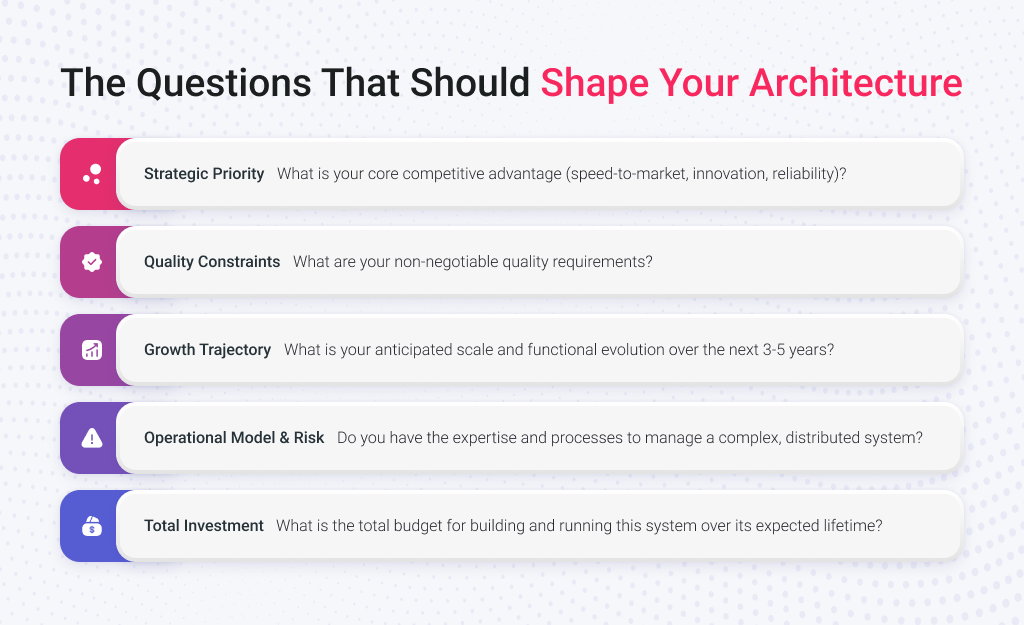
During scoping, business and technical leaders must collaborate to answer these critical, architecture-influencing questions:
- Strategic Priority. What is our core competitive advantage? Is it speed-to-market, relentless innovation, ironclad reliability, or minimal operational cost? The architecture must be designed to directly optimize for this primary objective;
- Quality Constraints. What are our non-negotiable quality requirements? Define measurable Non-Functional Requirements for performance, availability, and security that serve as benchmarks;
- Growth Trajectory. What is our anticipated scale and functional evolution over the next 3-5 years? The architecture must have the capacity to support this envisioned growth without requiring a fundamental rebuild;
- Operational Capability & Risk. What is our operational model and risk tolerance? Do we have the expertise and processes to manage a complex, distributed system?
- Total Investment. What is the total budget for building and running this system over its expected lifetime? This honest appraisal ensures architectural choices are balanced between upfront development and long-term operational costs.
Architecture as Your Business Blueprint
Thinking of software architecture as “foundational technical decisions” frames it correctly. It’s your project’s first major capital allocation. You are deciding where to pour the concrete for your digital business. Ignoring architecture in the scope allows these critical decisions to be made by default or convenience. Embracing it forces essential conversations about cost, risk, and strategic flexibility, transforming architecture from a hidden technical detail into a clear, reviewable business plan.
Ready to turn your business strategy into a resilient technical foundation? Contact us to discuss your project’s architectural blueprint.