Summary
This article analyzes the top application modernization companies in the USA based on modernization strategy, technical depth, risk management, and enterprise experience. It highlights the dominant modernization models and compares vendors by their real-world strengths rather than marketing claims. The key takeaway: successful modernization depends on partner alignment, not one-size-fits-all transformation.
Application modernization has shifted from a technical nice-to-have to a strategic business imperative. U.S. organizations are increasingly recognizing that outdated systems are a drag on growth, security, compliance, and customer experience. Research from ITPro shows that legacy systems are responsible for hundreds of millions in annual losses due to maintenance costs, technical debt, and failed transformation efforts, and that a majority of enterprises still depend on multiple legacy apps for daily operations.
But system upgrading does not mean simply rewriting everything from scratch. The smarter approach combines re-platforming, refactoring, and incremental evolution to preserve value while enabling scalability, agility, and compliance — exactly the kind of outcomes delivered by the top app modernization companies profiled in this analysis. It focuses on how companies modernize, not just what they claim.
How We Evaluated Application Modernization Companies
To identify the Top App Modernization Companies in the USA, we applied a structured evaluation framework focused on real upgrading capability. Application modernization is complex, high-risk work — especially for businesses running revenue-critical or regulated systems — so our criteria reflect what actually determines success in the field.
This analysis is based on public case studies, service focus, technical capabilities, and documented approaches of leading app modernization firms in the United States.
A key differentiator among leading app modernization companies is how they modernize. We prioritized companies that clearly understand that this process doesn’t equal rewrite.
High-scoring legacy application modernization companies demonstrate experience with:
- Incremental modernization instead of risky “big-bang” rewrites;
- Strangler pattern adoption to replace legacy modules gradually;
- Modularization of monoliths into scalable components;
- API-first refactoring to enable future integrations and platform growth.
This approach is critical for enterprises seeking application modernization services for enterprises without disrupting ongoing operations or customer-facing systems.
Read Also Big Bang vs. Gradual Data Migration? A Guide to Making the Best Choice
True USA app modernization experts must operate comfortably in both old and new worlds. We evaluated each company’s ability to modernize systems built on:
- Legacy stacks such as Java, .NET, PHP, and large monolithic architectures;
- Modern tech stacks, like React, TypeScript, JavaScript, Node.js, etc.;
- Enterprise databases and data-driven platforms;
- Front-end-heavy applications requiring UI and UX modernization.
On the modernization side, we assessed expertise in:
- Cloud migration for the U.S. market;
- Microservices architecture and containerization;
- UI revamping for complex, logic-dense applications.
This criterion separates general software vendors from specialized software modernization firms in the USA.
Application replatforming involves uncertainty by nature. We evaluated how companies manage that uncertainty through:
- Clear delivery models and phased execution;
- Predictable milestones and measurable outcomes;
- Experience modernizing mission-critical enterprise applications.
Companies that demonstrate structured risk management consistently outperform in long-term modernization programs, which is a key signal when identifying U.S. firms.
Not all modernization experience is equal. Considering this, we prioritized companies with proven results in:
- Regulated environments (finance, healthcare, energy, public sector);
- Data-intensive enterprise platforms;
- Long-lived systems supporting core business workflows.
This ensures the list reflects digital transformation experts, not just general digital agencies.
Finally, credibility matters. Therefore, every company included in this market analysis demonstrates:
- Publicly available case studies in software modernization;
- A clearly articulated methodology;
- Transparent service offerings and technical positioning.
This level of openness is critical when comparing vendors to identify partners capable of delivering custom software modernization solutions in the USA.
Top 11 Legacy App Modernization Companies in the USA (Analytical Rankings)
1. XB Software
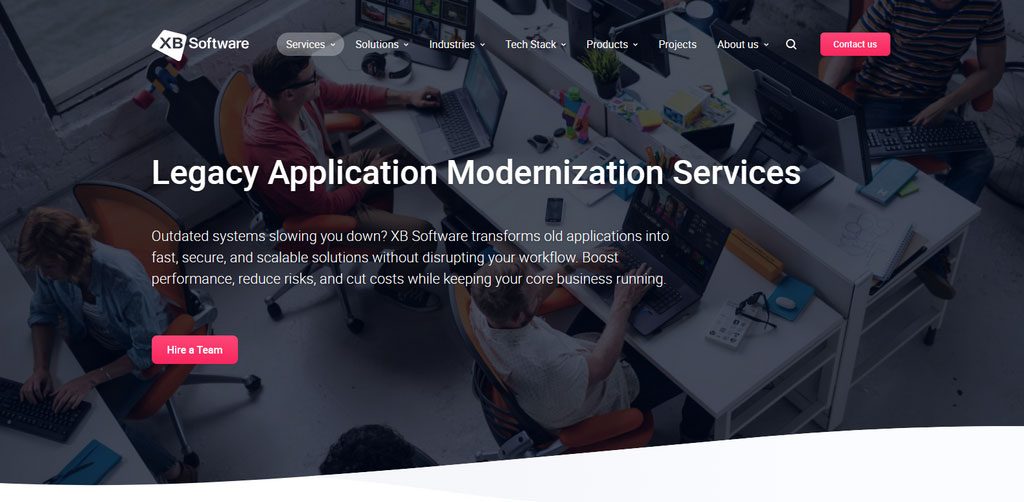
XB Software consistently appears in modernization projects where failure is not an option. The company’s focus is not on radical rewrites, but on incremental modernization of long-lifecycle systems with complex business logic. A strong emphasis on legacy UI modernization combined with backend stability makes the team a common choice for enterprises running mission-critical platforms.
Focus:
- UI modernization;
- Incremental refactoring and modularization;
- Frontend modernization for complex software systems;
- Long-running platforms in energy, healthcare, construction, and other data-heavy domains.
Best for:
- SMBs with complex, aging platforms;
- Organizations that cannot afford system downtime;
- Products that require gradual upgrading over multiple phases.
What differentiates company from others:
- Industry-Specific Software Modernization Services: Systems developed for specific operations and data;
- Accelerated Time-to-Value: Rapid UI development using proven frameworks and reusable components;
- Enhanced Usability: Interfaces tailored to real-world workflows, reducing training and support overhead;
- Scalable Architecture: Modular, API-driven backends built on Node.js for flexibility and growth;
- Future-Proof Design: Seamless integration with modern data layers and visualization tools.
Read Also Code Rewrite vs Code Refactoring. Choosing the Best Code Transformation Tactics
2. Appinventiv
Appinventiv operates at scale, often supporting enterprise-level digital transformation initiatives that combine modernization with product redesign and cloud migration.
Focus:
- Cloud migration;
- Mobile and web platform upgrading;
- Enterprise digital transformation initiatives.
Best for:
- Large organizations seeking end-to-end transformation;
- Companies combining modernization with new product launches.
3. TechMagic
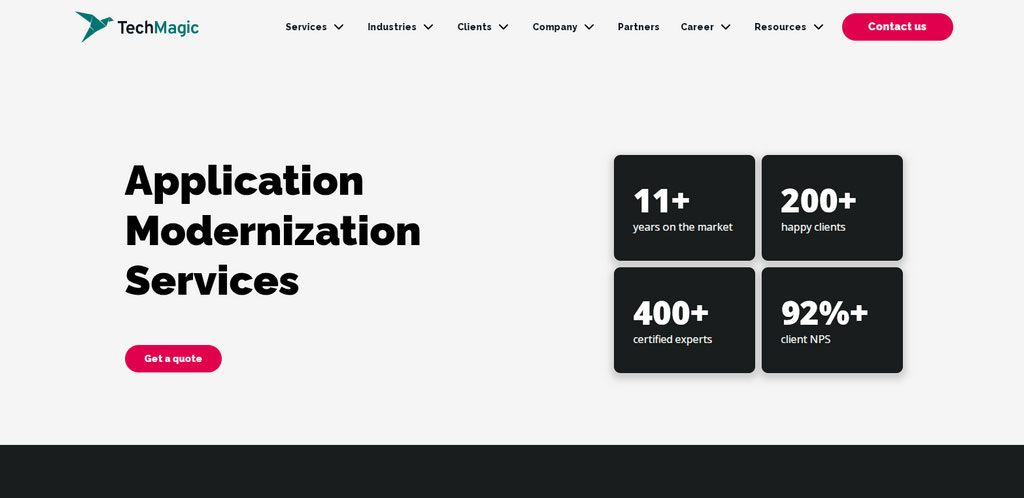
TechMagic approaches modernization from a product engineering perspective, often working with SaaS businesses that need to evolve their platforms without disrupting growth.
Focus:
- Backend refactoring and modularization;
- SaaS platform modernization;
- API-first architecture improvements.
Best for:
- Growing SaaS companies;
- Product teams modernizing while scaling.
4. CMARIX
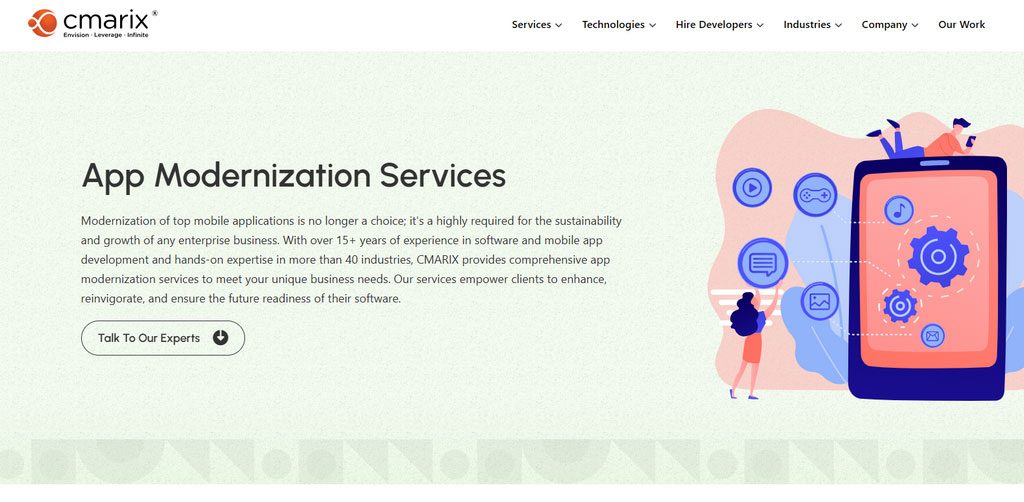
CMARIX offers modernization services across a wide range of technologies with a strong cost-efficiency angle, making them attractive for mid-sized businesses.
Focus:
- Legacy web and application modernization;
- PHP, .NET, Java-based systems;
- UI and backend upgrades.
Best for:
- Budget-conscious modernization projects;
- SMBs with older web platforms.
5. Sparity
Sparity focuses heavily on engineering rigor and system architecture, often working with enterprise-grade platforms that require careful refactoring rather than surface-level changes.
Focus:
- Backend refactoring;
- Platform engineering;
- Large system modernization.
Best for:
- Enterprises with deeply embedded legacy systems;
- Data- and process-driven platforms.
6. Narola Infotech
Narola Infotech provides accessible modernization services for companies looking to upgrade legacy systems without undertaking large transformation programs.
Focus:
- UI and backend modernization;
- Incremental upgrades;
- Web and mobile legacy systems.
Best for:
- SMBs modernizing step by step;
- Companies transitioning from outdated tech stack.
7. MindInventory
MindInventory combines modernization with mobile and web development expertise, often helping companies refresh customer-facing platforms.
Focus:
- UI-first modernization;
- Mobile app modernization;
- Cloud-ready refactoring.
Best for:
- Customer-facing products;
- Companies prioritizing UX improvements.
8. Zuci Systems
Zuci Systems often works with regulated and data-intensive systems, bringing strong analytics and governance awareness into modernization projects.
Focus:
- Enterprise application modernization;
- AI-ready data-driven systems;
- Regulated industry platforms.
Best for:
- Banking, Financial Services, and Insurance (BFSI) and regulated environments;
- Systems with complex data pipelines.
9. ManekTech
ManekTech provides broad system modernization services across industries, focusing on gradual system upgrades and UI refreshes.
Focus:
- Legacy web modernization with AI, IoT, and Blockchain;
- Backend refactoring;
- Cross-platform updates.
Best for:
- Companies with mixed legacy stacks;
- Multi-industry modernization needs.
10. Helpware Tech
Helpware Tech combines application modernization with operational and support services, making them relevant for companies modernizing while maintaining active systems.
Focus:
- Application modernization for Healthcare, Pharmaceutical, and FinTech businesses;
- Support-driven modernization;
- Process continuity.
Best for:
- Organizations needing legacy app cloud migration with ongoing support;
- Operationally sensitive environments.
11. iFour Technolab
iFour Technolab focuses on technical upgrades and refactoring, helping companies transition away from outdated frameworks and dependencies.
Focus:
- Legacy system upgrades with Azure modernization services;
- Containerization services;
- Backend refactoring.
Best for:
- Technically outdated platforms;
- Systems blocked by obsolete technologies.
Choosing the Right Partner: What This Comparison Reveals
This comparison highlights a critical reality of application modernization: there is no universally “best” modernization vendor. Each company on this list is optimized for a different type of system, risk profile, and business constraint. Choosing the right partner is less about reputation or scale and more about fit.
In practice, the decision depends on several interrelated factors:
- System criticality. If the application supports core operations, revenue flows, or regulatory processes, replatforming must prioritize stability and predictability over speed. Vendors experienced in incremental modernization are better suited for these environments than teams optimized for rapid transformation.
- Tolerance for downtime and disruption. Some organizations can afford temporary service interruptions or phased feature freezes. Others cannot. This tolerance level should directly influence whether a software development and modernization partner favors gradual refactoring, parallel system operation, or more aggressive architectural changes.
- Depth of legacy complexity. Many legacy systems carry undocumented logic, tightly coupled components, and business rules accumulated over years. Partners that underestimate this complexity often overpromise timelines and underestimate risk. A system strong modernization partner will explicitly plan for discovery, dependency mapping, and risk containment.
- Evolution vs. reinvention. Not every system needs to be re-architected. Some require interface modernization, performance improvements, or selective refactoring to extend their lifespan. Others genuinely need a new foundation. The right partner distinguishes between these cases instead of defaulting to a single modernization model.
- Internal readiness and ownership. Software modernization affects not just code, but teams, processes, and operational workflows. A mismatch between a vendor’s delivery style and a client’s internal maturity can derail even technically sound projects.
The most common failures come from choosing a misaligned vendor, not incompetent. When a partner’s philosophy conflicts with the reality of the system, organizations face unnecessary disruption, ballooning costs, or stalled initiatives.
Teams that evaluate modernization partners through this strategic lens — rather than feature lists or transformation promises — are far more likely to achieve controlled, sustainable, and low-risk modernization outcomes that actually support long-term business goals.
Read Also How to Redesign a UI Without Losing Usability: A Case Study on Modernizing a Legacy App
Final Thoughts: Modernization Is a Strategy, Not a Project
Application modernization is about reducing risk, preserving business continuity, and enabling long-term adaptability, not about just chasing new technology anymore. As this analysis shows, the strongest modernization companies are not defined by how aggressively they rewrite systems, but by how carefully they evolve them.
The right partner understands when to modernize incrementally, when to refactor deeply, and when transformation must happen quietly in the background. Organizations that approach modernization as a strategic, staged process — and choose partners aligned with their system reality — are far more likely to achieve sustainable results without costly disruptions.
So if you need a long-term partner that can ensure your brand new and shiny system grows and improves with your business, contact us. Our team of experts is here to help!
Frequently Asked Questions
Modernizing legacy systems reduces maintenance costs, improves performance and security, and makes it easier to introduce new features. It also helps businesses to extend the lifespan of critical software while aligning it with modern compliance, cloud, and integration requirements.
App modernization costs in the USA vary widely depending on system size, technical debt, industry regulations, and the chosen approach. Small modernization initiatives may start in the tens of thousands of dollars, while large enterprise programs can reach several hundred thousand or more, especially when done in phases.
In 2026-2030, modernization trends continue to favor incremental refactoring over full rewrites, UI-first modernization for faster ROI, cloud modernization with technical debt cleanup, AI-assisted system development and modernization, and increased focus on risk control, predictability, and long-term system evolution rather than rapid transformation.