Summary
AI inference costs often outpace proof-of-concept estimates once workloads scale. Learn how batching, caching, and model routing can restructure AI workloads, reduce projected spend without sacrificing output quality, and make production costs more predictable before rollout.
Deploying artificial intelligence within business software often begins with a proof of concept (PoC) that demonstrates useful functionality while leaving a critical question unanswered. Teams can see that an integration works on sample inputs, yet forecasting the expense of running that same workload at scale remains difficult. During delivery discussions at XB Software, centered around a financial-data integration featuring a JavaScript Microsoft Excel add-in and a custom API, that financial uncertainty prompted a deeper look into the underlying AI processing cost.
The team examined how the pipeline handled requests before the model saw them, not only which model was called. That review turned three architectural choices into the main cost levers: grouping work, reusing results, and matching model tier to task difficulty.
Why AI Inference Costs Increase
What developers see in rapid software prototyping rarely matches production reality. When a team builds an initial model integration, test scripts typically generate low request volume against sparse datasets. Under those conditions, computational overhead appears minor, and processing throughput seems adequate. As usage grows, the bill grows with it, and every unoptimized query adds tokens and GPU memory to the total. The problem is that the workload keeps paying for work it has already done or does not need to do at that tier.
Several factors drive up expenses in production environments:
- Handling inputs as isolated, monolithic operations ignores the efficiency gains of grouped execution;
- Redundant execution forces the system to recalculate identical queries repeatedly, inflating resource utilization;
- Assigning complex reasoning tasks to expensive frontier models when simpler tasks would suffice distorts the cost per completed task.
Without a deliberate strategy for AI workload optimization, organizations find that their AI cost at scale quickly outpaces initial budget projections.
AI Inference Cost Optimization: Rethinking the Workload
Controlling financial exposure in custom AI software development does not always require swapping a preferred model for a weaker alternative. Instead, sustainable LLM cost optimization starts by questioning how the workload is organized. Evaluating the execution pipeline reveals where repetitive computations occur, how requests are grouped, and whether model capabilities match the difficulty of incoming tasks.
The useful question is how the workload is arranged before it reaches the model. Three arrangements matter in practice: grouping requests so per-item overhead is paid once, reusing previous results instead of recalculating them, and sending simple tasks to cheaper tiers.
LLM Batching: Reducing the Overhead of Individual Requests
The first structural adjustment involves moving from single-item execution to grouped processing. Implementing LLM batching and AI batch processing allows the system to aggregate multiple items into a single execution block before sending them to the model provider. Providers price batch jobs lower than synchronous calls, typically at a discount, so the same tokens cost less when the work can wait.
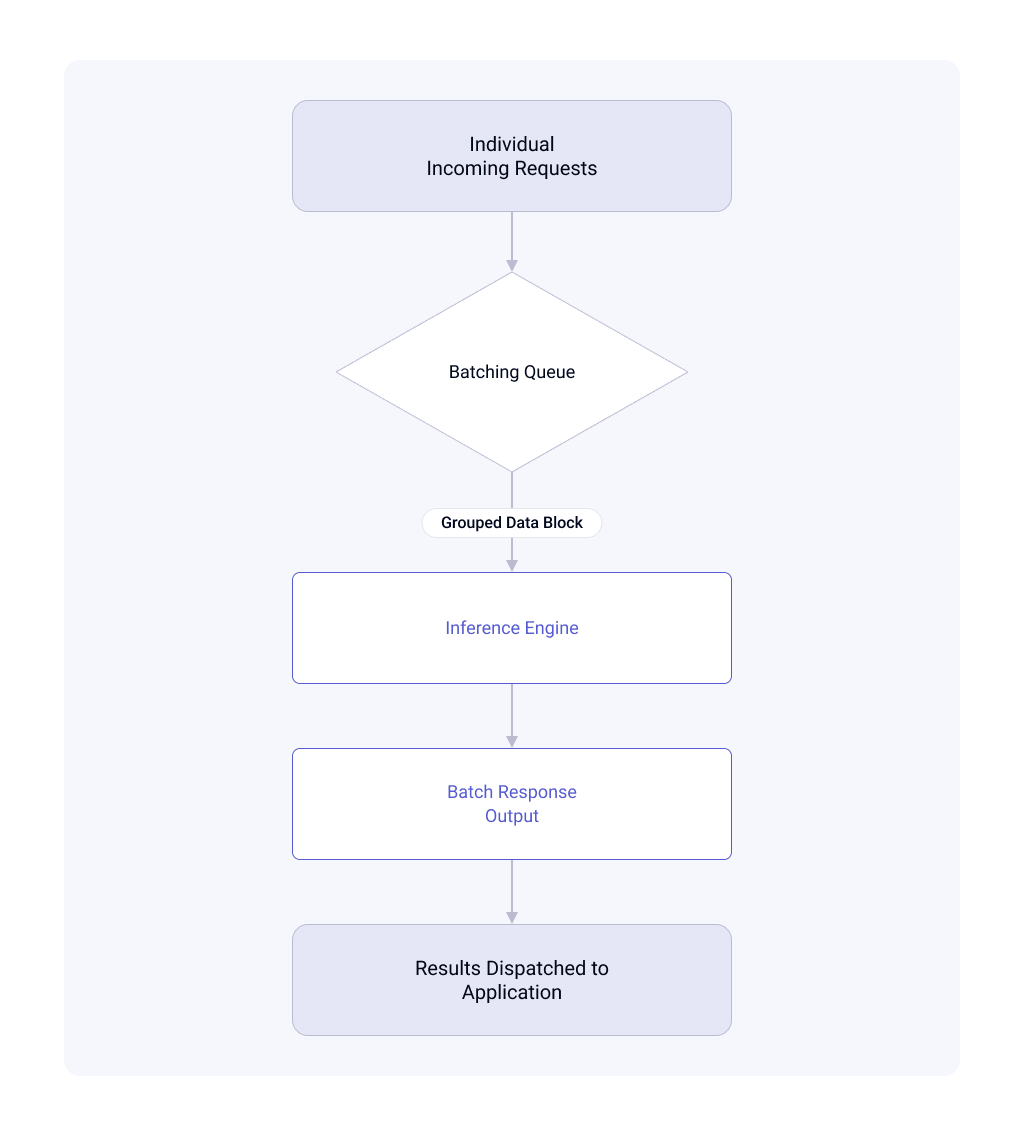
Despite its efficiency, batching introduces trade-offs regarding processing latency and execution granularity. Grouping requests means individual operations must wait for the batch window to close before transmission. Batch APIs return results item by item, so one malformed input does not sink the whole job.
The cost sits in reconciliation: you need to match returned results to their original inputs and decide which failed items are worth retrying. If that matching work is manual, it can eat the discount. Defining clear acceptance criteria for incomplete blocks ensures that recovered results remain correctly associated with their original inputs.
LLM Caching: Avoiding Repeated Computation
Repeated queries are the second avoidable cost. A cache returns a stored answer for an identical or sufficiently similar prompt instead of sending it to the model again. By implementing LLM response caching, systems bypass inference calls entirely for identical or semantically similar prompts, which helps cut operational expenditures.
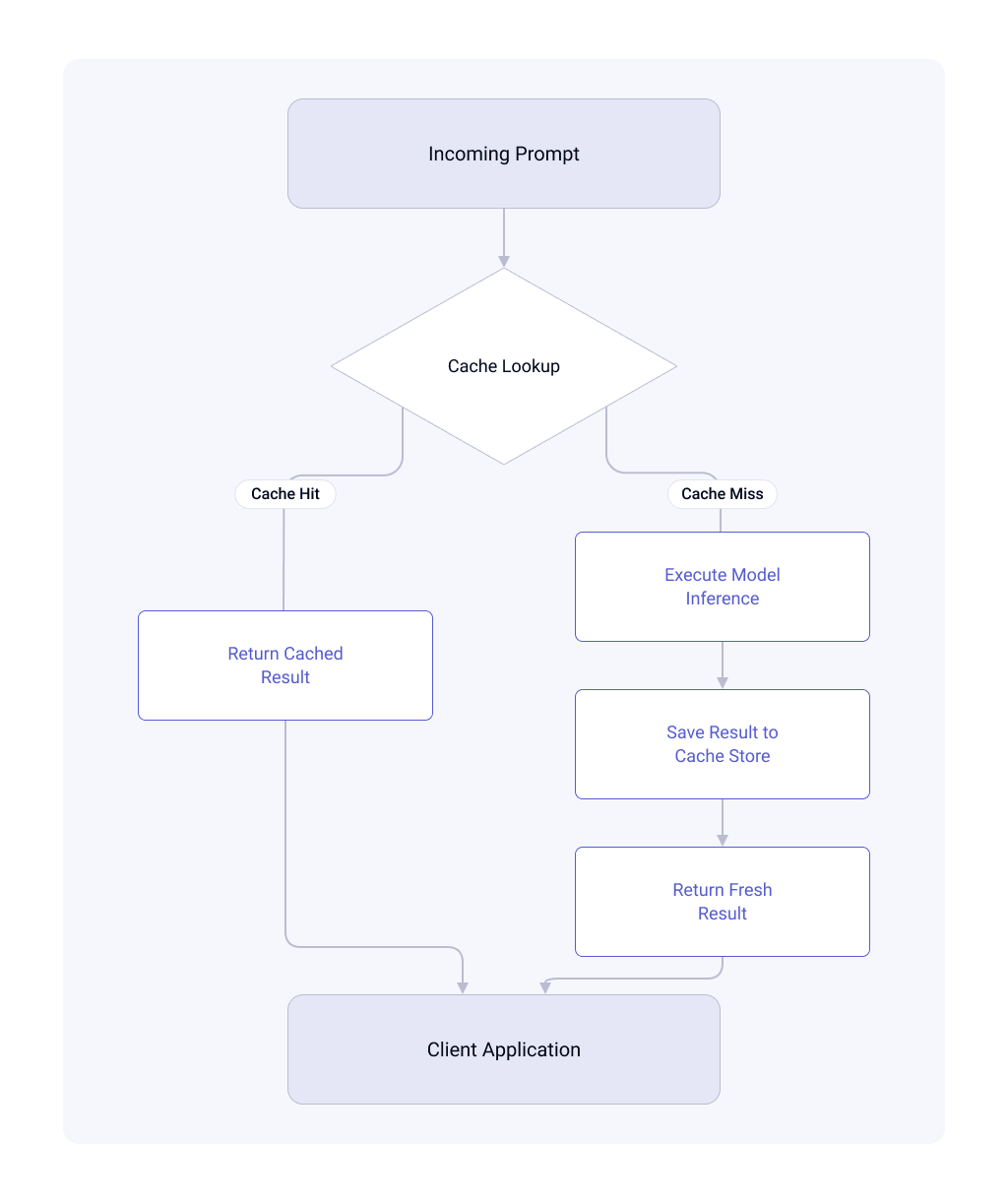
Effective reuse requires careful attention to data freshness and cache invalidation rules. A cached result depends heavily on underlying parameters; if input definitions or expected output schemas change, stale responses lead to logic errors. Maintaining a high cache hit rate demands ongoing architectural ownership. Teams must decide which calculations are safe to store and when context expiration should trigger recalculation.
AI Model Routing: Balancing Processing Cost and Output Quality
Routing sends each request to a model tier chosen for its difficulty. A classifier reads the prompt and assigns it to a cheap tier, a mid tier, or the frontier model. Implementing intelligent model routing ensures that simple classification or extraction tasks use lightweight models, while genuine edge cases escalate to capable frontier systems.
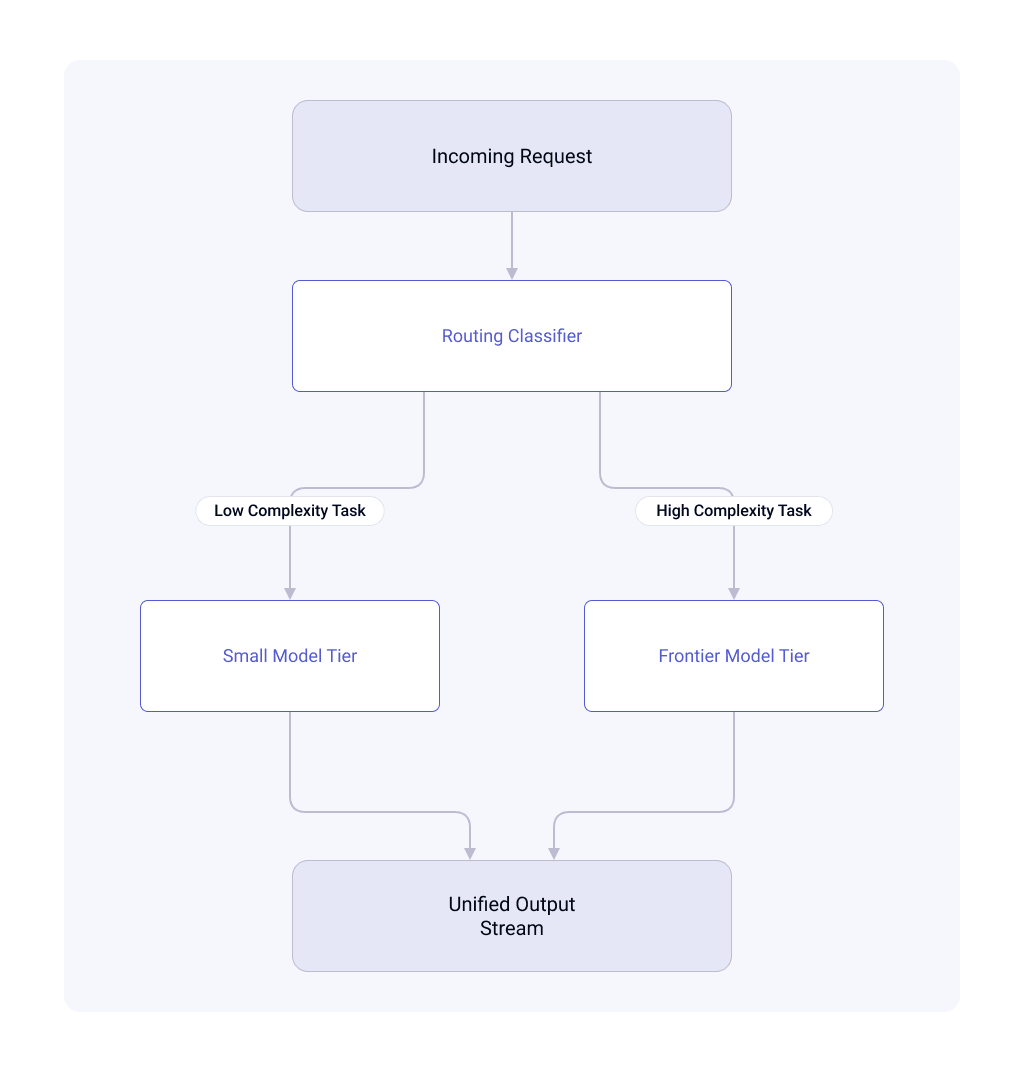
This strategy addresses the cost-quality trade-off directly. Designing an effective AI model routing architecture requires explicit quality requirements. Choosing a cheaper model first and defining acceptable output afterward reverses the correct engineering logic. A routing review needs a quality bar for each tier.
Pick the cheap tier for a task class, run a sample, and check whether the cheap model’s output clears that bar. If it does not, the task class belongs one tier up. The savings are only real if the review effort stays below the cost of sending everything to the frontier model. Through careful model routing cost optimization, teams capture significant financial gains without degrading overall performance.
How the Three Methods Compare
Each method addresses a different part of the cost problem, and they can be combined. The ranges below come from published provider pricing and reported production results. They are order-of-magnitude guides, not guarantees.
| Method | Main advantage | Main trade-off | Best place in the application | Approximate cost reduction* |
| Batching | Providers charge lower rates for asynchronous jobs; per-request overhead is paid once for the group. | Latency: results arrive later, and partial failures need reconciliation. | Tasks where no user is waiting: nightly classification, document extraction, bulk enrichment, report generation. | Around 50% off synchronous token rates at major providers. If combined with caching on static prefixes, the bill can fall to roughly 10% of the sync-uncached baseline for some workloads. |
| Caching | Identical or semantically similar requests skip inference entirely; repeated prefixes are billed at a discount. | Freshness: cached results must be invalidated when inputs or schemas change, and semantic caching needs a similarity threshold. | Anywhere the same prompt or the same prefix repeats: system prompts, tool definitions, policy context, common extraction templates, FAQ-style responses. | Prompt caching discounts stable input tokens by up to 90% on some providers and around 50% on others. Semantic caching handles 20-45% of traffic without a model call in reported deployments |
| Model routing | Cheap models handle easy tasks; the frontier model is reserved for hard cases, so average cost per task falls without a single-tier commitment. | Quality control: the router must classify difficulty correctly, and the cheap tier must clear the quality bar for each task class. | High-volume, mixed-difficulty endpoints: support triage, extraction pipelines, agent subtasks. | Reported reductions: 31% (RouteLLM) and 44% (FrugalGPT) |
* The savings figures are approximate. They reflect reported results available at the time of writing. Model prices, batch discounts, cache pricing, and routing benchmarks change often, so treat these ranges as a starting point for testing your own workload.
The ranges overlap because the methods overlap. A batch job that also hits a prompt cache pays less than either method alone, and a router that sends only hard cases to the frontier model changes the batch’s cost profile.
What Batching, Caching, and Model Routing Changed in the Cost Forecast
At XB Software, the initial forecast priced the financial-data integration as if every request would run synchronously against a frontier model. Grouping requests, reusing results, and sending simpler extraction steps to a lighter model brought the projection down. The team did not isolate which change contributed how much, so the revised figure is a combined estimate, not a measured production saving.

This combination highlights an important principle: the original estimate reflected decisions about how work was organized rather than the inherent difficulty of the AI task itself.
While the team reported positive results, the update did not isolate the exact contribution of batching versus caching or routing. Treating these architectural adjustments as a combined strategy avoids misleading claims about specific percentage reductions. Furthermore, forecast improvements must not be conflated with realized financial savings in production. The revised projections provided a concrete starting point for further engineering iterations, proving that examining processing decisions before scaling yields valuable clarity.
For a client facing a similar decision, the useful takeaway is to examine the assumptions behind the first estimate. That estimate may describe one way of organizing the workload rather than the only viable way to deliver the feature.
The next step is to test the revised design against representative inputs, required completion times, and agreed quality checks.
How to Validate AI Inference Cost Reduction Before Scaling
Before rolling out architectural changes across production environments, technical leaders should validate financial projections against real-world conditions. Evaluating AI inference cost reduction requires representative workloads and clearly defined metrics. Teams should assess the following:
- Processing throughput: Measure how many requests the system can handle under representative workloads.
- Output accuracy: Check whether batching, caching, or other optimizations affect the quality and validity of AI-generated outputs.
- Retry overhead: Track failed requests, repeated inference calls, and the additional resources they consume.
- Manual review effort: Measure the labor required to identify and correct errors or incomplete outputs.
- Latency and error recovery: Verify that performance improvements don’t introduce unacceptable delays or make failures harder to handle.
- Data validity: Confirm that optimized processing preserves the integrity and consistency of input and output data.
These checks are essential when implementing improvements in a SaaS application development lifecycle. For example, if a batching design or caching strategy introduces parsing errors or additional latency, the cost of manual correction can quickly erode projected savings. Define acceptance criteria for performance, error recovery, and data validity before scaling to ensure that estimated cost reductions reflect actual operational costs.
Read Also Why Software Architecture Matters for Long-Term Costs
Final Thoughts: Making AI Processing Costs More Predictable
Achieving economic efficiency in generative AI applications depends on deliberate workload organization rather than relying on usage caps or reactive spending limits. By integrating batching, caching, and model routing into the system design, engineering teams take control of their computational overhead.
For organizations seeking to evaluate their processing pipelines and refine their infrastructure, expert guidance can accelerate the process. If your team wants to explore AI inference optimization for an existing product or a new initiative, feel free to contact us to discuss how structured architectural reviews can make your AI expenditures predictable and sustainable.