Summary
Modern logistics platforms use event-driven architectures (EDA) and Node.js to replace sluggish batch polling. By processing continuous telemetry streams asynchronously, systems achieve sub-second GPS tracking, instant exception alerts, and seamless TMS/ERP integration.
Today, global transport networks run on continuous data streams. Thousands of connected devices generate signals every second. Request-driven architectures cannot manage high-concurrency sensor signals without causing severe latency, data loss, or server infrastructure failure. Building a scalable real-time transportation visibility platform requires a technology stack that handles thousands of concurrent open connections efficiently. This is where Node.js provides exceptional engineering value.
Why Real-time Visibility Has Become Essential in Modern Logistics
Supply networks face frequent disruptions, including traffic bottlenecks, port congestion, extreme weather events, and volatile customer demand. In this environment, delayed data leads to elevated operational costs, spoiled temperature-sensitive cargo, missed delivery windows, and eroded customer trust.
At the same time, customer expectations have reshaped the transport industry. B2B clients and retail consumers demand live map tracking, precise estimated time of arrival calculations, and instant alerts if delays occur. Meeting strict service-level agreements for same-day or next-day delivery can be difficult if dispatchers rely on data that is even ten minutes old. Fleet operators must know immediately when a refrigerated container loses power, a driver deviates from an assigned route, or a haulage truck enters a geofenced loading terminal.
Achieving comprehensive real-time visibility in logistics requires continuous monitoring across every operational node. Operations managers need full situational awareness covering vehicle locations, cargo states, warehouse inventory, and field personnel. When modernizing legacy platforms through custom logistics software development, organizations must choose a technological foundation that handles high data throughput and sub-second processing.
Read Also How GIS and GPS improve visibility across logistics operations
Why Traditional Logistics Systems Struggle with Real-time Data
Legacy logistics applications were engineered around synchronous request-response cycles and scheduled batch jobs. In a typical transport management system architecture, client applications poll a central relational database at fixed intervals (such as every five minutes) to check for status updates. While this approach works well for static administrative records, it encounters severe bottlenecks when scaled to thousands of active tracking devices.
When thousands of GPS units attempt to write coordinate data directly into a relational database at the same time, the database quickly suffers from write contention, lock escalations, and high CPU usage. Polling external systems for updates compounds the strain, wasting network bandwidth on repetitive requests that return no new data while still introducing latency when status changes occur.
These technical limitations create significant operational vulnerabilities:
- Stale tracking information. Dispatchers make decisions based on outdated vehicle positions, leading to inefficient driver assignments and inaccurate customer updates;
- Delayed exception management. Alerts for critical events, such as vehicle breakdowns, are delayed until the next batch run;
- Severe database load spikes. Constant API polling from driver apps and dispatcher dashboards causes system slowdowns during peak operational hours;
- Inconsistent statuses across platforms. Siloed Enterprise Resource Planning, Transport Management System, and Warehouse Management System tools work asynchronously, leaving managers with conflicting records.
A legacy vehicle telematics architecture based on polling cannot scale to meet telemetry demands without requiring cost-prohibitive infrastructure scaling. Evaluating modern real-time transportation visibility capabilities reveals that push-based stream processing is required to sustain continuous fleet updates.
How Event-driven Architecture Works in a Logistics Platform
To overcome the limitations of request-driven software, engineering teams adopt event-driven architecture (EDA). Instead of services constantly asking whether data has changed, components publish notifications the moment a state change occurs, and interested services listen for and react to those events asynchronously.
In an event-driven architecture for logistics, an event represents any meaningful change in state across the supply network. Examples include a GPS tracker transmitting a coordinate, a driver marking a delivery complete, a warehouse sensor logging a temperature variance, or a vessel entering a port boundary.
Consider a practical real-time supply chain visibility example involving a long-haul delivery truck:
- Event Generation. The onboard telematics unit detects a movement and broadcasts a payload containing the vehicle identifier, latitude, longitude, and timestamp;
- Event Ingestion. An API gateway accepts the incoming stream and forwards it to an event broker;
- Event Routing. The event-driven architecture broker distributes the event to multiple subscriber microservices simultaneously without blocking the ingestion gateway;
- Automated Reaction. The ETA service recalculates arrival times based on live traffic data; the geofencing service checks terminal boundaries; the dispatcher dashboard updates the vehicle marker on a live map; and the notification service alerts the receiving warehouse crew.
This decoupled workflow ensures every component reacts instantly without forcing a central database to process every step sequentially.
What Event-driven Architecture Improves Across the Supply Chain
Transitioning to an event-driven architecture supply chain delivers many benefits across freight, warehousing, and last-mile delivery operations.
First, it establishes real-time supply chain visibility. Because state changes propagate through message brokers in milliseconds, management teams gain an uninterrupted view of global operations. Companies can deploy real-time supply chain visibility solutions that convert raw sensor feeds into easy-to-read data they can act on.
Second, event-driven designs improve exception handling response times. When a cargo container door opens unexpectedly or a cold-storage unit exceeds safe thermal limits, the system triggers immediate alerts and automated corrective workflows. Dispatchers can re-route shipments or contact drivers immediately, preventing cargo damage or loss.
Third, EDA enhances platform resilience through architectural decoupling. In monolithic systems, sudden traffic spikes in incoming tracking data can slow down or crash customer portals. In an event-driven setup, if the notification service experiences a temporary slowdown, incoming telemetry records continue streaming into the broker without data loss.
Key benefits of real-time supply chain visibility enabled by EDA include:
- Automated workflows that reduce manual status entries and administrative overhead;
- Elastic microservices scaling that handles high-volume telemetry spikes independently;
- Seamless real-time visibility in supply chain operations, linking ERP, WMS, and TMS platforms through shared event streams.
Read Also How software improves visibility and coordination in supply chain management
Why Node.js Fits Event-driven Logistics Platforms
Building a responsive event-driven platform requires a runtime environment capable of managing massive concurrency, high network input/output, and continuous streaming data with minimal latency. Node.js is exceptionally well suited for this role due to its event-driven, non-blocking I/O model.
When thousands of IoT sensors, telematics devices, and mobile apps send tracking data concurrently, the server spends most of its time waiting on network I/O rather than executing heavy CPU computations. Traditional multi-threaded servers assign a dedicated thread to each incoming connection. Under heavy telemetry traffic, this model consumes massive memory through thread stack allocations and context switching overhead.
Node.js operates on a single-threaded event loop paired with asynchronous I/O primitives. When a telemetry payload arrives, Node.js delegates network operations to the underlying operating system and immediately returns to process the next connection. Once the I/O operation finishes, the event loop executes the designated callback function.
Key technical reasons why event-driven architecture in Node.js fits logistics applications:
- Efficient concurrency management. A single Node.js instance can manage tens of thousands of open connections with a low memory footprint;
- Built-in WebSocket integration. Node.js connects natively with WebSockets to push live coordinate updates directly to dispatcher map interfaces;
- Native stream processing. Node.js handles data streams efficiently, parsing incoming binary or JSON payloads on the fly without buffering large files into memory;
- Fast JSON execution. The V8 engine parses JSON telematics data rapidly, minimizing transformation bottlenecks.
Leveraging professional Node.js development for real-time applications ensures that ingestion services achieve maximum throughput and operational stability.
Where Node.js Fits in a Modern Logistics Platform Architecture
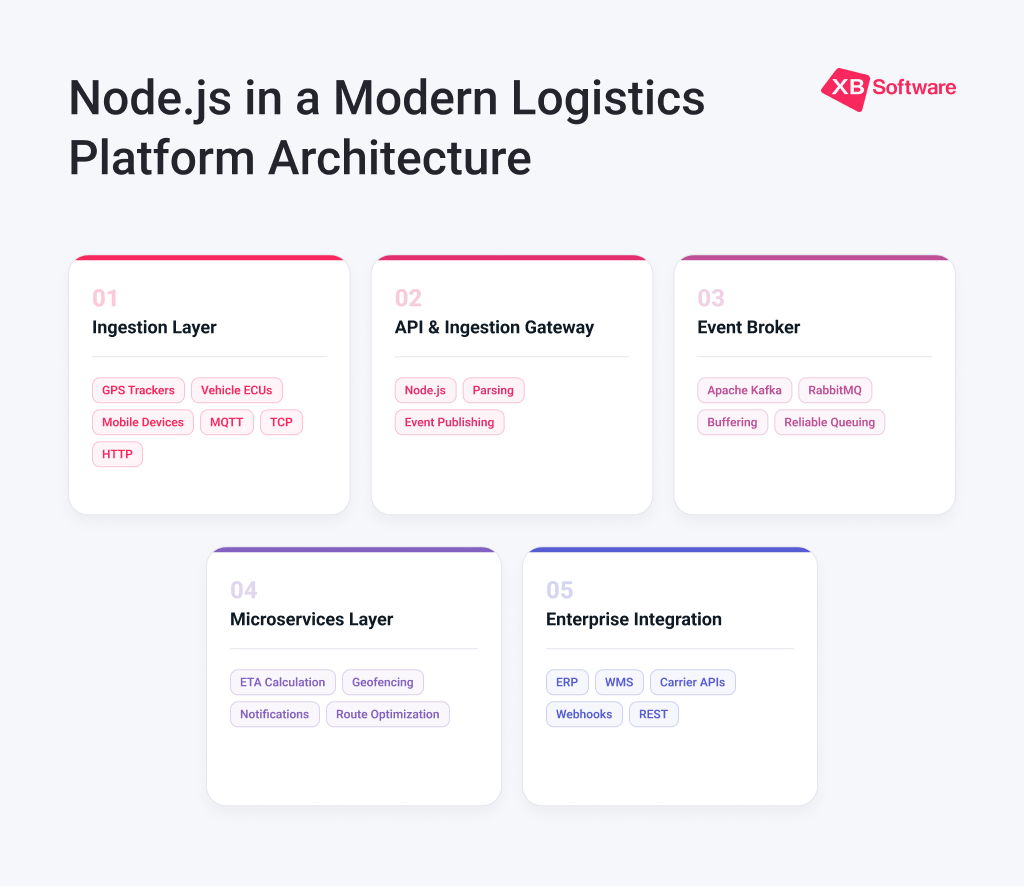
While Node.js excels at managing concurrent data streams, a complete real-time logistics architecture relies on a multi-tier design where each technology handles its ideal workload. It serves as the high-throughput communication gateway and event producer within an event-driven microservices Node.js setup.
A modern logistics software stack is organized into distinct functional layers:
- Ingestion Layer. GPS trackers, vehicle ECUs, and mobile devices transmit telemetry using MQTT, TCP, or HTTP protocols;
- API & Ingestion Gateway. Node.js instances authenticate device tokens, parse incoming telemetry, and publish clean events to the message broker;
- Event Broker. Distributed event streaming platforms like Apache Kafka or RabbitMQ buffer events and manage reliable queuing;
- Microservices Layer. Independent microservices subscribe to specific topics for ETA calculation, geofencing, notification dispatching, and route optimization;
- Enterprise Integration Layer. Enterprise systems, such as ERPs, WMS platforms, and carrier APIs consume processed events via Webhooks or REST adapters.
Positioning Node.js at the ingestion gateway protects backend databases from telemetry traffic spikes while maintaining sub-second map updates for dispatchers.
Real-World Applications of Event-Driven Logistics Systems
Theoretical architectural patterns matter most when they solve concrete bottlenecks. At XB Software, we have implemented event-driven designs to eliminate data lag, remove manual reporting steps, and stabilize high-throughput infrastructure across fleet management, energy operations, and maritime asset tracking.
Traccar-Based GPS Tracking and Fleet Visibility
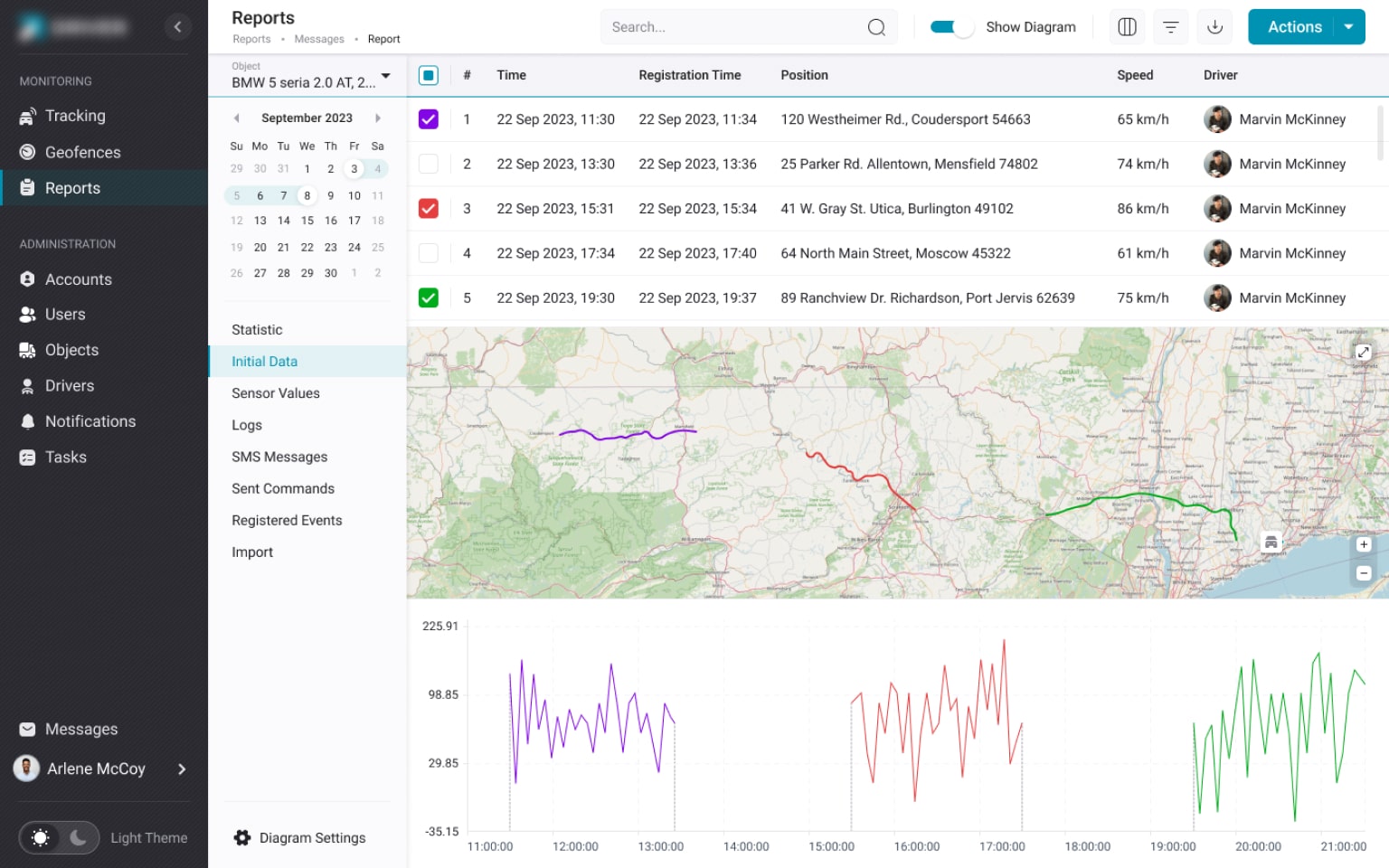
Customer Challenge: The client wanted to combine Traccar’s flexible open-source backend with a modernized interface inspired by Wialon to overcome the usability limits of existing market tools. Over years of incremental updates, legacy systems had accumulated architectural debt, cluttering user workflows and scattering core reporting features across disorganized menus.
Our Solution and Impact: We engineered a GPS tracking platform built around real-time fleet data powered by a custom Traccar backend integration. Drawing on our experience in preparing a Traccar-based tracking system for production use, we built an event-driven ingestion pipeline where incoming coordinate streams pass through an asynchronous message layer and update dispatcher maps instantly. This gave the client true real-time fleet visibility, automated their geofencing triggers, and significantly reduced backend database loads through optimized event-driven fleet management.
Oil and Gas Workforce Management
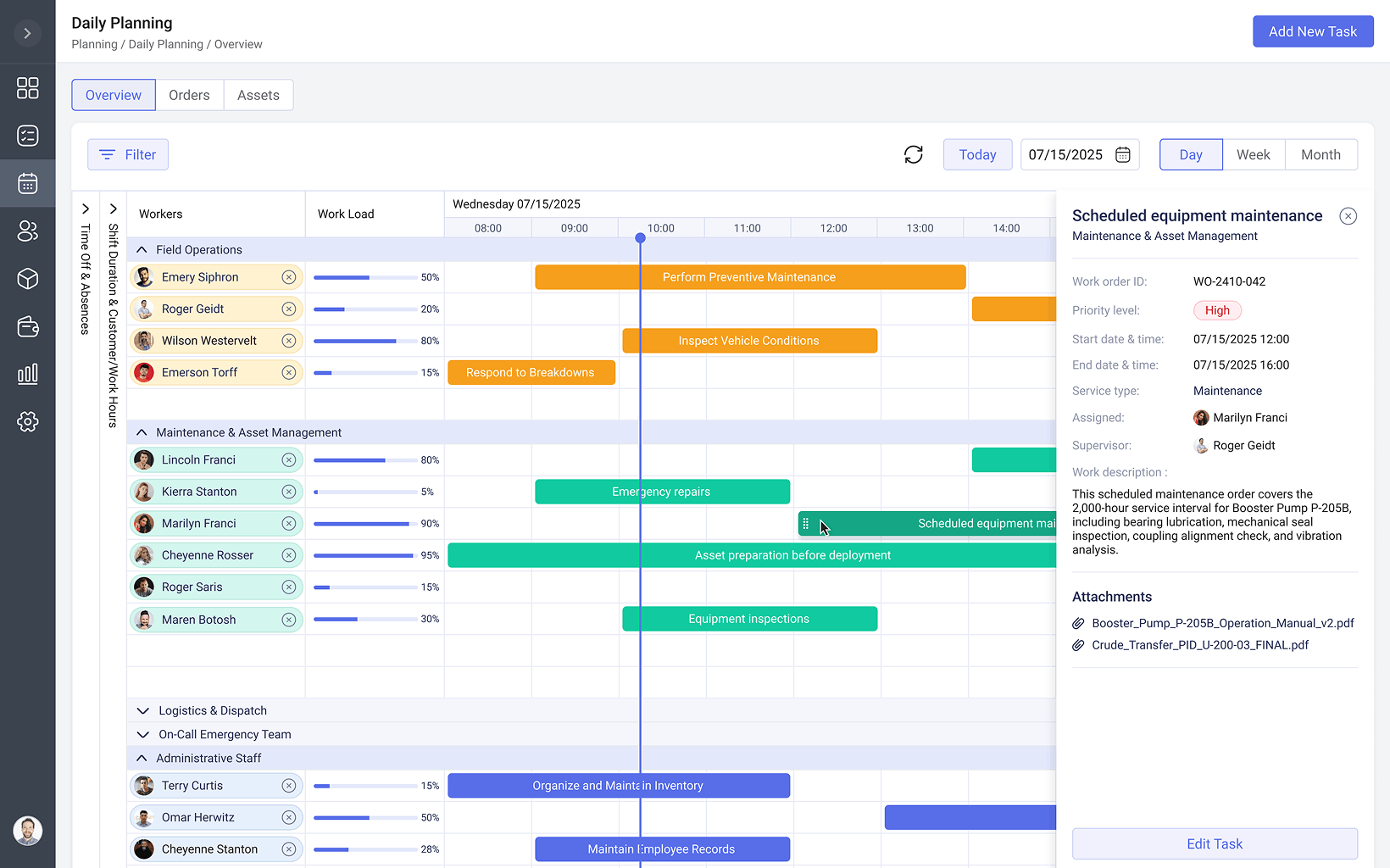
Customer Challenge: A US oilfield service provider struggled with fragmented crew scheduling and resource dispatching. Managing field crews, specialized machinery, and mandatory worker certifications through disconnected spreadsheets created frequent scheduling conflicts, delayed shift handovers, and obscured real-time resource availability.
Our Solution and Impact: Our team delivered a Workforce management platform for distributed oil and gas teams featuring an interactive drag-and-drop scheduling board and an event-driven backend. The system validates worker shift availability and equipment status automatically before confirming crew assignments. This custom solution cut dispatching time by 30 percent, eliminated manual scheduling errors, and gave leadership clear operational visibility across field sites. Providing tailored oil and gas software solutions helped the client standardize crew coordination across active energy assets.
Navigation Buoy GPS Tracking and Remote Asset Monitoring
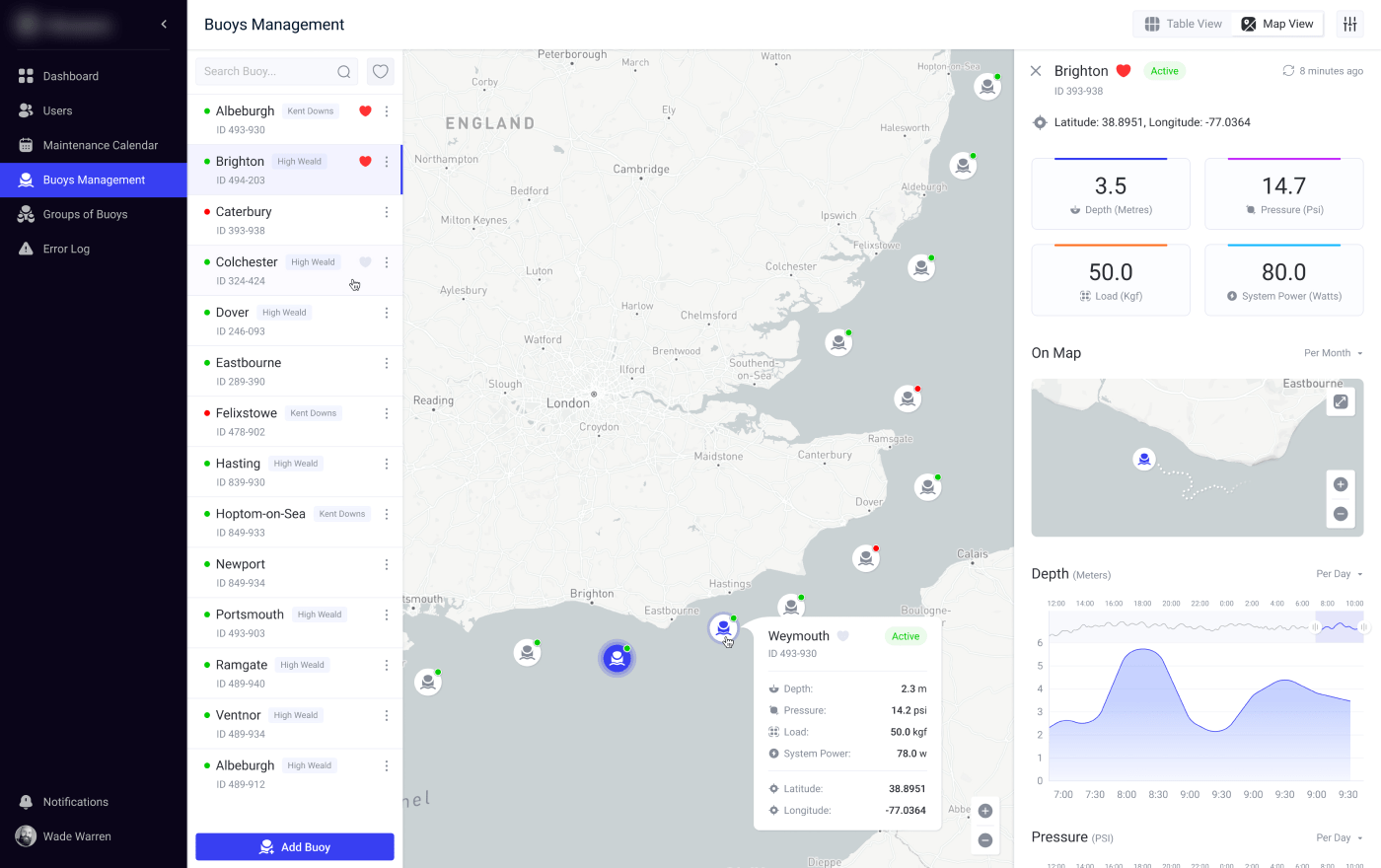
Customer Challenge: Marine buoys deployed in remote, hard-to-reach aquatic locations gather telemetry data such as water depth, pressure, structural load, and system power levels. Conducting manual inspections and maintenance across these isolated assets was expensive and labor-intensive. The client needed a cost-effective web platform to monitor buoy locations remotely, ingest sensor feeds, and streamline maintenance planning without requiring frequent physical site visits.
Our Solution and Impact: We built a Remote monitoring system for GPS-enabled navigation buoys based on a modern GPS tracking system architecture. The web application continuously ingests location coordinates and diagnostic parameters from satellite-connected sensors. When a buoy returns an error or stops transmitting data, the platform logs the incident, sends automated email alerts to assigned technicians, and adds maintenance tasks to an interactive team calendar. Combining custom GPS tracking software with a scalable GPS tracking architecture helped the client reduce manual field inspections, simplify maintenance scheduling, and ensure continuous remote visibility across offshore assets.
Conclusion. Building a Future-ready Logistics Platform Starts with the Right Architecture
Today, supply networks require instant situational awareness, automated exception handling, and frictionless data sharing between hardware sensors, core platforms, and mobile apps. Adopting an event-driven architecture enables logistics platforms to ingest high-frequency telemetry, scale services independently, and automate key workflows.
When paired with Node.js at the API gateway and event ingestion layers, engineering teams gain a resilient, low-latency foundation that handles thousands of concurrent tracking devices efficiently. Replacing legacy polling mechanisms with a decoupled, event-driven engine provides the visibility and responsiveness needed to thrive in today’s transport operations. If you’re looking to modernize your transport management system or build a high-throughput telemetry engine, contact us.