Summary
Clinical workflow optimization starts with understanding how patients, documentation, staff, and digital records move through an organization. Mapping these interactions can reveal gaps in patient identification, information flow, and process continuity that software can address.
Healthcare organizations rarely operate through a single, perfectly digital process. Even when patient information is stored electronically, clinical workflows often combine electronic health records, specialized software, paper documentation, medical devices, and manual coordination between departments.
This creates a particular challenge for organizations operating several clinics or facilities: the patient, physical documentation, and digital information may not always move through the healthcare workflow together.
A regional healthcare network faced exactly this situation. Its clinics used a mixture of digital systems and paper records, and staff had to repeatedly verify that the correct person, documentation, and clinical activity remained connected throughout a visit. Management initially considered file tracking, but clinical workflow analysis revealed a broader problem.
Custom healthcare software development can help to address these gaps by adapting digital processes to the way healthcare organizations actually operate, including their existing systems, documentation requirements, and clinical processes.
Here’s the solution we suggested.
Why Clinical Workflow Optimization Starts With the Actual Patient Journey
A common starting point for healthcare workflow improvement is to look at individual systems. A clinic may have an electronic medical record, laboratory software, scheduling tools, or patient registration software, but this doesn’t necessarily mean that the overall clinical workflow in healthcare is integrated. The gaps often appear between systems and departments.
During the discovery phase for this project, the team mapped the healthcare patient journey alongside the movement of physical documentation. This distinction proved to be important because the person and their folder didn’t always follow the same route.
A typical visit could involve:
- Patient registration;
- Nursing assessment;
- Physician examination;
- Laboratory or diagnostic procedures;
- Specialist consultation;
- Administrative processing;
- Follow-up or discharge.
At each stage, staff interacted with the person’s information and documentation. New data was generated, documents were added or transferred, and workflow states changed.
The problem was that many of these transitions depended on manual verification. Staff compared names, dates of birth, paperwork, and other information to determine whether the correct documentation was associated with the correct person. These checks were considered routine and were therefore rarely recorded as explicit events.
This made clinical procedures analysis particularly valuable. Instead of just asking which software features were missing, we also examined:
- who interacted with the patient at each stage;
- which documents were required;
- where information was created or updated;
- how physical records moved;
- which identifiers were used;
- where manual verification occurred;
- what happened when something didn’t match.
This type of process mapping provides a more complete foundation for healthcare workflow optimization. It reveals dependencies that may remain invisible when each department or application is considered separately.
Challenges: Patient Flow and Identification Across the Healthcare Workflow
Healthcare workflow optimization isn’t only about moving patients efficiently between departments. It also requires keeping their physical documentation, digital records, and process stages connected as they move through the organization. In this project, individual’s identification and flow optimization were therefore treated as parts of the same challenge: maintaining reliable information flow throughout the clinical workflow.
When Patient Flow and Information Flow Take Different Paths
Optimizing a healthcare process doesn’t necessarily mean making the patient move faster through the organization. In this project, patient flow optimization wasn’t primarily about queues, waiting times, or departmental capacity. The more important issue was the relationship between patient movement and information movement.
An individual might leave an examination room while their physical folder remained with a nurse or laboratory technician. A laboratory request could be attached to the folder while the person moved to another department. Additional paperwork could be added before the folder reached the next point of care. In other words, the patient workflow in a hospital or clinic can have several parallel information paths.
This becomes increasingly important as healthcare organizations grow. A single person may interact with registration staff, nurses, physicians, laboratory personnel, imaging specialists, and administrative coordinators. Each clinical handoff introduces another opportunity for information or documentation to become disconnected from the intended workflow.
Healthcare workforce management software can help to coordinate staff availability and responsibilities, but it does not by itself solve the information-flow problems that occur between these roles.

The healthcare network therefore needed more than patient tracking in hospitals. It needed visibility into the relationship between Patient, Physical Documentation, Digital Record, and Workflow Stage.
This relationship became the foundation of the solution.
There was no need to eliminate every paper-based process. Some documents continued to exist in physical form for practical, clinical, administrative, or external reasons. Instead, the project established a digital connection between those documents and the patient’s record.
This distinction was important for adoption. Rather than requiring staff to abandon familiar processes, the system introduced additional workflow visibility around them.
Patient Identification and Error Prevention Across the Clinical Workflow
Patient identification in healthcare is often treated as a registration problem: identify the patient when they arrive and create or retrieve their record. In practice, patient identity verification is an ongoing activity.
Every clinical handoff can require confirmation that the person, documentation, and current process stage correspond to one another. A mismatch may result from a simple transcription mistake, an incorrectly attached document, a damaged identification band, an administrative correction, or a physical record being transferred independently of the patient.
Duplicate patient records can create another source of identification errors as healthcare organizations increasingly rely on EHR systems. According to the 2025 peer-reviewed study on the National Library of Medicine (NLM), it was found that 2.9% of 1,185,752 patients had duplicate EHR records. The researchers also found that duplicate records were associated with more healthcare encounters, more diagnoses, and missing demographic information during initial registration.
This is why patient identification errors shouldn’t be considered only a data-entry issue. Identification needs to remain reliable throughout the clinical workflow, including when individuals, documents, and digital information move through different parts of the organization.
In the healthcare software development project we are covering in this article, the solution addressed identification at several points in the workflow.
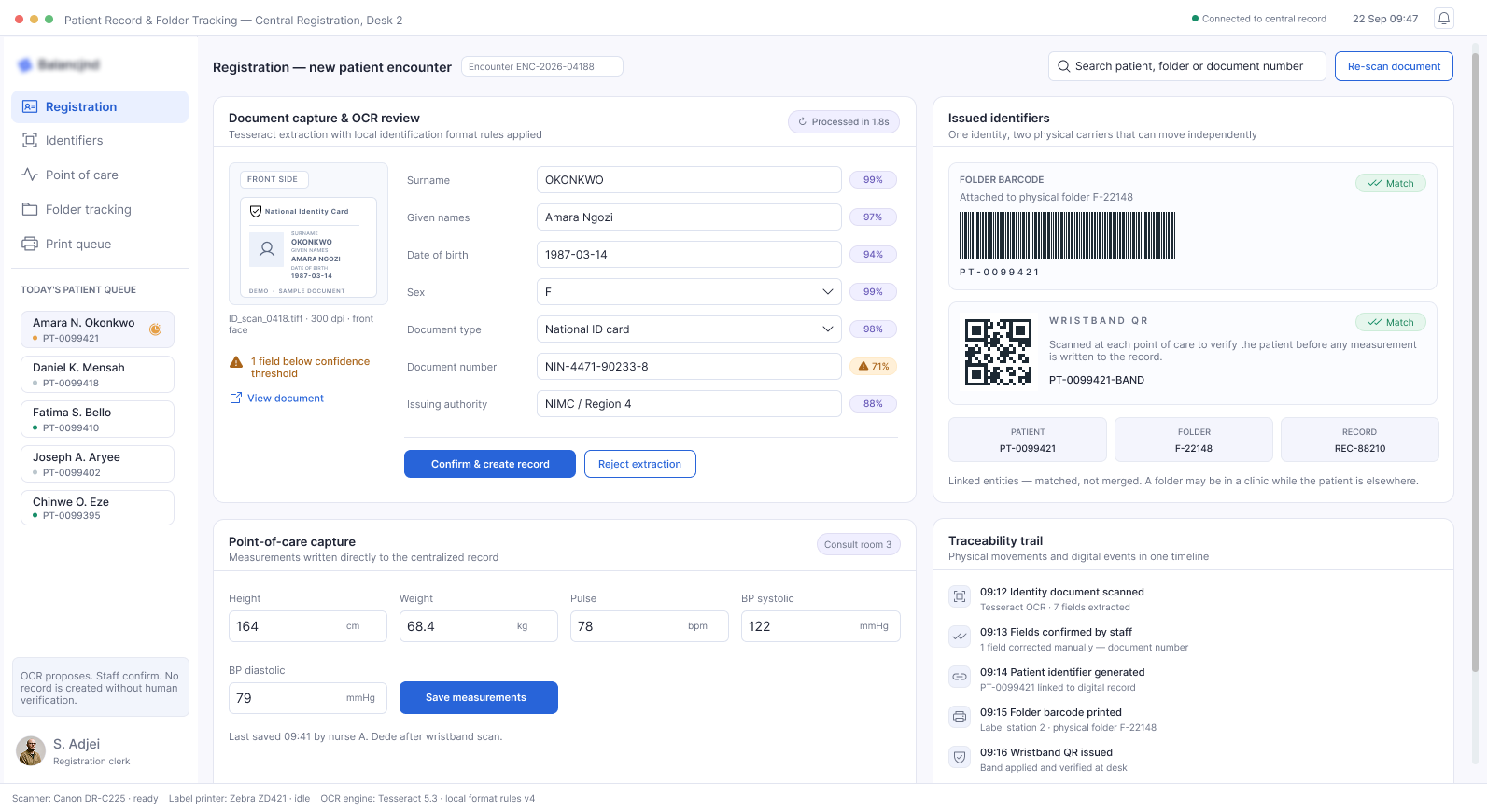
One of the project’s prototypes showing scan review with folder barcode and wristband QR, bedside measurements, and a combined paper-and-digital trail
During registration, staff scanned a government-issued identification document. OCR technology based on the Tesseract engine extracted relevant information, including the patient’s name, date of birth, gender, and document identifiers. Additional validation rules were applied to account for local identification formats. The extracted information was then presented to registration personnel for confirmation.
This approach combined automated data capture with human verification. The objective wasn’t to remove staff from the process, but to reduce unnecessary manual transcription and provide a more reliable starting point for the patient record.
The system then generated a unique identifier for the individual. This identifier was represented through two physical forms:
- a barcode attached to the physical folder;
- a QR code incorporated into a medical patient wristband.
The combination supported patient verification in healthcare while recognizing that the person and their documentation could move independently.
The key lesson is that preventing identification errors requires more than assigning an identifier once. A reliable approach can include:
- capturing identity information from authoritative documents;
- using a unique identifier across connected processes;
- verifying the patient at relevant clinical handoffs;
- linking physical documentation to the digital record;
- checking the current workflow state;
- recording failed verification attempts;
- monitoring repeated mismatches and exceptions.
This turns identification from a one-time registration step into a continuous control within the clinical workflow.
Read Also How patient management software improves healthcare workflows
Solution: Building a Traceable Patient Workflow Across Physical and Digital Records
The central design decision was to treat an individual, physical folder, and digital record as related but distinct entities.
Initially, it might seem sufficient to assign the same identifier to everything. However, real-world operations introduced cases where these entities could become temporarily disconnected. A folder could be transferred without the patient. A wristband could be damaged and reprinted. An administrative correction could change the relationship between documentation and a personal record.
Therefore, the system needed to perform more than a simple identifier lookup. It needed to answer questions such as:
- Does this wristband and the physical folder belong to the same person?
- Is this interaction expected at the current stage?
- Has the previous step been completed?
- Has an identifier recently been reissued?
- Is there a synchronization conflict?
The result was a model based on identity matching, record linkage, and workflow state.
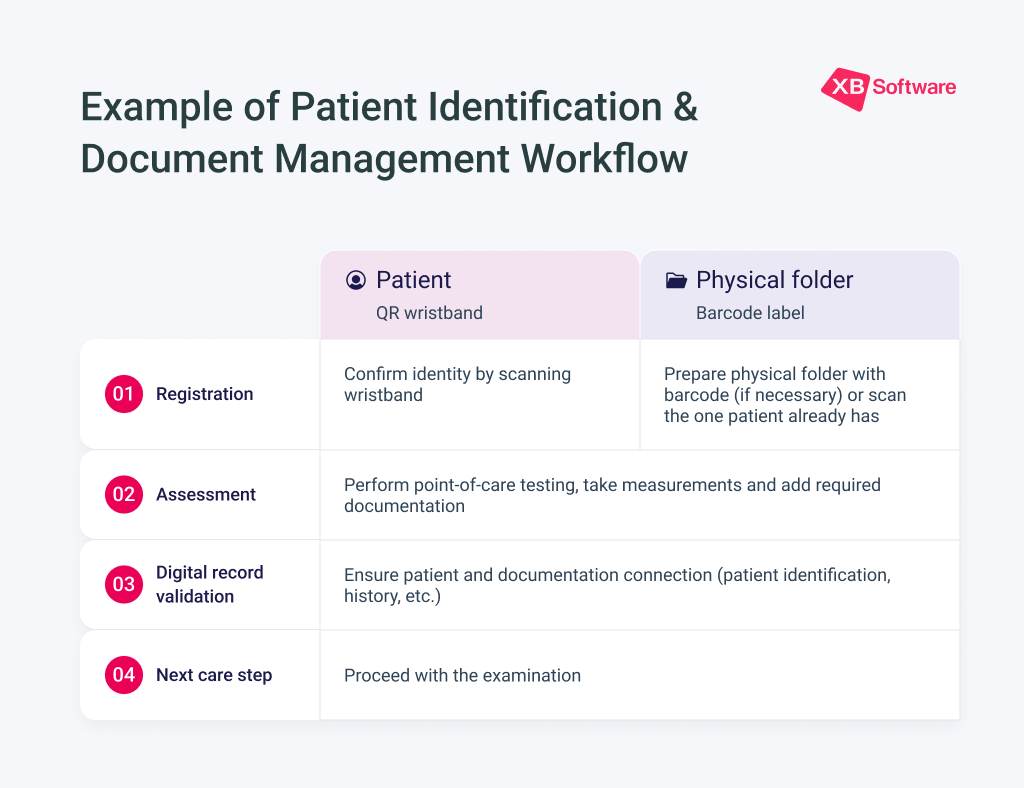
At an examination, for example, a medical assistant used a mobile application to scan the patient’s QR wristband and the barcode on the physical folder. The system checked the connection between both identifiers and the corresponding digital record. Only after successful validation could the examination continue.
The same application supported point-of-care data capture, allowing staff to record measurements such as height, weight, pulse, and blood pressure directly into the centralized system. Paper documentation could still be printed when required and placed in the physical folder.
This hybrid model was a deliberate part of the clinical workflow design. Instead of just digitization for its own sake, the goal was to create patient traceability while allowing clinical teams to continue using physical documentation where it remained necessary.
The resulting patient document tracking model connected physical records with digital events without requiring the organization to replace every existing process.
Read Also Moving from paper records to digital clinical workflows
Designing Clinical Workflows for Real-World Operating Conditions
A healthcare workflow cannot be designed solely around ideal infrastructure.
During technical analysis, the development software team identified unstable network connectivity at several clinics. These weren’t permanent outages but intermittent interruptions lasting from seconds to several minutes. A conventional application that depended on a real-time backend request for every validation would therefore have introduced an operational risk.
Clinical work couldn’t simply stop whenever connectivity temporarily disappeared. At the same time, storing complete personal records on mobile devices would create unnecessary security and data-management risks. So, the solution required a controlled offline validation mode.
We provided mobile app development services to build a mobile version of the application that stored only the minimum information required to maintain workflow continuity. Rather than caching complete clinical records, it used short-lived identifiers and cryptographically signed validation tokens.
Clinical data remained on the server side. When connectivity returned, locally queued events were synchronized with the central system. This architecture supported operational continuity without turning mobile devices into repositories of complete patient records. It also introduced another important consideration: synchronization.
An offline-capable application must account for what happens when several events occur while the central system is temporarily unavailable. Events may arrive later than expected, occur in a different order, or conflict with changes made elsewhere. This makes data consistency, data integrity, and exception handling important parts of healthcare workflow design.
The broader lesson is applicable beyond this particular project: healthcare IT infrastructure should be designed around actual operating conditions while also accounting for healthcare data security, data availability, and workflow continuity.
Technical Nuances: Why Failed Validations Matter for Clinical Workflow Improvement
A successful scan confirms that the system found the expected connection. A failed scan can tell the organization even more.
For this reason, we ensured that the system recorded not only successful validations but also failed attempts, identifier mismatches, and synchronization conflicts. Every scan represented an event that could contribute to understanding the actual workflow.
The technical architecture used an event-driven approach. Scan events were recorded as immutable events, allowing the organization to reconstruct what happened during a patient’s journey. This created a foundation for event logging and auditability.
It also separated operational events from analytical processing. Immediate validation and workflow control could operate independently from reporting and monitoring workloads, while analytical projections were generated asynchronously.
This distinction became particularly useful during deployment.
One clinic showed repeated validation mismatches in a particular department. Initially, the system itself appeared to be functioning correctly: the identifiers were valid, and synchronization was working as expected. The underlying problem was operational: patient identification wristbands were being reprinted more frequently than anticipated because of printer calibration issues.
Without detailed event logging, the organization might have seen individual mismatches without recognizing the recurring pattern. With historical events available, the repeated failures became a signal for clinical workflow improvement.
This illustrates an important difference between preventing errors and understanding them. A healthcare workflow can be technically correct while still producing unexpected operational behavior. Failed validations provide evidence about where the process is diverging from its intended design.
For teams working on clinical workflow management, this creates an additional feedback loop of workflow, event, exception, analysis, and process improvement. Over time, this can help organizations to identify weaknesses in processes, equipment, user interactions, and system integration.
Read Also Automating medical documentation in healthcare software
Conclusion: From Patient Journey Optimization to More Reliable Healthcare Workflows
The project began with a seemingly straightforward requirement: track patient files. The discovery and development process revealed a more fundamental challenge. The organization needed a reliable way to connect the patient journey with the movement of physical documentation and the state of digital records.
Barcode and QR scanning became useful technologies within that solution, but they weren’t the solution by themselves. The more significant components were:
- clinical workflow analysis to understand how work actually happened;
- process mapping to identify dependencies between departments and physical records;
- reliable identification and identity matching;
- linkage between people, folders, and digital records;
- workflow state transitions;
- controlled offline operation;
- synchronization and data consistency;
- event-driven architecture;
- exception handling;
- auditability and process visibility.
This is why improving clinical workflow often requires looking beyond individual software features. A barcode can identify an object. A QR code can provide a convenient way to retrieve an identifier. OCR can automate data capture. None of these technologies, on their own, can guarantee that the right person, documentation, and clinical activity remain connected throughout a complex healthcare process.
So, if you need to reconsider your clinical workflow, contact us, and we will suggest a software solution that both fulfills your needs and enhances the positive effect.