Summary
Building safe AI mental health apps requires strict safeguards. This article explores why product owners should avoid open-ended AI chats in favor of constrained summaries for doctors and how to build an investment-ready MVP that complies with FDA, FTC, and data privacy rules.
Patients often arrive at therapy sessions with a fragmented memory of their past few weeks. They usually recall the hardest day or a recent argument, but struggle to see the broader pattern of their daily lives. This lack of continuity makes sessions less focused and creates a gap that technology could fill.
When founders and product owners look at this problem, many decide to build an AI mental health app that acts like an open, conversational chatbot. At XB Software, we approached an anonymized MVP project from a completely different angle.
What a Mental Health Self-Monitoring App Should Actually Do
Our team deliberately avoided the simulated therapist route. When an application processes sensitive health data, creating an overly humanized algorithm often leads to unverified clinical advice and false assurances. These unpredictable outcomes pose serious AI chatbot mental health risks.
Instead, we asked how digital tools for mental health could help adults maintain context between appointments without forcing an algorithm to make a clinical judgment. The solution was a heavily constrained progressive web app (PWA).
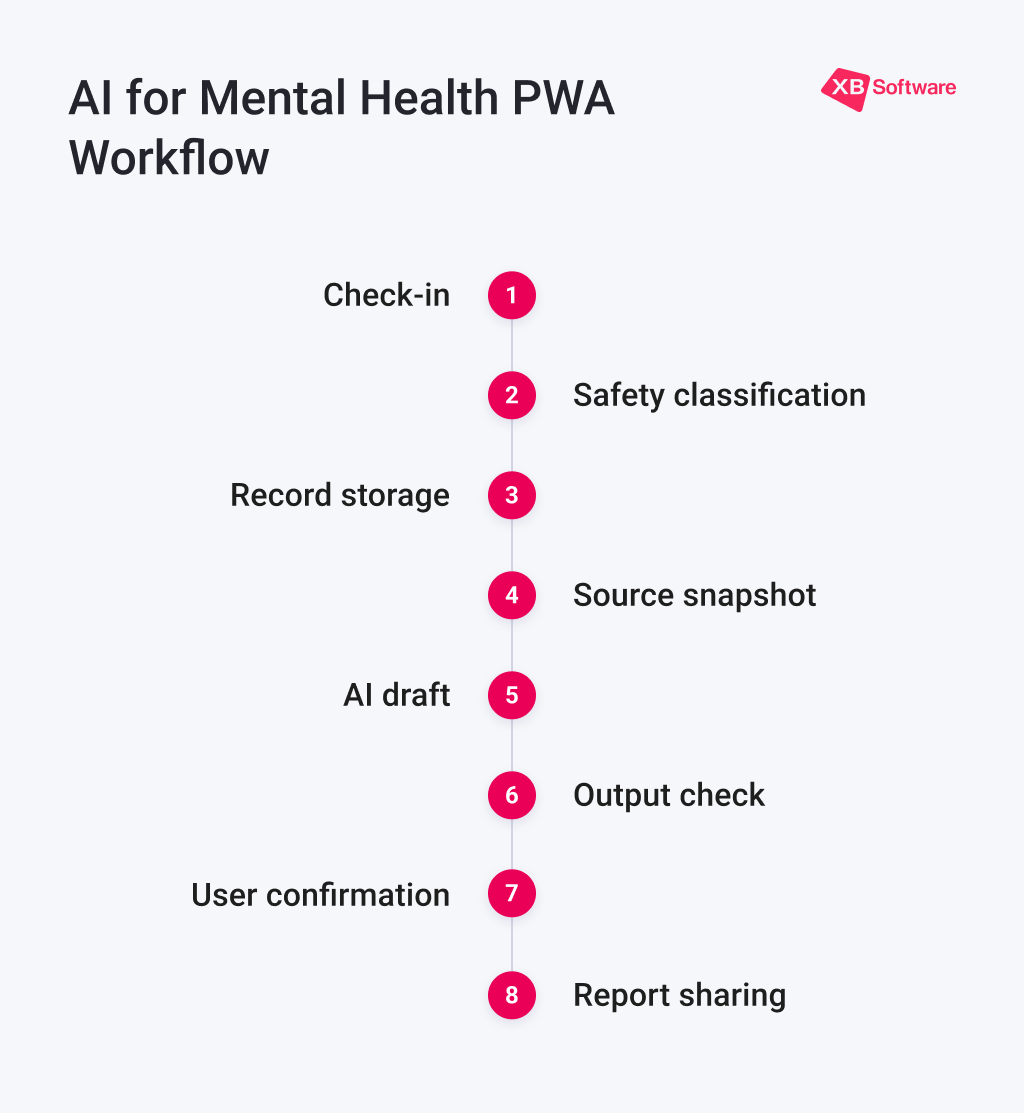
The workflow moves logically from mental health check-ins to safety classification, secure storage, source isolation, and finally a controlled summary generation. This sequence defines the product boundary and ensures AI therapist safety by keeping the model entirely out of the therapy seat.
The primary problem we aimed to solve with this app was context preservation. A reliable mental health tracking journal should serve users who want a fast, manual way to record their current state. In a properly scoped application, users log variables like mood tracking, stress levels, sleep quality, and daily functioning. They can also add a brief text note to capture their thoughts in their own words.
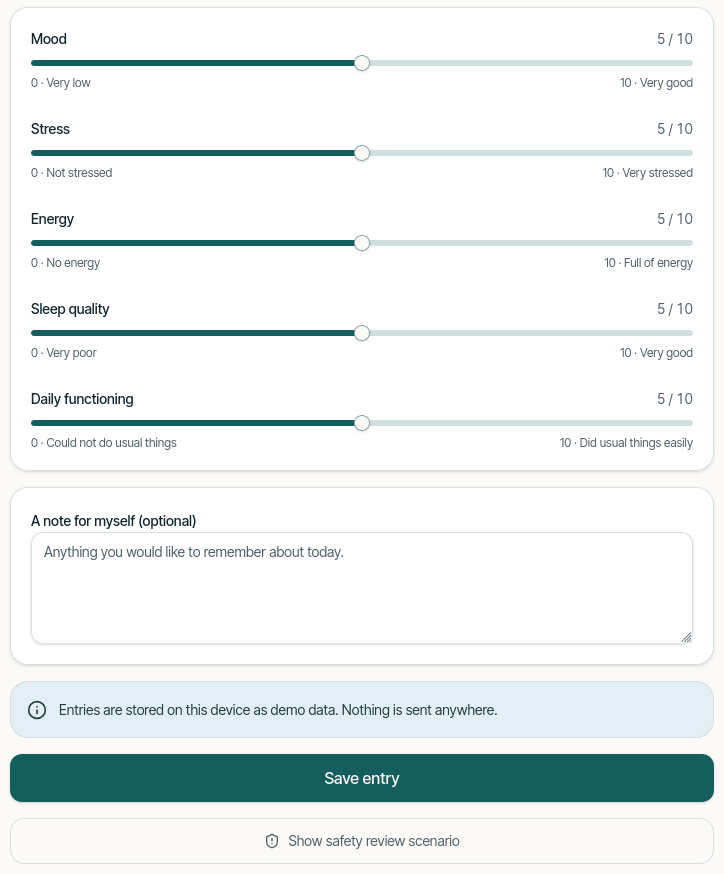
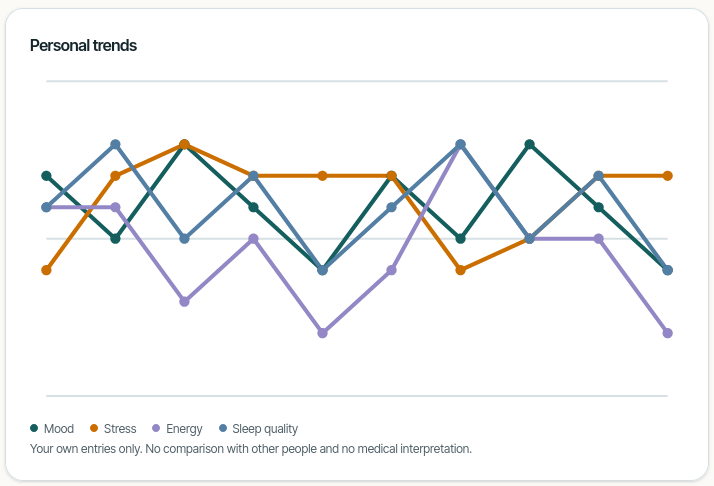
The application exists strictly to display the user’s personal history and trends. It does not rank the user against a population average. It also refuses to assign a wellness score or categorize a behavioral pattern as a medical disorder. Self-reports can serve as helpful context for a doctor, but the user-reported data alone is not a diagnosis. We maintained a strict boundary between simple self-monitoring and formal clinical evaluation.
This separation holds significant weight in the United States market. The FDA General Wellness policy draws a clear line between low-risk general wellness products and software meant to diagnose, treat, or manage diseases. An app’s user interface, marketing materials, sales messaging, and support documentation must reflect its stated intended use. We designed this MVP concept to show that an app can deliver clear user value by helping people organize their observations. It does not interpret the medical meaning of that data. Users rely on it to prepare for their next professional consultation.
Our client also valued the clarity this approach enabled. It sends a clear message to patients: “This tool helps you prepare, but your doctor remains the sole interpreter of your data.” That transparency built trust and set clear expectations. Ultimately, our client received a practical, patient-facing solution that delivers real value.
Product Decisions to Validate Before Development Before committing to AI infrastructure
A product owner should be able to answer:
- Who is the primary user, and who pays?
- Will users consistently log enough data for summaries to be useful?
- Will clinicians read the report, and what format fits a real appointment?
- Which claims and workflows change the product’s regulatory exposure?
- What evidence will demonstrate value without making clinical claims?
A safer architecture cannot compensate for weak demand. Validate these assumptions through user interviews and a low-fidelity workflow test before building the generation pipeline.
Why Open-Ended AI Chat Is Difficult to Control
Adding a free-flowing chat interface is the easiest way to impress stakeholders in a product demo. It also introduces an enormous and unpredictable attack surface. Startups pitching AI mental health app features often underestimate these challenges.
An unconstrained language model can easily misinterpret a short user input. It might offer treatment guidance disguised as friendly advice, reinforce an unhealthy cognitive bias, or project false certainty based on minimal data. You cannot solve these limitations of AI for mental health support by simply writing a stricter system prompt. Guardrails often fail when users push the conversational boundaries.
The business bears ultimate liability for the data entering the model and the text coming out. As your technical partner, we architect fail-safes to protect your product when third-party dependencies fail. For these reasons, we avoid relying on a completely open chat interface as it fundamentally undermines the ethics of AI in mental health.
Instead of allowing free conversation, we constrained the technology to a much narrower summarization task. This approach centers on human-centered AI principles, keeping the user in full control of the interaction and preventing the algorithm from making sensitive choices on their behalf.
Generative AI in Mental Health for Summaries, Not Therapy
To extract the actual benefits of AI in mental health, we designed a highly restricted generation pipeline. When a user wants a report, they select a specific date range containing sufficient entries. The system then locks these selected records into an immutable source snapshot. The generation service only sees the data within this fixed perimeter.
This architecture guarantees that the resulting draft ties directly to a known dataset. If a user modifies an old journal entry a week later, the previously generated summary does not automatically update in the background. Adding version control increases the engineering complexity, but it prevents the output from becoming a shifting, untraceable target. The user always understands the exact scope of the source material.
The generated text must adhere to a strict template. A valid structured summary includes neutral observations pulled directly from the logs. It also highlights neutral themes the user might want to explore with a professional. Before the user ever sees the draft, an output validation layer checks the text against prohibited concepts. The summary cannot include causal explanations, medical prognoses, medication advice, or any statements assessing suicide risk.
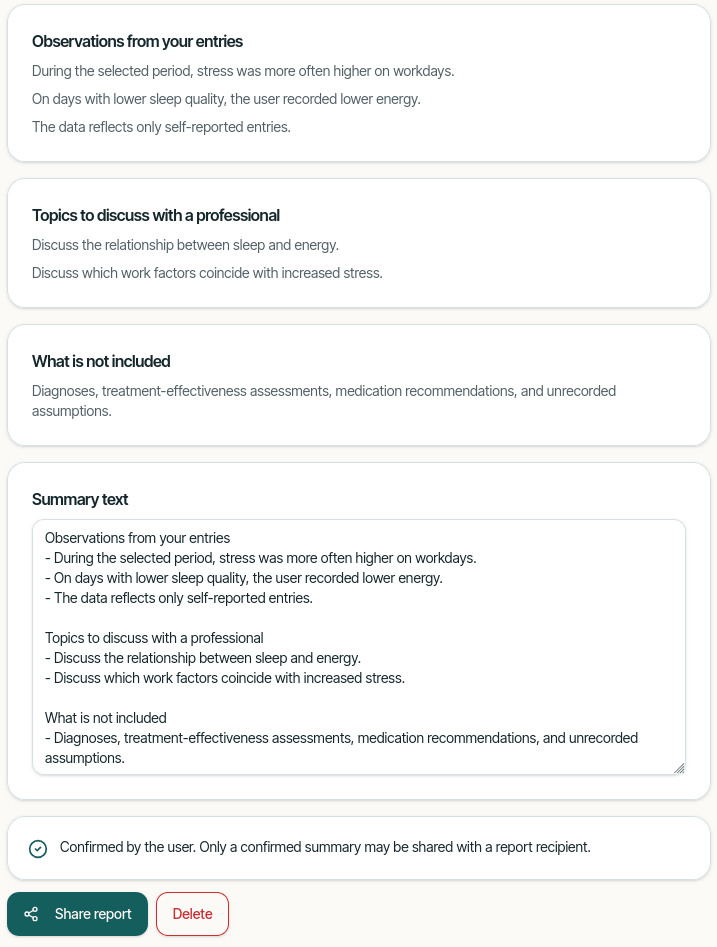
The user then reviews the text. They can edit it, delete it entirely, or proceed with user confirmation. The final result lacks the conversational flair of an algorithmic companion, but it perfectly fulfills the app’s core mission. It turns scattered daily notes into an accurate, user-governed preparation document.
Handling Critical Notes Without Turning the App Into a Crisis Service
Allowing users to type free text introduces a critical safety vulnerability. A note might contain urgent information that should never pass through a standard generative API. Some developers try to handle this by prompting the language model to adopt a compassionate tone when it detects distress. We completely rejected that strategy.
In this MVP, every optional note undergoes a rigid safety classification step before the generation feature can access it. If the classifier detects a critical threshold, it immediately blocks the text from the standard pipeline. The product does not attempt to comfort the user with synthetic sympathy or reword the prompt. Instead, it surfaces pre-approved, static crisis support resources.
For an application launching in the U.S., these resources require careful clinical and legal vetting. The baseline response directs users to call or text 988, use the 988 Lifeline chat, or call 911 if they face immediate physical danger. We relied on established public frameworks like the SAMHSA crisis support guidance rather than attempting to build our own response network.
Equally important is defining what the product will not do. It does not forward notes to a clinician. It does not text family members or emergency services. Furthermore, it certainly does not promise to catch every single emergency. The safety mechanism mitigates one specific technical risk. It does not transform a consumer logging tool into an emergency intervention platform.
Mental Health App Data Privacy and Consent
You cannot achieve true mental health app data privacy by simply pasting a legal link in the application footer. Every feature requires rigorous data protection from the earliest architectural planning stages. We applied robust healthcare data security practices across all components.
The foundation of our approach was strict data minimization. The application deliberately ignores precise geolocation, contact lists, microphone access, and passive behavioral metrics. We excluded all advertising SDKs. Crucially, the platform explicitly prohibits utilizing consumer entries to train external language models.
We separated user consent into distinct categories. A user must agree to operate the journal. They must provide separate permission for AI processing. Finally, they need a separate agreement to share a report. If a user revokes consent for generation, the system immediately blocks future API calls while keeping their historical entries fully intact and accessible.
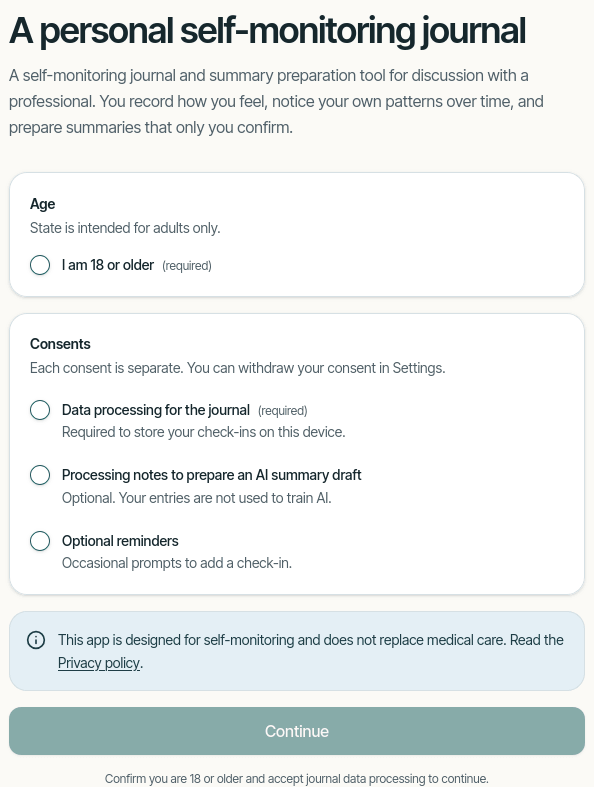
Report sharing operates under similar restrictions. When a user shares a summary, the recipient does not gain access to the raw logs. They only see a specific, confirmed report version for a limited time. The architecture logs every viewing, expiration, and revocation event. However, we ensure users understand one practical limitation. Revoking a link cannot erase a PDF that a doctor already downloaded. Masking this reality behind a smooth interface would violate user trust.
Regulatory landscapes mandate this level of discipline. While HIPAA compliance for AI mental health apps does not automatically apply to every direct-to-consumer product, developers still face severe scrutiny.
The Federal Trade Commission and state regulators hold developers accountable for their promises. Frameworks like the FTC guidance for mobile health apps provide essential guardrails. State-level regulations also require targeted attention. For instance, the Washington My Health My Data Act demands distinct consent workflows that standard bundled agreements fail to meet. Founders must address these requirements early to secure funding and pass regulatory audits and convert them into product requirements before estimating the MVP.
Our technical discovery phase maps these boundaries for you before development begins.
Read Also Healthcare Software Development for Ambulatory Care
Keeping AI Predictable After Launch
Deploying an algorithm is not the final step of development. Businesses and their investors must treat AI in mental health care apps as an external liability that carries distinct failure modes. As models update and policies shift, maintaining control requires robust AI-assisted development workflows and strict versioning.
In our design, every generated draft and safety event logs the specific model and policy version active at that exact second. A vendor cannot silently update a model in our production environment. Any change requires the system to pass a comprehensive regression testing suite. The test cases intentionally try to force the algorithm to output prohibited medical claims or violate the defined schema. We also enforce mandatory human oversight during major version transitions.
The application must also degrade gracefully. If the generation API goes offline, users can still log their entries and view their history. The interface simply disables the generation button. If the safety classification service fails, the system saves the raw note but explicitly blocks it from future generative processing. We ensure the user sees accurate status indicators rather than pretending an invisible check occurred.
This operational model aligns closely with the NIST AI Risk Management Framework. It treats risk governance as a continuous technical requirement. Global regulatory bodies echo this need for rigorous testing and accountability in health-related tools, including the World Health Organization recommendations on generative AI.
What to Leave Out of a Mental Health App MVP
Deciding what to build is less important than deciding what to exclude. We intentionally left several mental health app MVP features out of the initial release:
- AI therapy or free-form chat;
- Diagnosis, clinical screening, treatment advice, or medication guidance;
- Automatic notifications to clinicians, family members, or emergency services;
- EHR/EMR integration, appointment scheduling, billing, and telemedicine;
- Recipient license verification or a clinician portal;
- Data from wearables, health platforms, biometrics, audio, contacts, or precise location;
- Native mobile apps and their separate platform-compliance workstream;
- A HIPAA-scoped deployment for a provider or health plan.
We deferred these capabilities because each one radically alters the product’s risk profile. For instance, adding a wearable integration changes the data flow and the regulatory footprint. We treat these complex functions as completely separate initiatives requiring their own dedicated discovery cycles, security controls, and clinical reviews.
Conclusions
The most effective implementations of AI for mental health do not necessarily generate the highest volume of text. In highly sensitive spaces, a product proves its maturity by refusing to make decisions on the user’s behalf. We designed a system that prioritizes user control over data sources, explicit consent boundaries, and predictable outputs.
If you are pitching a new digital wellness MVP, a predictable, compliant architecture is what secures investor confidence. Don’t underestimate upfront technical discovery. We can help you define the intended use, map the regulatory landscape, establish your AI safety mental health protocols, and build a testing strategy before writing a single line of code.
At XB Software, our mental health app development services help organizations turn complex requirements into secure, realistic products. We specialize in mapping these boundaries early to prevent costly architectural rewrites later. If you need a technical partner to navigate these challenges, contact us to discuss your project requirements.