Summary
This article explains how intelligent ambulatory care workforce management software—featuring automated scheduling, predictive analytics, and real-time visibility—can reduce administrative burdens and help clinicians focus more on patient care.
Once considered a temporary challenge, healthcare staffing shortages have evolved into one of the biggest operational threats facing ambulatory care providers. A 2025 workforce survey found that over half of U.S. healthcare workers are actively considering changing jobs due to burnout and workload pressure.
Across the United States and Europe, outpatient clinics, ambulatory surgery centers, and specialty practices are being asked to do more with fewer resources. Patient volumes continue to rise, administrative requirements become more complex, and expectations for high-quality, personalized care keep increasing. Meanwhile, healthcare organizations struggle to recruit and retain qualified staff.
The consequences extend far beyond scheduling headaches. This is exactly why ambulatory care workforce management has become a strategic priority rather than an administrative function. So, let’s see how it can help to sweeten the pill.
How Staffing Gaps and Burnout Disrupt Ambulatory Care Operations
The healthcare workforce shortage did not emerge overnight.
An aging population is increasing demand for outpatient services. Healthcare professionals continue leaving the workforce due to stress and burnout. At the same time, ambulatory organizations face growing competition for experienced nurses, medical assistants, care coordinators, and administrative staff.
The result is a difficult balancing act.
Providers must continue delivering timely, high-quality care despite operating with limited resources.
In ambulatory care settings, where efficiency and patient throughput directly affect financial performance, even small staffing gaps can disrupt entire workflows. This creates challenges such as:
- longer appointment wait times,
- increased overtime,
- uneven workload distribution,
- higher turnover,
- declining employee satisfaction,
- reduced patient experience.
For many organizations, the real question now is how to operate effectively despite staffing shortages.
The Hidden Cost of Burnout in Ambulatory Care
Recent AMA data shows that about 41.9% of physicians reported at least one symptom of burnout in 2025. While this is slightly improving compared to previous years, the number remains consistently high across healthcare systems.
Burnout is often discussed as an individual wellness issue.
In reality, it is also an operational problem:
- Healthcare teams work within fragmented systems, they spend significant portions of their day switching between applications, manually updating schedules, making phone calls, and coordinating tasks that could be automated.
- Patients experience longer wait times, communication breakdowns, and reduced continuity of care.
- Leadership teams face increasing pressure to maintain profitability while preserving care quality.
Because of these inefficiencies, administrative burden accumulates quickly and the time available for patient care is reduced. Over time, constant interruptions and excessive cognitive load contribute to exhaustion, lower engagement, and higher turnover rates.
Replacing experienced staff is expensive.
Losing institutional knowledge is even more costly.
Traditional Staffing Approaches No Longer Work
A recent clinical workforce study found that about 47.9% of physicians regularly work in incompletely staffed teams. This shows that many ambulatory organizations still rely on methods designed for a much simpler healthcare environment.
Staff schedules are managed through spreadsheets. Coverage requests handled through calls and text messages. Manual approval chains. Disconnected communication tools.
These approaches may function adequately for smaller teams. However, as organizations grow, complexity increases rapidly.
Unexpected absences, fluctuating patient demand, seasonal trends, and evolving regulations require organizations to make staffing decisions quickly and accurately. Without real-time visibility, leaders often react after problems have already affected operations.
This reactive approach increases stress for everyone involved.
What Is Ambulatory Care Workforce Management?
At its core, ambulatory care workforce management involves ensuring the right people are available in the right place at the right time.
That sounds simple.
In reality, it involves balancing dozens of moving pieces simultaneously:
- patient demand,
- staff availability,
- qualifications,
- regulations,
- scheduling preferences,
- productivity targets,
- and unexpected disruptions.
Custom healthcare workforce management software helps organizations to bring these variables together into a single operational picture.
Instead of relying on disconnected spreadsheets and manual coordination, leaders gain real-time visibility into staffing levels, workloads, and care delivery needs across the organization.
But effective workforce management for healthcare goes far beyond filling empty shifts. It includes forecasting future staffing requirements, supporting flexible staffing models, improving communication between care teams, and reducing the administrative burden placed on healthcare professionals.
In ambulatory care environments, where schedules change quickly and patient volumes fluctuate throughout the day, this level of visibility in a healthcare system becomes especially valuable.
You can’t simply make scheduling more efficient. You need to create working conditions that allow healthcare teams to focus more of their time on patient care rather than operational firefighting.
Read Also Healthcare Data Security: How to Protect Data in Clinical Systems by Design
Workforce Management System Features Ambulatory Providers Should Prioritize
Not every healthcare workforce management platform addresses the unique realities of ambulatory care. Outpatient organizations often require more flexibility than systems originally designed for inpatient environments.
When evaluating ambulatory care software, healthcare providers should look beyond scheduling functionality alone and should consider the following functionality:
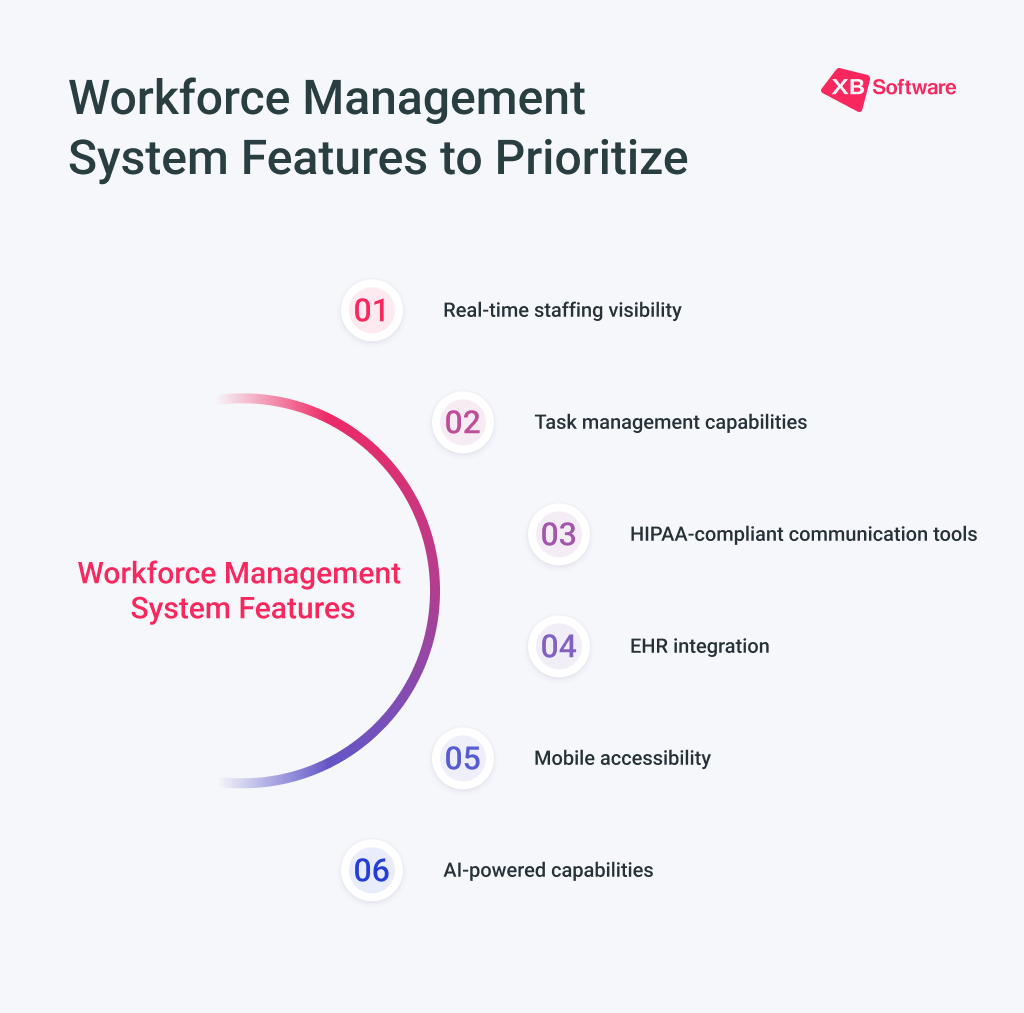
- Real-time staffing visibility allows leaders to understand capacity across departments before bottlenecks develop. Configurable workflows help organizations adapt the software to their specific operational processes rather than forcing teams to change how they work.
- Task management capabilities help to coordinate the work that happens between patient visits. Managers can assign responsibilities, monitor progress, track follow-ups, and ensure that care plans, administrative activities, and operational tasks don’t fall through the cracks. This becomes especially valuable for care coordinators working across multiple teams and locations.
- HIPAA-compliant communication tools reduce reliance on unsecured messaging channels and scattered email threads. Secure chat, role-based notifications, escalation alerts, and team messaging help clinicians and administrative staff collaborate efficiently while protecting sensitive patient information.
- EHR integration remains equally important. Whether organizations rely on ambulatory EHR systems, telehealth platforms, or specialized care coordination tools, information should move seamlessly between systems to avoid duplicate documentation and fragmented care.
- Mobile accessibility has also become essential. Healthcare professionals increasingly need the ability to review schedules, receive notifications, approve requests, and communicate with colleagues while away from their desks.
- AI-powered care management software capabilities are gaining attention as well. Machine learning in healthcare staffing can identify patterns humans may overlook, helping organizations optimize schedules, predict workforce demands, and improve resource allocation over time.
Technology should support clinical operations without adding unnecessary complexity.
The best healthcare workforce management solutions often feel invisible. They simply help work happen more smoothly.
Read Also General-Purpose AI vs. Medical AI: A Practical Guide for HealthTech Businesses
How Care Management Software Addresses Staffing Challenges
Staffing shortages cannot always be solved by hiring more people. Sometimes, the biggest opportunity lies in helping existing teams work more effectively. This is where care management software and healthcare workforce management solutions begin to make a measurable difference.
- Offers intelligent scheduling automation
One of the first areas organizations improve is scheduling.
Traditional scheduling processes often depend heavily on managers manually coordinating shifts, finding replacements, approving requests, and communicating updates through multiple channels. Even minor changes can trigger a cascade of emails, phone calls, and text messages.
Intelligent scheduling automation simplifies much of this complexity. Healthcare workforce management platforms can automatically identify coverage gaps, suggest qualified staff based on certifications and availability, notify employees about open shifts, and streamline approval workflows.
This is exactly what we’ve done in one of our latest projects.
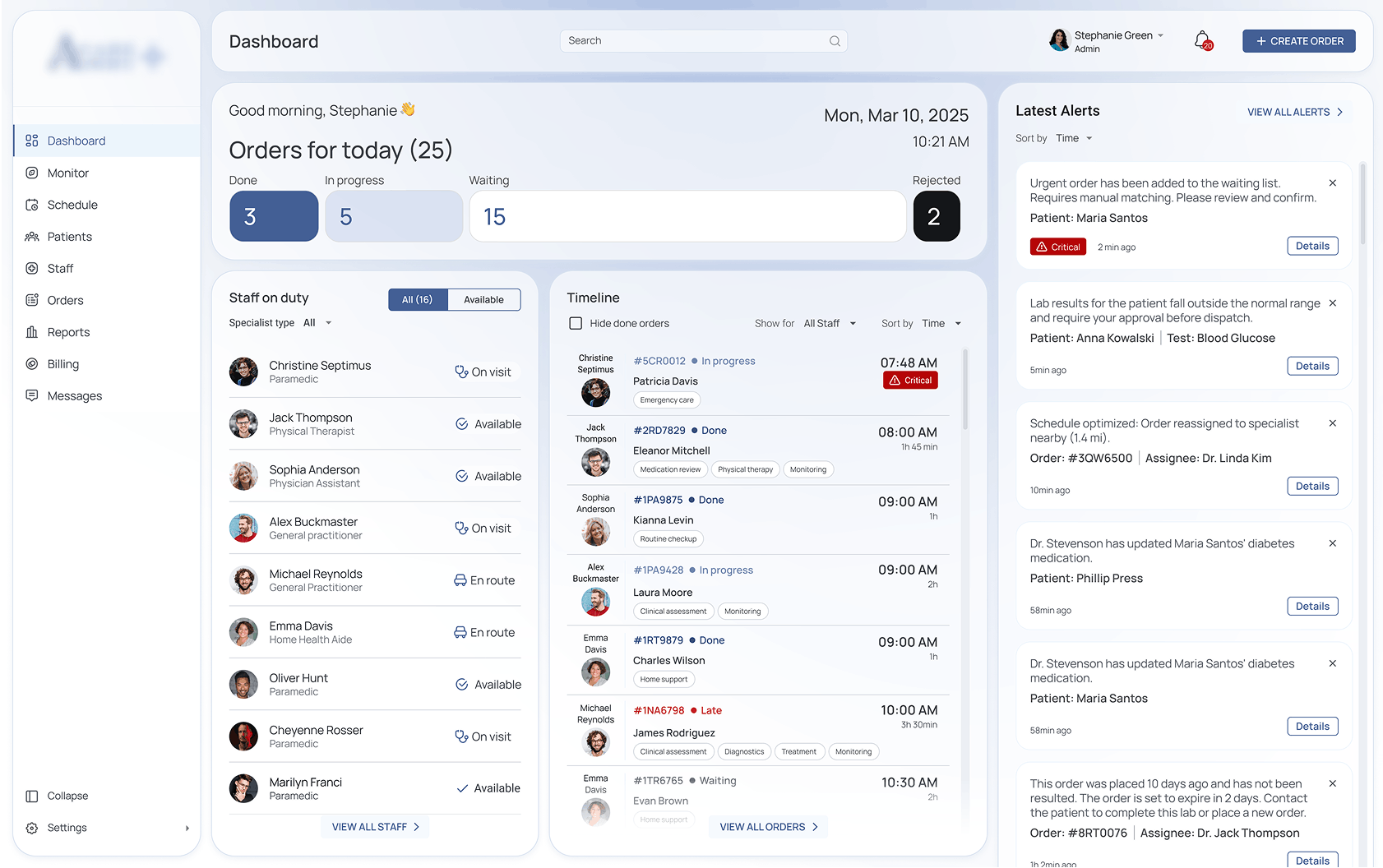
Case study: Healthcare Workforce Management Software for Ambulatory Care
XB Software worked with a healthcare organization that needed to bring structure to fragmented scheduling and care coordination processes across ambulatory services. Besides the volume of shifts, the challenge also was in the lack of a unified view of who is available, who is qualified, and where staffing risks were building up.
The solution introduced a centralized scheduling layer that connected staff availability, role requirements, and real-time operational demand. When a shift gap appears, the system suggests suitable clinicians based on certifications, workload, and location.
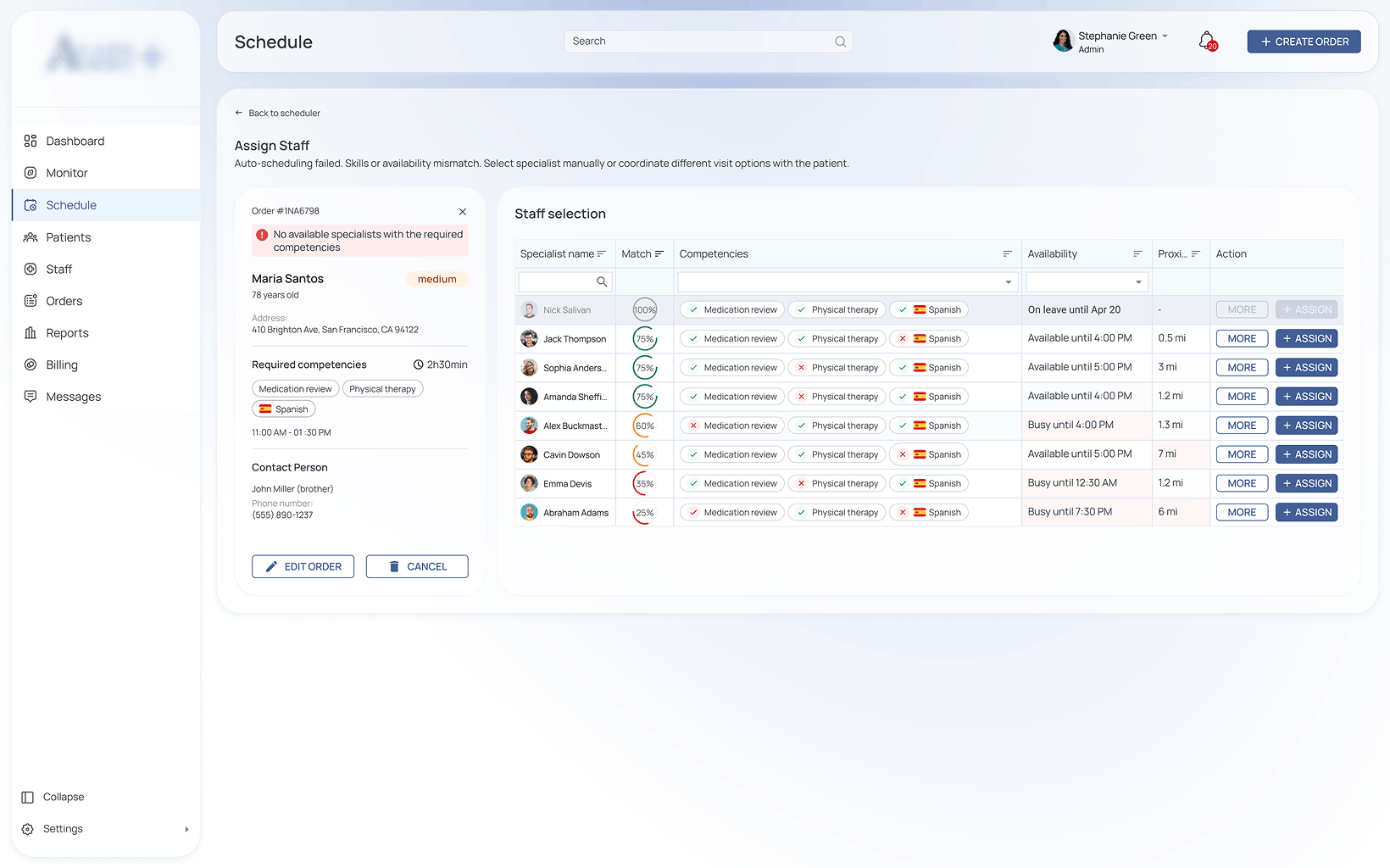
Automatic patient-staff matching in ambulatory care workforce management system
This reduced the time spent manually searching for replacements and removed a large portion of last-minute coordination overhead.
- Implements predictive analytics
Predictive analytics for staffing adds another layer of support. By analyzing historical appointment volumes, seasonal patterns, provider utilization, and patient demand trends, healthcare organizations can anticipate future staffing needs more accurately.
For example, an ambulatory surgery center may identify recurring periods of increased demand and adjust schedules before overtime becomes necessary. Similarly, specialty clinics can prepare for predictable fluctuations tied to chronic disease management cycles or preventive care initiatives.
It helps to use available resources more strategically.
- Reduces administrative burden through better coordination
One of the biggest contributors to clinician burnout is everything surrounding patient care.
Administrative tasks consume valuable time that healthcare professionals would rather dedicate to improving patient outcomes. Care coordinators track follow-ups through spreadsheets. Front-desk teams manually contact patients about appointment changes. Managers spend hours resolving scheduling conflicts. Nurses search for information scattered across disconnected systems.
These seemingly small inefficiencies accumulate quickly. Medical group data shows that provider workload (measured in patient visits and clinical activity) has increased by ~2-3% year over year, while staffing ratios continue to decline. Care coordination software helps to eliminate much of this friction by centralizing communication and workflows.
Instead of switching between multiple applications, staff members can access relevant information from a single environment. Tasks become easier to assign and monitor. Updates become visible to everyone involved in the patient’s care journey. Integrated alerts reduce the likelihood of missed follow-ups. Communication improves across care teams.
As operational friction decreases, healthcare professionals regain time and cognitive capacity. This supports better work-life balance while improving the overall patient experience.
Build vs. Buy: When Custom Healthcare Workforce Management Software Makes Sense
For some organizations, commercially available healthcare workforce management software provides everything they need. For others, off-the-shelf products introduce new limitations.
Ambulatory care organizations frequently develop highly specialized workflows based on provider types, scheduling rules, care plans, reimbursement models, and patient populations. A generic platform may cover 80% of requirements while forcing teams to work around the remaining 20% through manual processes. Over time, those workarounds create the same inefficiencies organizations hoped to eliminate.
Custom ambulatory care software development offers an alternative approach.
Rather than adapting operations to fit predefined functionality, healthcare providers can build solutions aligned with existing clinical and administrative workflows. This becomes especially valuable when organizations require complex EHR integration, telehealth capabilities, advanced reporting, flexible staffing models, or unique care coordination processes.
The decision isn’t always a choice between buying and building entirely from scratch.
Many healthcare organizations adopt hybrid approaches, integrating specialized functionality into existing systems while preserving previous technology investments.
The right answer depends on organizational complexity, growth plans, and long-term strategic priorities.
Read Also Top 11 Healthcare Software Development Companies in USA
Final Thoughts: From Workforce Management to Better Patient Care
Staffing shortages may remain one of healthcare’s defining challenges for years to come. But burnout and operational inefficiency don’t have to be accepted as inevitable consequences.
Ambulatory care workforce management represents an opportunity to rethink how work gets done.
By automating repetitive administrative tasks, improving care coordination, supporting flexible staffing models, and providing real-time operational visibility, healthcare organizations can create environments where clinicians spend less time navigating fragmented processes and more time caring for patients.
Ultimately, workforce management becomes about protecting the people who deliver care every day. Because when healthcare professionals have the support they need to succeed, patients benefit too.
And that may be one of the most important investments ambulatory organizations can make for the future. So, if you need a software development partner that can provide you with a suitable workforce management solution, contact us.