Summary
Machine learning transforms manufacturing by combining rule-based automation with predictive insights to optimize scheduling, maintenance, and quality control. Backed by XB Software’s expertise in custom manufacturing and AI development, the article covers data requirements, challenges, a real case study, and a practical implementation roadmap.
Manufacturing efficiency depends on coordinating multiple variables at once: incoming orders, production deadlines, equipment availability, workforce capacity, material supplies, and quality requirements. Even a small change in one area can affect the entire production schedule.
Machine learning offers manufacturers a smart way to tackle these production challenges. By analyzing historical and real-time operational data, ML models can identify recurring patterns, estimate future outcomes, and support decisions about production planning, maintenance, quality control, and resource allocation. This article explores practical applications of machine learning, the data and infrastructure they require, and how manufacturers can approach implementation.
How Does Machine Learning Work in Manufacturing?
Machine learning is a branch of artificial intelligence that enables software to identify patterns in data and use them to make predictions or recommendations. Instead of relying exclusively on predefined instructions, an ML model learns relationships from historical examples and applies them to new situations.
In manufacturing, these examples may include completed production orders, operation durations, machine utilization records, maintenance logs, material consumption, and quality inspection results. By analyzing this information, a model can identify factors associated with production delays, equipment failures, or recurring quality issues.
Consider production planning. A conventional scheduling system can follow predefined rules: an operation cannot start before its predecessor is completed, a machine cannot process two orders simultaneously, and certain jobs require specific equipment. These constraints are essential for creating a feasible production schedule.
However, predefined rules cannot always determine how long a particular operation will take under changing conditions. A machine learning model can analyze historical production records to estimate operation duration based on order characteristics, materials, equipment, and other relevant factors. The scheduling system can then use these estimates when calculating expected completion dates.
This distinction explains how traditional automation and ML complement each other:
- Rule-based automation enforces production constraints, checks machine availability, and triggers predefined action;
- Machine learning analyzes historical patterns, predicts likely outcomes, and provides estimates or recommendations;
- Production management software combines these capabilities with operational data and interfaces that allow employees to review and adjust plans.
Together, these capabilities support manufacturing AI process automation, combining predefined operational rules with predictive insights to improve how production tasks are coordinated. This combination is central when using AI in manufacturing processes: automation handles established operational logic, while predictive models help to address decisions that depend on changing conditions.
What Data Is Needed for Machine Learning in Manufacturing?
The US National Institute of Standards and Technology (NIST) reports that 40% of surveyed manufacturers were deploying AI in production planning. However, the usefulness of the deployed AI tools depends heavily on the quality and relevance of the data used for training and analysis.
Manufacturers do not necessarily need to collect every possible operational metric. They need information that directly relates to the problem they want to solve, so different applications require different datasets.
| Data type | Potential sources | Manufacturing applications |
| Order history | ERP, order management systems | Demand forecasting, delivery estimates, order pattern clustering |
| Production operations | Manufacturing Execution System (MES), scheduling systems, production logs | Operation duration prediction, production planning |
| Equipment data | IoT sensors, machine controllers, maintenance records | Equipment failure prediction, predictive maintenance |
| Inventory records | ERP, warehouse management systems | Material demand forecasting, inventory optimization |
| Quality records | Inspection systems, laboratory reports, production logs | Defect detection, quality prediction |
| Workforce information | Workforce management and scheduling systems | Workload balancing, resource allocation |
Connecting these sources is often more challenging than selecting a machine learning algorithm. Different systems may use inconsistent identifiers, measurement units, timestamps, or data formats. Some records may be incomplete, duplicated, or outdated.
Before training a model, manufacturers should establish how information will be collected, validated, synchronized, and maintained. Data quality directly affects model validation and the reliability of predictions. A sophisticated algorithm cannot compensate for missing production records or inaccurate equipment measurements.
Top Machine Learning Applications in Manufacturing
Machine learning can support different stages of the manufacturing lifecycle, from planning incoming orders to monitoring finished products. Industrial machine learning is particularly valuable when predictive models can address recurring operational problems and support decisions across connected production processes.
The following machine learning use cases in manufacturing illustrate where predictive models can support existing processes.
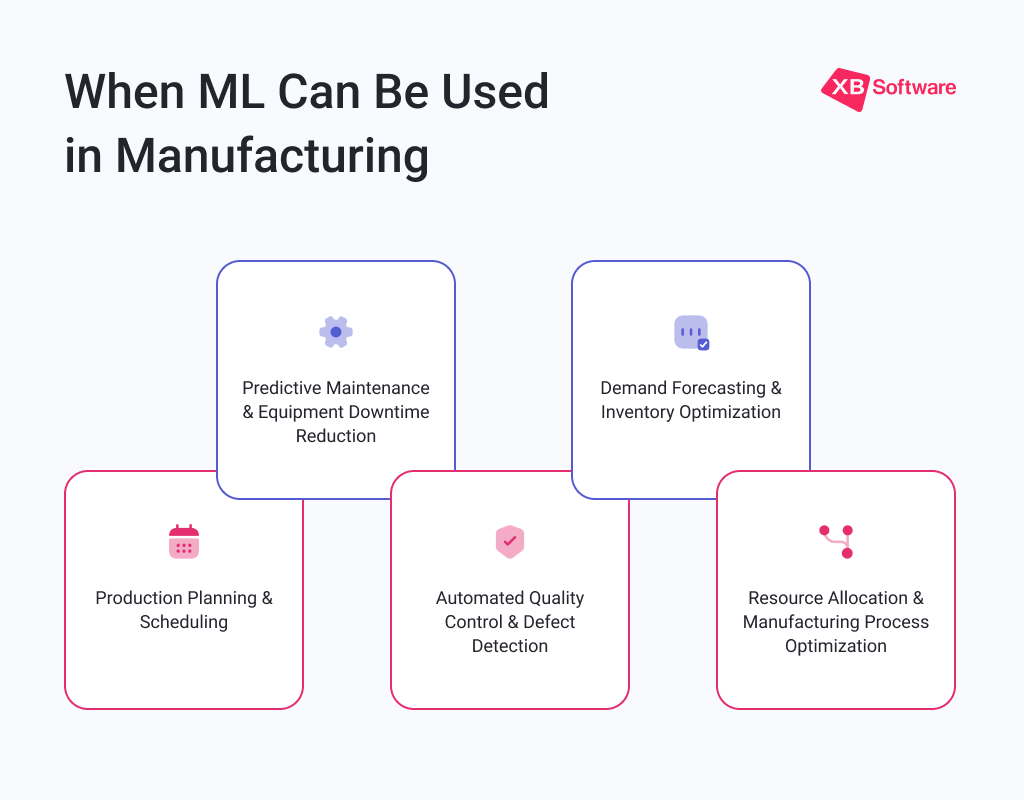
Production Planning and Scheduling
Production planning involves coordinating orders, operations, equipment, employees, and delivery commitments. As the number of simultaneous orders increases, managers must account for more scheduling constraints and dependencies.
Machine learning for scheduling can help to estimate how long individual operations are likely to take. Models trained on historical production records can identify patterns associated with processing times, including order characteristics, material types, equipment, and production conditions.
However, AI production planning does not eliminate the need for scheduling rules. A model may estimate operation duration, but the scheduling engine still needs to check machine availability, task dependencies, and production priorities. Combining both approaches helps manufacturers to create schedules that are not only more predictable but also operationally feasible.
Predictive Maintenance and Equipment Downtime Reduction
Unexpected equipment failures can disrupt production schedules, delay orders, and increase maintenance costs. Traditional preventive maintenance typically follows fixed intervals, while reactive maintenance begins after a problem occurs. Both approaches have limitations: equipment may be serviced too early, or a failure may happen between scheduled inspections.
Predictive maintenance using machine learning offers a more data-driven alternative. Models analyze equipment performance and historical maintenance records to identify patterns that may indicate developing problems. For example, an unusual increase in vibration combined with rising operating temperature may indicate that a component is deteriorating. A predictive model can identify this combination as a potential warning sign and help maintenance teams investigate before the equipment fails.
AI for predictive maintenance in manufacturing can support maintenance prioritization, spare-parts planning, and decisions about when to inspect or service equipment. However, predictions should be validated against actual maintenance outcomes. False alarms may lead to unnecessary inspections, while missed warnings can create a false sense of security.
Automated Quality Control and Defect Detection
Quality inspection is another area where machine learning can help manufacturers to identify problems earlier and more consistently. For example, computer vision models can analyze images captured by cameras on production lines or during inspection. Depending on the application, they may identify surface scratches, cracks, incorrect dimensions, missing components, or other visible defects.
Machine learning in quality control can also involve analyzing structured production data. A practical implementation may combine image recognition with production records. However, automated detection does not automatically guarantee accurate quality assessment, so models must be trained on representative examples of both acceptable and defective products.
Demand Forecasting and Inventory Optimization
Demand fluctuations make it difficult to determine how much material a manufacturer should purchase and when it should be available. Ordering too much ties up working capital and increases storage costs. Ordering too little can interrupt production and delay customer orders. Demand forecasting using machine learning helps manufacturers to estimate future requirements by analyzing historical orders, seasonal patterns, market trends, and other relevant variables.
These predictions can support purchasing and inventory decisions. For example, a model may identify recurring increases in demand for a particular material during certain periods. But forecasts should not be treated as guaranteed outcomes. Manufacturers should therefore combine predictive models with current operational information and allow procurement specialists to adjust recommendations when circumstances change.
Resource Allocation and Manufacturing Process Optimization
Production bottlenecks often emerge when equipment, employees, or work areas are not utilized evenly. One machine may have a growing queue of orders while another remains underused. Some production stages may consistently take longer than expected, affecting the entire workflow.
Machine learning can help to identify these patterns by analyzing production throughput, operation durations, resource utilization, and historical delays. The results can reveal where production capacity is being constrained and which factors contribute to inefficient workflows.
Read Also Manufacturing Software Systems for Improving Production Operations
ML-Powered Production Planning: A Metal Fabrication Case Study
A practical example of combining rule-based automation and machine learning comes from XB Software’s project for a metal fabrication company producing custom steel structures.
The client’s production planning relied on whiteboards, spreadsheets, and paper notes, with critical scheduling information often held by the production manager. As the number of simultaneous projects increased, managers faced scheduling conflicts, resource bottlenecks, and communication delays.
Building a Centralized Production Planning System
XB Software developed an AI-powered production scheduling software centered around an interactive Gantt chart. This centralized approach laid the foundation for production scheduling optimization, giving managers better visibility into task dependencies, equipment availability, and resource allocation.
Each customer order was represented as a parent task, with individual manufacturing stages displayed as connected subtasks. This made task dependencies and potential bottlenecks easier to identify.
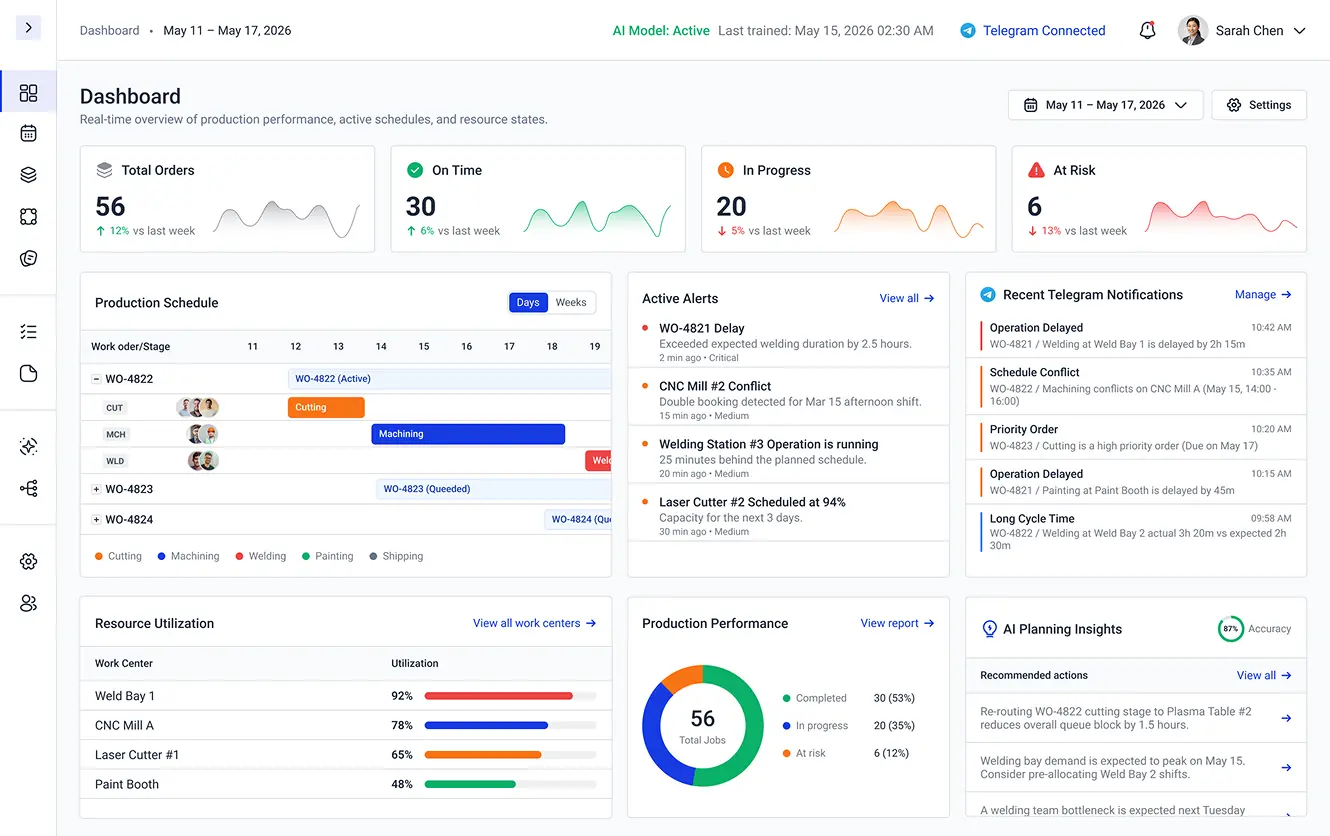
The first stage focused on rule-based automation rather than machine learning. The system checked machine availability before saving schedule changes, preventing overlapping assignments. It also monitored production progress, compared actual operation durations with expected values, generated follow-up tasks, and sent notifications about delays and scheduling conflicts via Telegram Bot API.

This functionality addressed immediate coordination problems and established a centralized source of production history.
Read Also Production Scheduling and Resource Planning with Gantt Charts
Introducing Machine Learning After Data Accumulation
After several months of operation, the platform had accumulated enough data on production orders to support an additional ML component.
XB Software introduced a Python microservice using scikit-learn to perform order pattern clustering. The model analyzed manufacturing characteristics and grouped similar production orders into clusters. This helped the system to identify recurring workflow patterns and provide more relevant planning insights for future orders.
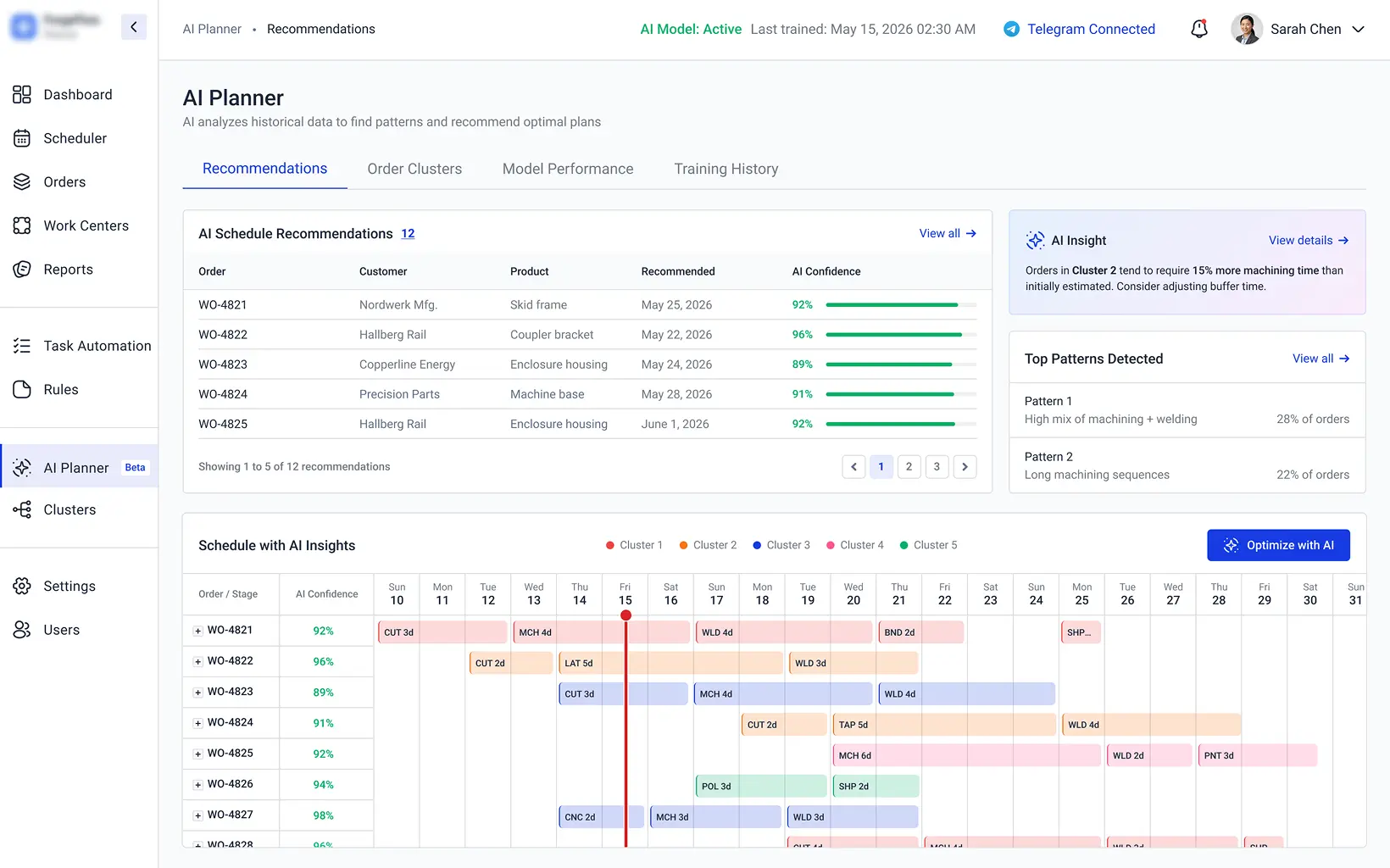
The model was periodically retrained using newly completed orders, allowing it to incorporate additional production history. Results were displayed within the scheduling interface, where managers could distinguish order groups and use the information when reviewing future plans.
Importantly, machine learning did not replace the scheduling engine or make final production decisions. Rule-based automation continued to enforce operational constraints, while the ML component provided additional information to support planning. Production specialists retained control over the schedule.
This project reflects XB Software’s experience in custom online scheduling software development for businesses with complex planning and resource management requirements and shows how machine learning adds predictive capabilities once enough historical data has accumulated.
When Does Custom Manufacturing Software Make Sense for Machine Learning?
Manufacturers do not always need a custom machine learning platform. The right approach depends on the complexity of their workflows, existing software, data infrastructure, and the level of integration required.
- Ready-made software may be sufficient when a company has standard production processes and its requirements are covered by existing ERP, MES, inventory, or predictive maintenance products. These systems can reduce implementation time, although their configuration options and integration capabilities may be limited. So, white-label solutions like Stockelix may be a good alternative in this case.
- Extending existing software can be a practical option when the current platform already manages core production workflows but lacks a specific capability. For example, a manufacturer may add a predictive analytics module to an existing scheduling system or connect equipment monitoring data to its maintenance platform.
- Custom development becomes more relevant when production processes involve specialized rules, complex dependencies, or integrations that standard products cannot support effectively. A manufacturer may need a scheduling application that reflects its exact production stages, equipment constraints, and workforce allocation practices while incorporating ML models for forecasting or recommendations. A custom system can also be designed to introduce machine learning gradually. This approach avoids making the entire production workflow dependent on a model before its performance has been validated.
The choice should also account for the total cost of ownership. Custom software services involve ongoing support of the system infrastructure, data management, model monitoring, and maintenance. If a standard product can address the problem reliably, building a new platform may not be justified.
XB Software helps manufacturing companies assess these requirements and develop software that supports their operational processes. Our manufacturing software solutions include production planning, resource management, workflow automation, system integration, and custom application development.
When a project requires predictive capabilities or AI integration, our AI software development services can support the process from identifying suitable use cases and preparing data to developing, integrating, and evaluating ML components.
What Makes Machine Learning Difficult to Adopt in Manufacturing?
Despite the potential of AI and machine learning in manufacturing, these technologies are not plug-and-play tools. Their effectiveness depends on production data, system integration, operational consistency, and the ability of employees to use their outputs.
Several challenges deserve attention before implementation.
Insufficient or inconsistent data. Historical records may be incomplete, stored in disconnected systems, or maintained in formats that are difficult to combine. If production durations are recorded inconsistently or equipment failures are not documented, models may learn misleading patterns. Data preparation and validation can therefore take a significant share of the project effort.
Integration with legacy systems. Manufacturing environments often combine ERP platforms, MES software, machine controllers, spreadsheets, and custom applications. Connecting these sources may require API development, data transformation, and synchronization mechanisms. An ML model that cannot access reliable operational data or return its predictions to the systems employees use will have limited practical value.
Changing production conditions. Manufacturing processes evolve as companies introduce new materials, equipment, products, and operating procedures. A model trained on historical data may become less accurate when these conditions change. This problem, often referred to as model drift, requires ongoing performance monitoring and periodic retraining.
Prediction errors and unclear recommendations. Machine learning produces estimates, not guarantees. An inaccurate delivery forecast or missed equipment warning can affect production decisions. Manufacturers need to understand how predictions are evaluated, which decisions can safely rely on them, and when human approval is required.
Employee adoption. Production managers and workshop personnel may be reluctant to trust recommendations from a system they do not understand. If an application introduces unfamiliar workflows or hides the reasoning behind its outputs, employees may avoid using it or maintain parallel spreadsheets. Involving operational specialists in requirements gathering, testing, and rollout helps to address this risk.
These challenges also explain why the benefits of AI in the manufacturing industry depend on more than model accuracy. Successful adoption requires a reliable data foundation, integration with daily workflows, and clear responsibility for operational decisions.
Read Also Common Manufacturing Challenges and Software-Based Solutions
How to Implement ML in Manufacturing: A Practical Roadmap
A successful implementation should begin with a clearly defined operational problem, not with the choice of an algorithm. The following roadmap helps manufacturers to move from an initial idea to a solution that supports real production workflows.
Choose a challenge that has a measurable business impact. It could be inaccurate delivery estimates, recurring equipment failures, excessive material inventory, or uneven workload distribution.
Define how success will be measured. Depending on the use case, relevant indicators may include downtime, overdue orders, production cycle time, defect rates, inventory turnover, or forecast accuracy.
Identify which systems contain the information needed to address the problem. Review historical records, data formats, missing values, update frequency, and access restrictions.
Determine whether existing data is sufficient to train and validate a model. If not, the project may first require improvements to data collection, integration, or production tracking.
Build a limited version of the model using a representative dataset. The purpose is to verify whether the selected approach can identify useful patterns or produce sufficiently accurate predictions.
For example, a production scheduling project might begin with estimating operation durations for a specific machine group rather than attempting to optimize the entire factory at once.
Evaluate predictions using data that was not used during training. Compare model outputs with actual production outcomes and assess performance across different order types, machines, and operating conditions.
Model validation should also consider the cost of errors. A slightly inaccurate delivery estimate may be manageable, while an unreliable equipment failure prediction could have serious operational consequences.
Once the approach has been validated, connect it to the applications employees already use. Depending on the architecture, this may involve ERP, MES, scheduling software, inventory systems, or equipment data sources.
Predictions should appear in the context of relevant workflows. For example, estimated operation durations should be available to the production planner when reviewing a schedule, rather than being isolated in a separate analytics dashboard.
Production conditions change, and models may become less accurate as new products, equipment, or processes are introduced. Monitor prediction quality, collect feedback from employees, and retrain models when necessary.
The system should also provide a way to identify unreliable predictions and allow responsible specialists to override recommendations when operational circumstances require it.
Conclusion: Making Manufacturing Decisions More Predictable
Machine learning can help manufacturers to make production decisions based on more than predefined rules and individual experience. By analyzing historical and real-time operational data, predictive models can support production scheduling, equipment maintenance, quality control, inventory planning, and resource allocation.
However, the value of these technologies depends on how well they fit existing production processes. Reliable data, realistic model validation, integration with operational systems, and employee involvement are essential for effective manufacturing workflow optimization and turning predictions into practical improvements.
If your manufacturing business is considering machine learning or needs software tailored to its production workflows, contact us to discuss your project and explore an approach that fits your operational requirements.