Summary
AI coding accelerates development, but without process governance, it increases risk and technical debt. By pairing AI with clear specifications, continuous testing, and staged execution, modern software vendors ensure predictable, high-quality SaaS delivery.
When CEOs evaluate a software vendor, they often focus on development capacity, hourly rates, and technical credibility. While these criteria are important, the rapid integration of AI into software engineering introduces a far more critical question: How does a delivery partner prevent accelerated code production from reducing project oversight and control?
Without governance, project predictability often declines as requirements drift unchecked, automated testing comes late, and design contradictions surface long after implementation. XB Software’s experience on a recent SaaS project demonstrates how a structured delivery framework keeps AI generation disciplined, transparent, and aligned with business goals.
AI-Assisted Software Delivery Needs More Than Speed
Promotional narratives surrounding AI-assisted engineering mostly focus on a single metric: speed. Marketing campaigns emphasize rapid code generation and shortened sprint cycles. However, evaluating an engineering partner solely on velocity is a flawed buying criterion.
Accelerating development without a disciplined approach leads to the accumulation of structural flaws. A vendor that focuses exclusively on speed creates hidden business costs that emerge later in the product lifecycle:
- Requirements that remain vague and shift throughout active implementation;
- Features that appear complete during surface-level reviews but prove difficult to validate against complex business rules;
- Contradictions between user interface designs and domain logic that surface late in QA cycles;
- Test coverage that is written retroactively after generated code has already dictated application behavior;
- Heavy organizational dependence on individual developers who hold unwritten knowledge regarding system architecture.
Executive buyers must be careful when evaluating vendors that pitch AI strictly as a throughput story. Generating a higher volume of code does not automatically grant greater software delivery control. In many cases, unguided acceleration produces faster ambiguity.
Practical Application: Governing AI in a Web SaaS Delivery
To address these risks in one of our recent SaaS projects, XB Software applied a SpecKit-style operating model centered on clear written specifications, iterative requirements clarification loops, controlled task breakdown, staged frontend and backend implementation, and automated testing that evolved alongside system architecture. For executives procuring SaaS application development services, this disciplined framework clarifies decision-making logic, surfaces technical trade-offs before code is committed, and establishes predictable software delivery.
The primary value of this engagement came from treating generative tools as a controlled layer inside a governed system rather than relying on AI as an autonomous engine. This distinction directly influences the measurable ROI of AI-assisted software engineering. When a vendor maintains strict oversight, leadership receives dependable releases rather than unpredictable code dumps.
Read Also Why faster AI coding does not automatically mean faster SaaS delivery
Spec-Driven Development Creates a Clearer Software Delivery Strategy
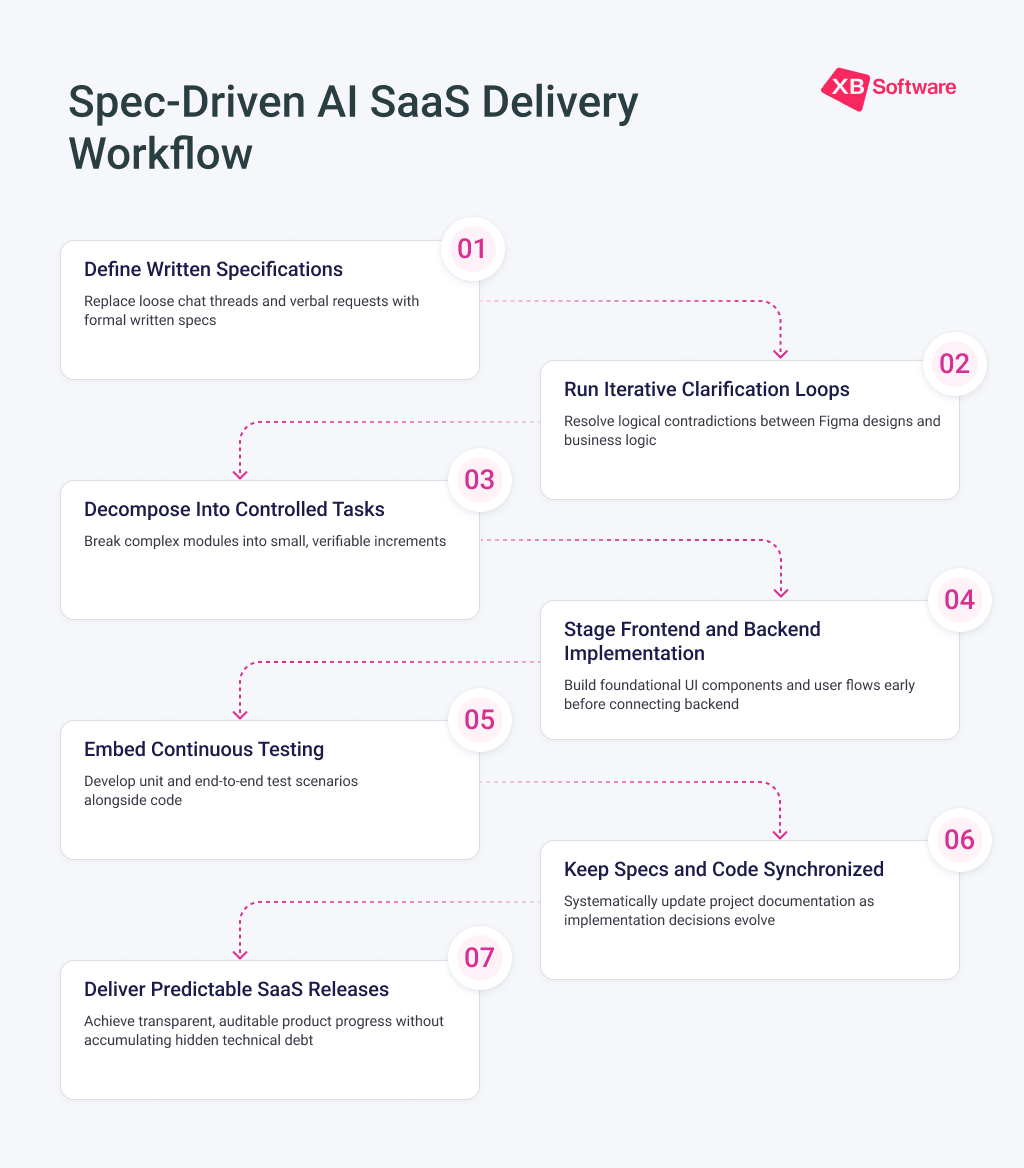
A defining pattern was our team’s refusal to rely on loosely defined client requests or ad hoc verbal corrections. Instead, engineering progress was driven through a repeatable sequence: formal specification, iterative clarification, structural planning, task generation, and implementation.
While this workflow appears technical on the surface, its commercial value for executive leadership is direct and practical. A vendor utilizing a spec-driven development architecture offers a clear and transparent operating rhythm.
Rather than allowing edge cases to hide in chat threads or relying on individual memory to recall verbal decisions, the team used written specifications as the primary control layer. Iterative clarification loops were deployed to detect logical contradictions before engineering began. Task generation was derived strictly from verified specifications rather than verbal interpretations. When our engineering team uncovered new technical or domain details during execution, that updated context was systematically written back into the project documentation rather than remaining isolated as personal knowledge.
For SaaS clients, this structured approach yields distinct operational advantages:
- Auditability. Every technical task follows visible, documented logic;
- Early correction. Misunderstandings surface while they are still cheap to fix;
- Continuity. Institutional knowledge survives team transitions because system context lives in the documentation, not in people’s heads.
By establishing a governed operational model through dedicated AI-assisted software development services, XB Software built a delivery environment where the SaaS product remained coherent and manageable as system complexity expanded. This approach forms the foundation of a resilient software delivery strategy in modern AI-assisted software engineering.
Better Specifications Reduce Risk in Software Delivery
The majority of software project delays are caused by unclear intent. Ambiguous business requirements force engineers to make unverified assumptions, leading to expensive rework when finished features fail to align with executive expectations.
Throughout the project, the XB Software’s delivery team focused on improving input quality. Requirements were systematically refined using SpecKit’s /clarify command. Logical contradictions between Figma interface designs and backend business logic were identified and resolved before writing implementation code. Testing scenarios were explicitly defined so that AI test generators received precise instructions rather than vague prompts. Furthermore, even changes introduced through Plan Mode were discussed in terms of whether official specifications would remain synchronized.
Maintaining synchronized documentation addresses major sources of SaaS development risk. When active implementation drifts away from documented architecture, the hidden cost accumulates through continuous re-explanation, interface friction, and prolonged refactoring.
XB Software demonstrated that a capable technical partner does not quietly absorb incomplete requirements and hope to resolve issues mid-build. A strong partner improves the quality of the delivery inputs before committing resources.
Using a SpecKit-style workflow provided a disciplined mechanism to convert partial requests into executable engineering tasks without letting the delivery process degrade into informal improvisation. Incorporating continuous software development risk assessment into daily workflows provides the most effective framework for proactive risk management in software delivery.
Read Also How specifications keep AI-assisted development aligned
A Structured Delivery Model Improves Software Delivery Efficiency and Visibility
Delivery sequencing plays a central role in keeping software projects legible and manageable. Rather than attempting to generate massive product modules in a single step, our engineering team divided execution into controlled, verifiable increments.
We focused on building reusable foundational components during early sprints, establishing standard UI elements and data handling rules before addressing complex features. Simpler functional areas were implemented first. Frontend user flows were structured ahead of backend logic, making product behavior and user interactions visible to stakeholders early in the build cycle. Complex core systems, such as login and access control, were intentionally postponed until the team built deep context and confidence within the application domain.
This disciplined sequencing provides multiple management benefits:
- Executive leadership gains clear progress visibility, inspecting working software early rather than relying on status reports;
- Code reviews remain focused on bounded functional areas, reducing cognitive fatigue for product owners;
- Strategic priorities can be adjusted based on working software before a significant development budget is locked into incorrect assumptions;
- The client retains superior steering capability throughout the entire development lifecycle.
Asking AI tools to generate massive, combined chunks of frontend layouts, backend APIs, and database schemas simultaneously creates severe review bottlenecks. Output may appear quickly, but reviewing and verifying monolithic code blocks requires immense manual effort. Maintaining effective AI software delivery governance ensures that complex work is divided into manageable increments.
Continuous Testing Protects AI Code Quality as Architecture Evolves
Software quality assurance cannot be relegated to a final cleanup phase scheduled right before release. Treating testing as a late-stage formality creates severe delivery bottlenecks, introduces release anxiety, and exposes SaaS platforms to undetected regression issues.
In this project, validation was integrated into the daily engineering routine. Tests were written alongside feature code rather than added retrospectively. End-to-end testing scenarios were designed as a core structural element of delivery. Test criteria were defined with increasing specificity over time, allowing AI tools to generate relevant, targeted test suites rather than superficial assertions. Additionally, Plan Mode was used to explore test scenarios and edge cases without cluttering the main code repository with redundant documentation.
This integrated approach demonstrates why continuous testing in software development is critical when using generative tools. However, automated test generation in an AI context requires strict human oversight.
While AI tools can generate test scripts rapidly, maintaining AI-assisted code quality requires active human review. Generative models can easily write passing tests that validate flawed logic if the underlying prompt or code contains subtle errors. Some tests could reinforce the same mistakes as the implementation if left unreviewed. Establishing dependable AI code validation requires experienced engineers who verify test intent, evaluate edge cases, and ensure test suites reflect true business logic.
Read Also Why AI-assisted products can fail between demo and production
What AI-Assisted Software Delivery Means for Vendor Value in Practice
From a buyer’s perspective, the practical takeaway extends far beyond a single SaaS project. The real commercial value of an engineering partner comes from combining modern tooling with rigorous process discipline.
Throughout the project, XB Software delivered value by integrating several operational behaviors:
- Transforming vague product concepts into structured, executable technical tasks;
- Keeping written specifications continuously synchronized with active implementation code;
- Sequencing technical delivery so that project progress remains reviewable;
- Utilizing AI tools where they increase velocity without sacrificing human judgment;
- Embedding quality validation habits directly into daily workflows rather than postponing testing until QA.
This combination distinguishes a mature software development partner from a simple staff augmentation vendor. Most organizations do not struggle to find developers who can write code. The true challenge is finding engineering partners who maintain architectural clarity, system documentation, and predictable momentum as product scope grows.
When structured effectively, AI-assisted software delivery becomes a catalyst for product stability. Maintaining strict AI development governance ensures that automation serves the long-term strategic goals of the SaaS platform rather than creating technical debt.
Checklist: What CEOs Should Look For in a Governed Software Delivery Model
When leadership evaluates an external development partner that advertises AI-driven speed, standard questions about toolsets are insufficient. Executive buyers should evaluate the vendor’s underlying delivery operating model to determine whether their process yields predictable SaaS engineering.
CEOs and product leaders should verify whether a prospective vendor demonstrates:
- A written delivery process that systematically clarifies requirements and catches contradictions before coding begins;
- A clear method for keeping active implementation decisions synchronized with project documentation;
- A sequencing execution model that presents progress in manageable, inspectable increments;
- An integrated testing approach that validates software behavior continuously throughout the build cycle;
- A willingness to challenge ambiguous requirements rather than quietly building flawed specifications.
These criteria offer far stronger buying signals than raw acceleration claims. Evaluating these factors helps establish sustainable SaaS engineering governance.
The strategic conclusion for SaaS executives is clear. The most valuable technical partner is not the vendor that claims to automate away engineering discipline. The highest value comes from a partner that combines AI velocity with robust process controls, turning raw execution speed into transparent, high-quality, and predictable product growth.
To learn how spec-driven delivery and governed engineering can bring predictability to your next product initiative, contact us today.