Summary
AI tools build impressive demos fast, but prototypes lack release reliability. Learn how software engineers can help stabilize your vibe-coded app, protect your investment, and turn fragile AI code into a scalable, production-ready SaaS platform without starting from scratch.
Inheriting a software project that looks impressive during a quick walkthrough but collapses under real usage is one of the most frustrating challenges in modern software delivery. AI coding tools make it easy to assemble visually rich user interfaces in days. However, underneath those polished screens, a vibe-coded app often has fragile architecture, duplicated requests, hardcoded logic, and brittle components that function only under perfect conditions.
This article examines a real-world recovery project where XB Software took charge of an inherited vibe-coded web app. Instead of launching an expensive complete rewrite, the engineering team established a method to stabilize the system, reconstruct missing backend behavior, enforce typed data contracts, and introduce automated testing. The result was a clear path from an unpredictable prototype to a production-grade SaaS platform.
Why a Vibe-Coded App Is Not Production-Ready
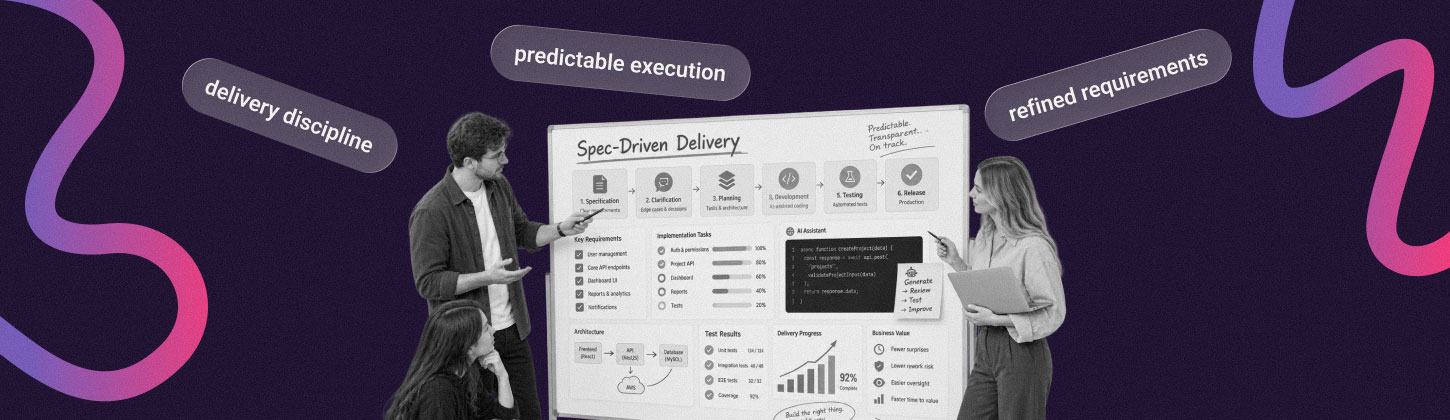
A functional demonstration is fundamentally different from a release candidate. A presentation demo exists to prove that a concept can be rendered on screen. It shows that key forms submit when clicked in a specific order and that primary navigation elements load without throwing errors. In contrast, a release-ready SaaS application requires long-term maintainability, predictable state management, reliable data processing, and structural safety during ongoing updates.
Achieving true vibe-coded app production readiness requires shifting focus away from surface appearance and toward underlying engineering control. Bringing an AI prototype to production demands data validation, clear responsibility boundaries, and reproducible deployment steps. Without this foundation, you’ll have to deal with endless emergency hotfixes, poor application performance, and lost customer trust.
Read Also Compare vibe coding with traditional and AI-assisted development
Why the Front-End Should Not Be Treated as the Source of Truth
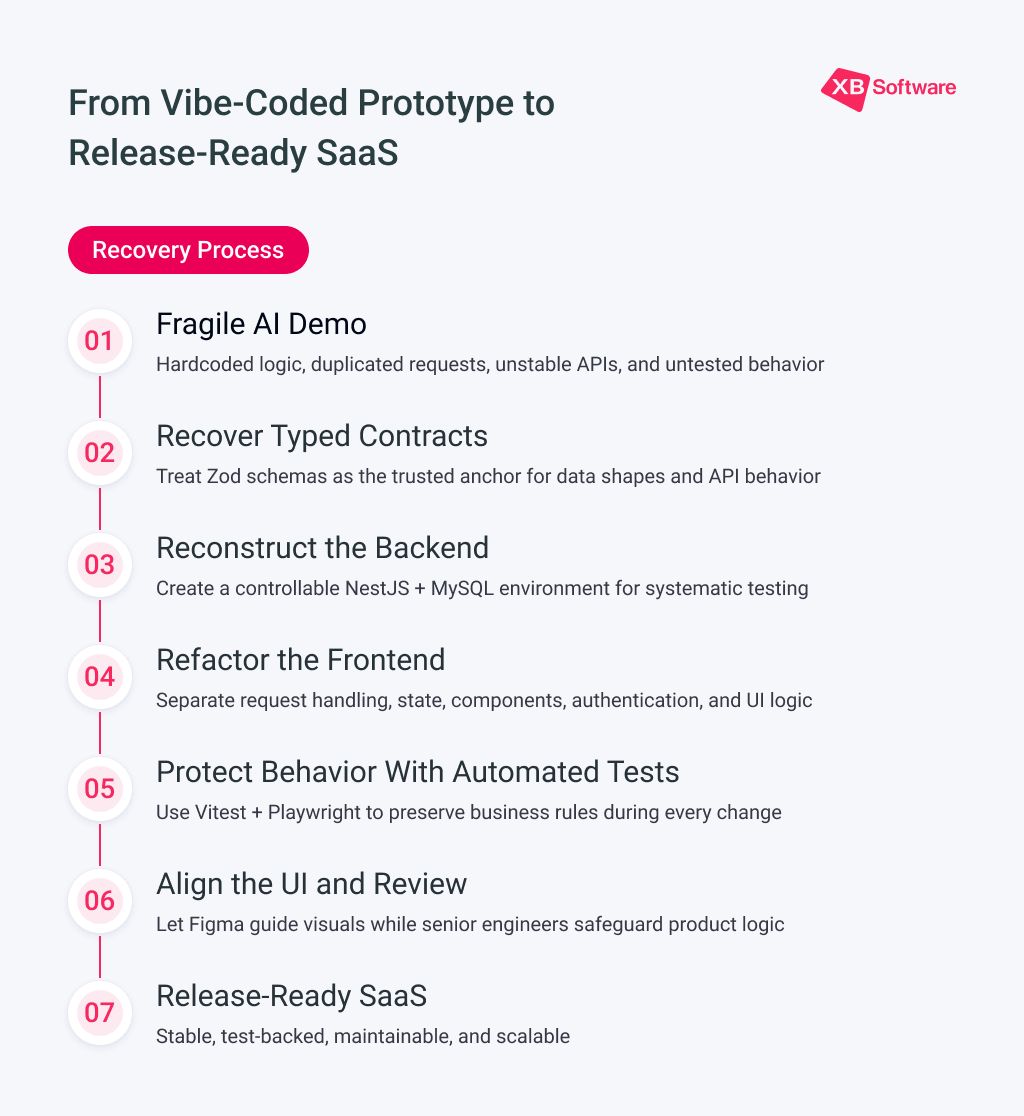
When XB Software conducted an initial vibe-coded app audit, the inherited codebase revealed some serious structural flaws. The frontend was calling dozens of backend endpoints, but a substantial part of those requests failed continuously during normal user sessions. In multiple places, identical network requests triggered repeatedly in rapid succession.
The primary cause was that the original application logic was concentrated heavily inside a single pages directory. This structure mixed user interface rendering, local component state, network request orchestration, and implicit assumptions about backend server behavior into tightly coupled files.
Furthermore, the original external backend environment was slow, incomplete, and highly unpredictable. Attempting to refactor frontend components while relying on an unstable backend is a classic trap in recovery engineering. Developers end up polishing visual elements on top of shifting sand, making it impossible to distinguish between frontend state bugs and backend API failures.
The breakthrough came when the team discovered Zod-based request and response schemas embedded in the frontend repository. These Zod schemas served as the single trustworthy technical anchor. While they did not document the entire business domain, these typed contracts explicitly defined entity shapes, required payload properties, and expected API interactions.
Read Also How structured development improves AI-assisted engineering
Reconstructing the Backend Before Refactoring the Front-End
Instead of waiting for the external backend to become stable or attempting to fix frontend bugs in isolation, the team prioritized backend reconstruction. Developers built a dedicated Nest.js backend paired with a MySQL database to execute targeted backend emulation. This local server was not intended to replace the client’s enterprise infrastructure permanently, but rather to serve as a controllable environment for systematic testing and development.
The team approached this phase as a strict black-box recovery process. Every endpoint was constructed directly from the established Zod schemas and validated against real network traces captured from browser developer tools. The team compared execution results against the original API where that was still useful.
This operational sequence transformed the project trajectory. With a deterministic local backend running, developers gained full control over server state and response timing. They could inject specific error codes, simulate slow database queries, verify payload validation rules, and inspect incoming JSON bodies without external dependencies.
Establishing a stable server environment made vibe-coded app refactoring predictable. Engineers stopped guessing whether a blank screen resulted from a broken component or a failed HTTP fetch. The team laid a solid foundation for comprehensive AI-generated code refactoring across the entire client application.
Refactoring an AI-Generated Frontend Without Rewriting Everything
With a dependable local server in place, the team initiated targeted frontend stabilization. The objective was not to perform a complete code tear-down and rebuild, which would have consumed unnecessary time and budget. Instead, the engineering goal was to restore clear responsibility boundaries and enforce proper separation of concerns throughout the existing codebase.
The team executed a series of structural improvements to establish order:
- Constructed a centralized, shared HTTP layer to replace fragmented request handling;
- Removed hardcoded IDs and fragile assumptions in favor of dynamic dependencies;
- Broke down large forms that had grown into thousand-line files into smaller units;
- Eliminated duplicated and commented-out code;
- Cleaned up token handling and authentication flow to reduce avoidable bugs.
This approach to AI-generated frontend refactoring produced immediate benefits. Previously broken modules, including document management workflows and complex access control systems, became fully functional. The refactored architecture successfully supported a granular role-management framework handling hundreds of distinct user permissions.
Rather than discarding the initial prototype, the team reclaimed the existing work by organizing its component structure around clean engineering principles.
How Automated Testing Makes UI Changes Safer
To prevent silent regressions during updates, XB Software introduced a comprehensive, two-tiered automated testing strategy:
- Vitest for fast unit tests to verify that request payloads complied strictly with Zod schemas and backend responses were mapped correctly into frontend data structures;
- Playwright for end-to-end business logic validation across critical user journeys. Playwright scripts simulated real user interactions, filling out complex forms, and navigating multistep workflows.
This dual-layer testing suite reduced regression risk across the entire application lifecycle. A form could be split apart, request handling could be rewritten, and the same regression testing could flag any broken dependencies or missing payload fields.
Automated tests enabled a secure UI migration process. Developers established a repeatable verification workflow: run Playwright tests against the existing screen, refactor the visual components to align with Figma target UI, and re-run the exact same test suite. If all assertions passed, the team had empirical proof that the visual updates preserved underlying business rules. This methodology provided true peace of mind when modifying an AI-generated app.
Read Also Explore the risks between AI prototypes and production software
Using Figma Without Losing Business Logic
Visual updates often introduce unforeseen disruptions when developers rely on design tools as the source of system behavior. While Figma provides an essential target for visual layouts, color schemes, and component styling, it cannot represent dynamic SaaS state or server validation errors.
During the app modernization process, the team utilized automated tools to extract screen context directly from Figma URLs. This capability accelerated UI styling for simple screens. However, large forms created recurring problems. Large, data-heavy views routinely exceeded LLM context windows. As a result, fine details could be dropped. Furthermore, static design screens represented happy paths, not the edge cases and data states that appear in production.
Non-standard controls present another hurdle. For instance, the application contained a specialized grid control that was essential to the core user experience. Replacing this component with a generic UI library element would have destroyed critical interaction patterns. The grid had to be hand-engineered and wired to custom event handlers rather than blindly regenerated.
To maintain stability, the team adhered to a strict discipline: Figma guided the visual destination, but existing code tests guarded the product logic. This is one of the scenarios where automation can’t replace architecture, testing, or product logic validation.
Where AI Helps and When Human Review Is Still Required
AI tools played an important role in accelerating the recovery timeline, but only because they were deployed within strict engineering boundaries. Rather than treating AI models as autonomous creators, the team used them as targeted assistants supplied with precise technical context.
Engineers provided coding agents with structured artifacts, including Zod schemas, captured request and response shapes, DevTools network observations, existing React and MUI component structure, and screen-level design context coming from Figma through MCP-connected URL and node-ID lookups. Using that input, AI helped the team to:
- Scaffold Nest.js modules, data transfer objects, validation paths, and endpoint handlers;
- Propose safer refactors for the shared HTTP layer and token flow;
- Split oversized forms into smaller components;
- Draft Vitest and Playwright coverage for repetitive form behaviors.
This constrained AI usage delivered measurable speed improvements. Routine frontend refactoring tasks that typically take weeks were completed in days. The initial working combination of backend reconstruction and frontend stabilization was accomplished in approximately six working days, avoiding a multi-month manual rewrite. Efficiency gains came from compressing dozens of small engineering loops: generate a module from a contract, compare it with observed behavior, correct the mismatch, rerun tests, inspect the next failing request, and repeat.
In that loop, MCP reduced context transfer overhead. Instead of manually restating every design detail, the team could pull targeted screen context from Figma and use AI to update specific surfaces while preserving the existing component model. Prompts were constrained: update existing components instead of inventing parallel ones, work screen by screen instead of sending oversized multiscreen context, and keep the output aligned to the project’s MUI-based structure.
However, unmanaged AI output poses severe risks if left unchecked.
The team observed that AI-generated backend work was only partially reliable and required close supervision. Large contexts caused detail loss. Automatically generated tests sometimes needed correction. A second AI agent was not considered a sufficient validator of the first agent’s logic. Rigorous AI-generated code review performed by experienced senior developers remained indispensable.
Organizations seeking to scale their technical capabilities safely can leverage specialized AI-assisted software development services to combine automated coding speed with expert human oversight.
What CTOs Should Know About Taking a Vibe-Coded App to Production
For engineering executives, the central lesson of AI-assisted development is clear: rapid prototyping speed is valuable, but speed without structural discipline creates compounding technical debt. Successfully navigating the transition from vibe coding to production requires restoring technical control through a sequence of engineering operations.
When evaluating an inherited or rapidly scaffolded codebase, CTOs should apply key takeaways from real-world recovery projects:
- Never assume an unstable frontend accurately reflects true business logic;
- Treat typed contracts, such as Zod schemas, as primary recovery assets to anchor data structures;
- Prioritize backend emulation to unblock frontend development and eliminate external environment dependencies;
- Focus refactoring efforts on establishing clear responsibility boundaries and separating concerns before attempting visual polish;
- Implement automated testing with Vitest and Playwright to make UI updates and design migrations commercially safe;
- Use Figma as a visual reference for user interfaces, never as an authoritative source of system behavior;
- Enforce mandatory human review for all AI-generated code to safeguard architecture, security, and business rules.
Taking a vibe-coded app production pipeline from a fragile demo to an enterprise-level product is about changing the order of operations. By anchoring development in explicit contracts, stabilizing server environments, enforcing modular component boundaries, and protecting business behavior with automated test suites, organizations can confidently transform an unpredictable prototype into a release-ready SaaS platform.
To evaluate your existing application architecture or plan a structured modernization effort, explore our comprehensive software product development services or contact us directly to speak with our senior engineering team.