Summary
Operational silos plague growing contractors as data scatters across disconnected systems. This article explores a phased approach to construction software modernization, without disrupting active projects. Learn how to audit workflows, prioritize fixes, and roll out changes incrementally.
As mid-sized contractors grow, they face more projects, subcontractors, and moving parts that often means more chaos. Information scatters across spreadsheets, scheduling tools, email threads, and messaging apps. Construction companies struggle when project, field, and back-office teams operate on fragmented information, inconsistent workflows, and delayed reporting.
Construction software modernization can solve these issues by redesigning how information flows between systems. This doesn’t mean replacing everything at once and can be achieved without disrupting active projects or weakening controls. In this article, we’ll walk through a practical, phased roadmap to show you how to prioritize which workflows to fix first and preserve critical business data.
How Legacy Construction Software Creates Operational Silos
Operational silos in construction do not appear overnight. A company buys a scheduling tool for one project team. Another department adopts a procurement system. Field crews start using a mobile app for daily reports. Over time, the organization accumulates disconnected applications, duplicate vendor and project records, inconsistent cost codes, and competing definitions of progress, committed cost, and earned value.
Governance is an even deeper issue. If there is no enterprise decision on system ownership, data stewardship, integration standards, and process accountability, even a new ERP can become another silo.
Every typical fragmented data environment looks familiar: estimating in one tool, project management in another, accounting in a separate ERP, plus point solutions for safety reports, timekeeping, and photos. A single large industrial project can produce millions of photos and scans, thousands of RFIs and submittals, and gigabytes of equipment and sensor data in one year. Yet many firms still rely on spreadsheet reconciliation.
The consequences compound:
- Multiple versions of the same data create confusion about which drawing, cost code, or approval is current;
- Manual data reconciliation forces office teams to export CSVs, re-key numbers, and reconcile hours and committed costs by hand, often days or weeks after the work happens;
- Dependence on key individuals means critical knowledge walks out the door when experienced staff retire;
- No shared visibility across projects makes it impossible to see how the same crews and subcontractors are deployed across multiple sites;
- Late discovery of conflicts means problems are identified only at weekly meetings rather than in real time.
The problem intensifies when managing multiple projects simultaneously where the same crews and subcontractors work across different sites. In this scenario, resource allocation becomes a guessing game and construction scheduling conflicts multiply across jobsites.
Read Also A centralized platform for managing multiple bridge-related projects
What Construction Software Modernization Actually Means
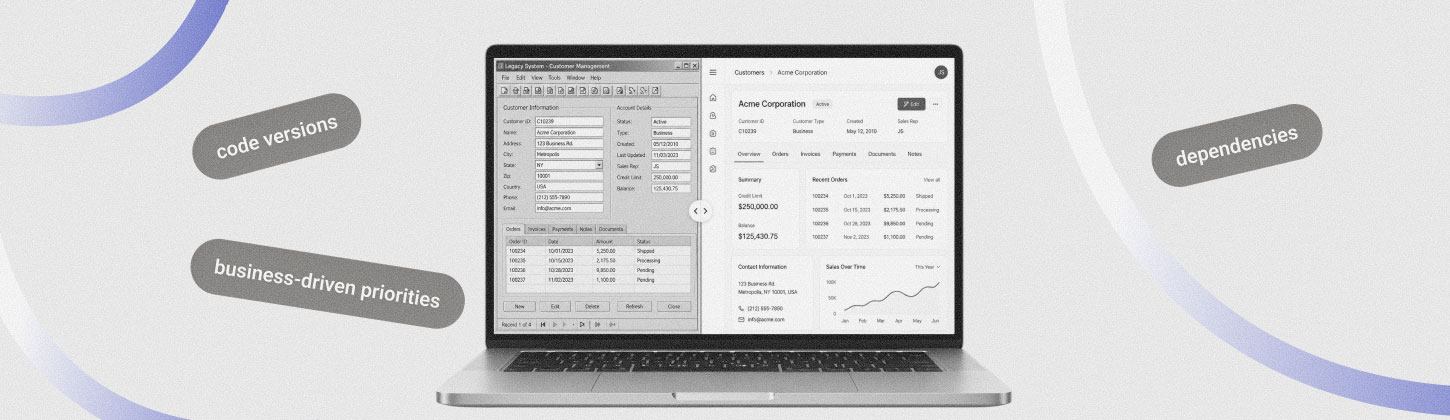
Construction software modernization means more than simply replacing an old system with a new one. It is about unifying project data, schedules, workforce information, and management decisions in a common data environment.
Modernization can take several forms:
- Upgrading individual components while preserving critical business logic;
- Building an integration layer that connects existing systems;
- Creating centralized data views without replacing backend systems;
- Phased replacement of the most problematic parts of the system.
What must be preserved during modernization: useful business logic, project history, critical integrations with ERP, accounting, procurement. The main goal here is to eliminate the friction caused by disconnected data. Application modernization for fragmented business systems means treating the existing technology landscape as an asset to be evolved and allows contractors to preserve what works while fixing what does not.
Read Also What a construction management platform should connect across projects
Construction Project Visibility: Which Processes Should Be Modernized First
Modernization should start with processes that span multiple projects and require constant manual coordination. These are the areas where fragmentation causes the most damage:
- Multi-project planning. When the same crews, equipment, and subcontractors are allocated across several active jobs, spreadsheets cannot keep up. Without visibility into cross-project dependencies, conflicts emerge and double-booking happens;
- Construction subcontractor coordination. Everything breaks down when subcontractor and crew availability, resource assignments, and performance data live in separate places. A centralized view of who is working where and when reduces scheduling conflicts and improves reliability;
- Construction workforce visibility. This means knowing not just headcount but skills, certifications, and availability. Without it, labor forecasting is guesswork, and resource allocation becomes reactive rather than planned;
- Dependency tracking between project phases. Steel erection cannot start until foundations are poured. Electrical rough-in follows framing. These cross-project dependencies are obvious on paper, but invisible in disconnected systems;
- Management reporting. Executive dashboards assembled manually from multiple sources are always out of date. Operational reporting should draw from a single source of truth, not require reconciliation across systems.
The priority should be processes that most affect schedules, resource utilization, and decision quality. Construction workflow management software should address these pain points first.
Read Also A project management system built around interdependent construction tasks
Construction Software Modernization Without Disruption: A Phased Approach
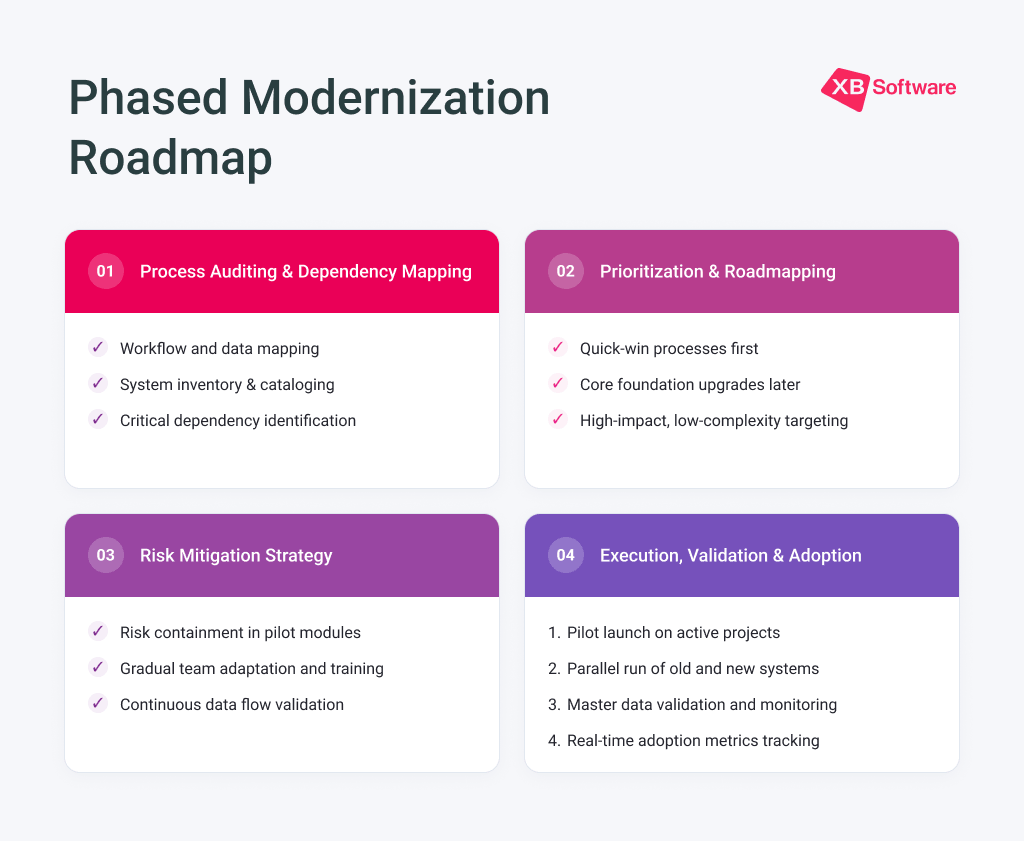
The key to construction software modernization without disruption is the right sequence of steps. Directly replacing core software systems across an entire construction enterprise often leads to data corruption and field-level resistance. For mid-sized contractors managing multiple active jobsites, a structured, phased approach minimizes risk while preserving business continuity.
Below is a step-by-step framework for planning and executing a modernization initiative without disrupting ongoing operations.
Phase 1: Process Auditing and Mapping Data Dependencies
Modernization begins with a thorough audit of the contractor’s actual operational workflows. Before introducing new tools, organizations must build an accurate map of how information flows between field teams, project managers, estimates, and back-office accounting. Key focus areas during this phase include:
- Workflow and data mapping. Tracking the journey of key operational records, such as how estimates transition into project budgets, how field daily logs generate payroll entries, and how subcontractor invoices are verified against completed milestones;
- System inventory. Identifying all formal and informal software tools currently in use, including ERPs, specialized scheduling software, localized spreadsheets, and mobile messaging channels;
- Critical dependency identification. Highlighting mission-critical processes where data delays or errors directly impact jobsite productivity, material deliveries, or cash flow.
Understanding these interdependencies prevents breaking underlying business logic when individual modules are updated.
Phase 2: Prioritization and Roadmapping
Not all operational bottlenecks need to be solved at once. Contractors should evaluate potential modernization targets based on business impact, implementation complexity, and data readiness:
- Quick-win processes. Initial phases should focus on workflows that deliver high operational value with manageable technical complexity, such as centralizing subcontractor availability, consolidating time-tracking, or unifying equipment allocation;
- Core foundation upgrades. Complex transformations, including core financial accounting, enterprise resource planning, and cross-project analytics, are scheduled only after master data standards and integration layers are established.
Read Also How better workforce planning reduces scheduling conflicts on construction projects
Phase 3: Risk Mitigation: Why Phased Rollouts Outperform “Big Bang” Modernization
Switching all enterprise systems simultaneously creates massive vulnerability for a construction firm. A single data synchronization failure or software configuration bug can delay field purchasing, freeze subcontractor approvals, or compromise job costing accuracy. A phased rollout protects business operations through:
- Risk containment. Technical glitches or process issues are isolated within specific pilot modules rather than spreading across the entire company;
- Gradual change management. Field crews, superintendents, and project managers can adapt to new interfaces iteratively without experiencing operational overload;
- Continuous validation. Data integrity and integration accuracy are validated continuously against real-world jobsite workflows prior to full-scale deployment.
Phase 4: Execution, Validation, and Adoption Strategy
To ensure seamless execution, the transition phase relies on specific control mechanisms:
- Pilot deployment. The updated solution is deployed first on 1-2 representative active projects featuring tech-forward project managers. This isolates feedback and refines workflow settings before broader implementation;
- Parallel running. During initial deployment, old and new workflows run side-by-side for a defined period. This allows accounting and project controls teams to reconcile financial figures, cost codes, and payroll hours between systems, ensuring zero data loss;
- Master data validation. Automated scripts and manual sampling continuously verify the accuracy of migrated vendor registers, cost codes, equipment logs, and active contracts;
- Monitoring real adoption. Project success is measured by active utilization metrics, such as daily active user rates among field staff, time to approve change orders, and the elimination of offline spreadsheet workarounds.
Phased Approach vs. “Big Bang” Modernization
| Evaluation Factor | Phased Modernization Strategy | Big Bang Replacement |
| Business Continuity Risk | Low: Issues are contained within pilot projects | High: Unforeseen errors can freeze enterprise-wide operations |
| Data Integrity Verification | Continuous, iterative reconciliation during parallel runs | Single-point migration with higher risk of undetected data loss |
| Field Team Adaptation | Gradual learning curve tailored to specific modules | High risk of user frustration and reliance on shadow IT/spreadsheets |
| Capital & Resource Overhead | Distributed predictably across manageable budget phases | Requires massive upfront investment and concentrated resource strain |
Building a Coordination Platform for a Mid-Sized Residential Contractor
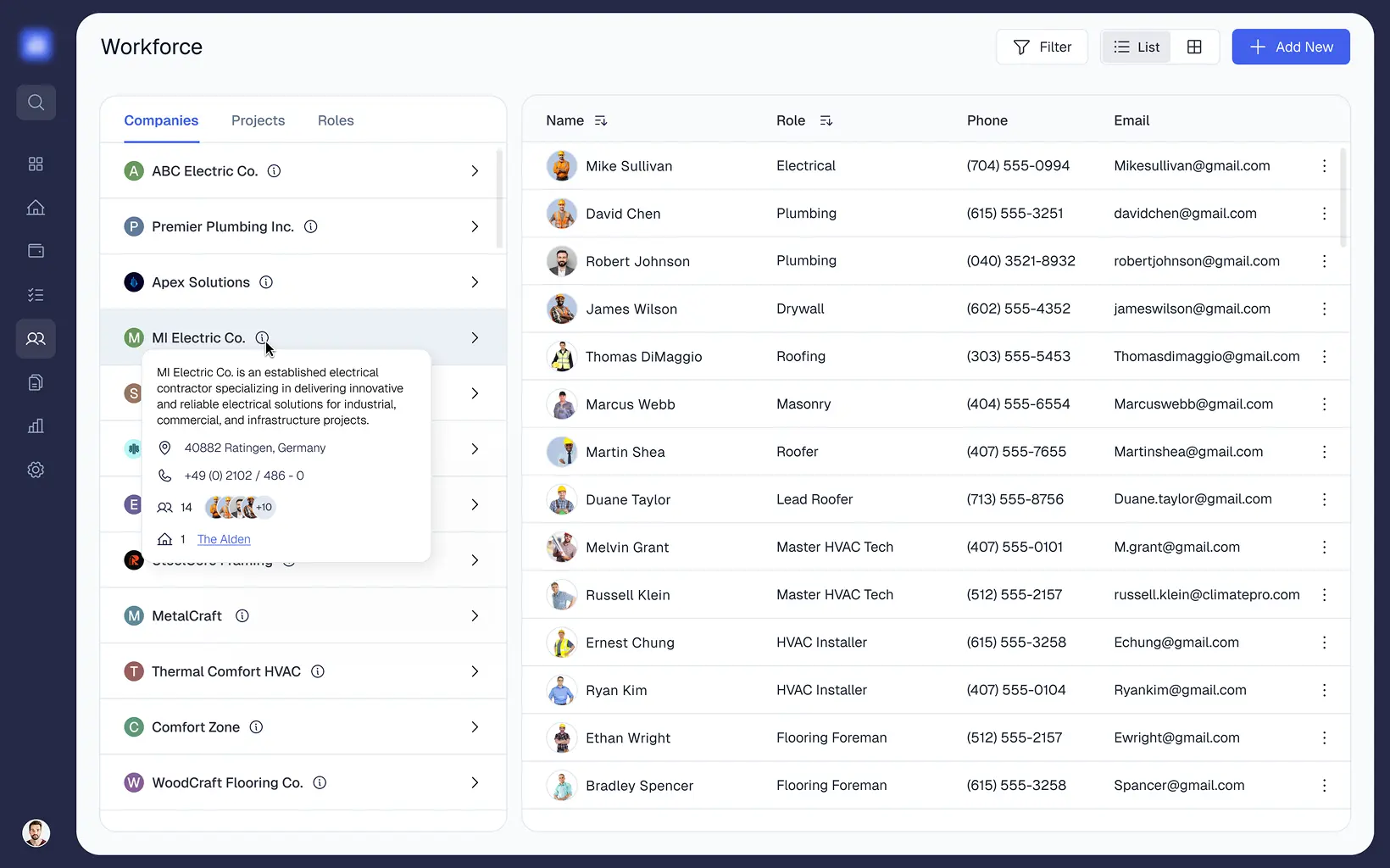
Let’s consider a practical example. Our client, a mid-sized residential contractor, was managing 15-20 active projects simultaneously and coordinating more than 120 subcontractor teams, regional supervisors, procurement staff, and project managers. Information was scattered across spreadsheets, messaging apps, and separate schedules.
The solution was a centralized coordination platform: an interactive Gantt-based scheduling system that became the primary workspace for daily task coordination. It provided complete visibility into subcontractor availability and assignments, enabled cross-project resource allocation, and tracked project milestone dependencies and audit history automatically.
As a result subcontractor scheduling conflicts dropped by 35-40%. Downtime between construction phases was reduced through better visibility into milestone dependencies. Coordinators could detect overload, workforce gaps, and dependency conflicts several days before they affected downstream activities.
This AI-assisted development of a construction project coordination platform shows how a phased approach works in practice for a contractor facing challenges we mentioned earlier.
How an AI-Assisted Engineering Workflow Accelerated Delivery
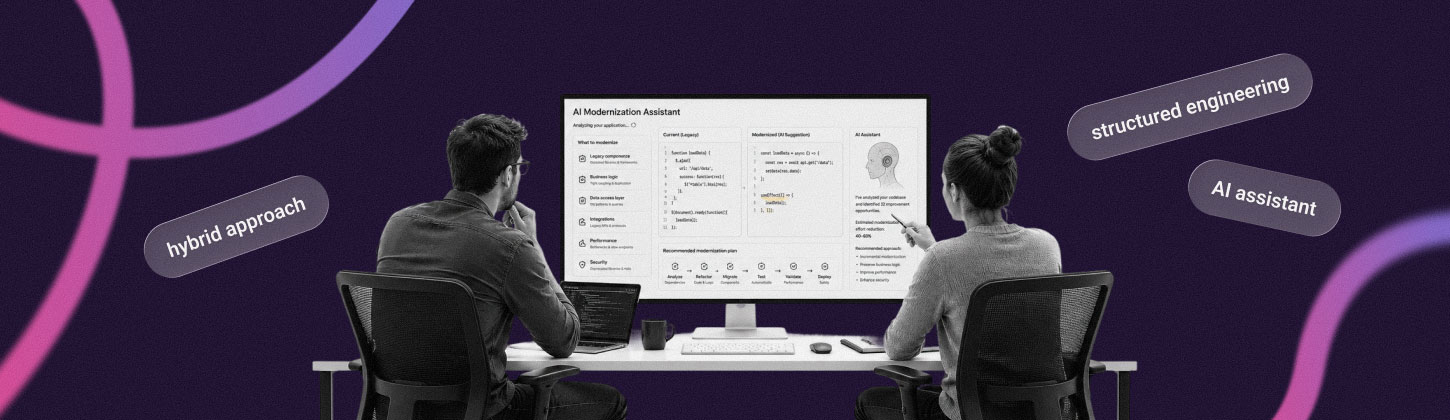
Artificial intelligence was used as part of the engineering process for building the platform. AI-assisted engineering helped accelerate routine tasks, such as preparing boilerplate code, developing certain UI elements, documentation, and some test scenarios. While the AI-assisted engineering approach accelerates development, it amplifies human capability rather than replacing industry expertise and architectural decisions.
Successful Modernization Starts With Construction Workflows
Successful modernization starts with understanding the real operating model of the company. The system must account for dependencies between projects, schedules, employees, and subcontractors. The goal is not technology replacement for its own sake. It is creating a unified view of operations and reducing the volume of manual coordination. Construction companies that improve project performance through better data integration will be the ones that win work and protect margin in every market cycle. Contact us, and we’ll help you design a modernization roadmap that fits your business.