Summary
AI accelerates app modernization but doesn’t replace engineers. It compresses discovery, automates translation, and generates tests. Risks include hidden errors and governance pressure. Human-led AI assistance is the only reliable path
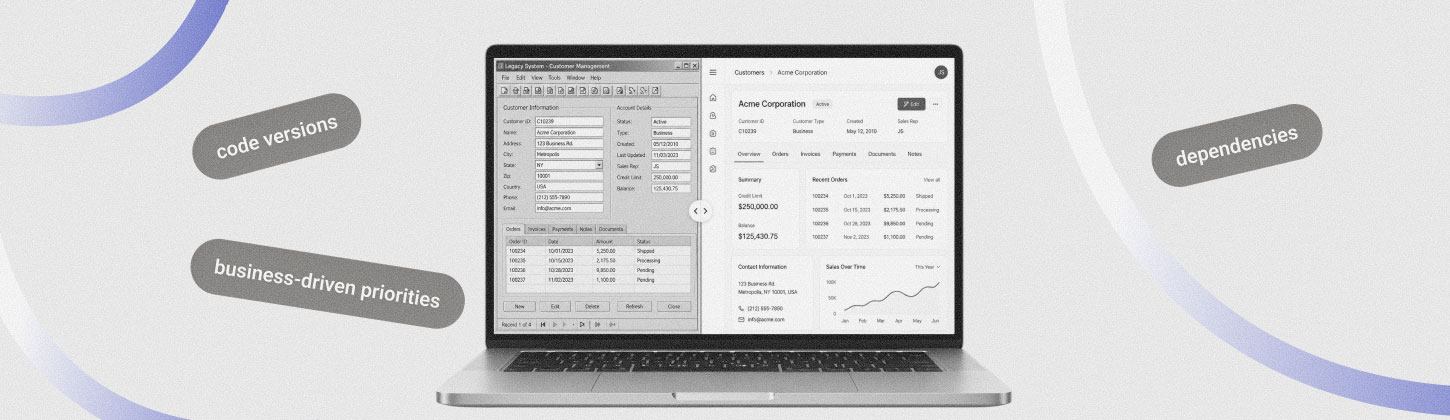
The math on legacy application modernization has always been brutal. High cost, high risk, long timelines, and uncertain outcomes. According to a Pegasystems study, enterprises hemorrhage nearly $134 million each year on legacy transformation projects alone. AI changes that by compressing the discovery work that historically made modernization too expensive.
The main questions regarding AI in application modernization is where it actually delivers value, where it introduces new risks, and why a human-led modernization process with AI‑assisted software development remains the only reliable path. Today, we’ll walk through the real state of AI in legacy application modernization.
What AI Actually Changes in Legacy Application Modernization
Most organizations struggle with incomplete discovery. Manual dependency mapping relies on documentation that is decades out of date. Critical business logic lives only in the heads of senior engineers who left the company many projects ago. Integration points exist nowhere except in runtime behavior that no one has documented.
On top of that, complexity only becomes visible during the work. A bank can spend fourteen months manually mapping dependencies across a COBOL core banking system and still miss critical paths.
Artificial Intelligence helps compress the assessment phase. AI-powered app modernization tools can parse entire codebases, traverse call graphs, and surface integrations that no documentation captures. The output may not be a perfect diagram, but it tells which components carry the most downstream dependencies and where undocumented business logic is hiding.
This matters because most IT leaders already know their legacy work is draining resources. The same Pegasystems survey found that 78% of respondents describe maintaining and transforming old systems as a “waste of time, effort, and money”.
Read Also From Old to Gold: Transforming Legacy Systems with Modernization Techniques (with Real Examples)
Where AI Delivers Real Value in Application Modernization
Code Analysis and Discovery
An AI-powered discovery pass produces a prioritized risk register. It helps identify high-complexity modules, surfaces hidden coupling between seemingly unrelated components, and flags integration points that exist only in production logs.
For companies delivering legacy app modernization services, this shifts the conversation from guesswork to data. Developers know where to start, what to leave alone, and which parts of the system are candidates for early retirement.
Automated Refactoring and Code Translation
Generative AI models are good at converting code from one language or framework to another. A COBOL batch routine becomes Java. A PL/SQL stored procedure moves to a modern service layer. The output is not necessarily production-ready, but it is a working first draft.
Architecture Analysis and Service Boundary Detection
LLM-based tools can analyze a large monolith, identify natural seams for decomposition, flag circular dependencies, and generate candidate service boundaries. This happens at a speed that manual architecture review cannot match.
The decision about which boundaries to enforce and how to sequence the work still requires experienced engineers. But having AI surface the options first makes the conversation faster and more concrete.
Intelligent Test Generation
Legacy systems often predate automated testing. AI infers expected behavior from production logs, historical transactions, and static code analysis. The resulting test suites cover scenarios that the system has handled for years without a formal specification.
For organizations starting from zero test coverage, this is where the most asymmetric value sits. You go from no safety net to a regression baseline that catches breaking changes early. Once a legacy system is stabilized, an AI software development company can help organizations build entirely new intelligent features on top of the modernized core.
The Risks That Come with AI in App Modernization
Subtle Code Errors That Pass Testing
AI-translated code can compile and pass initial tests while harboring logic errors that surface only under specific production conditions. A payment processing module may have a rounding error in financial calculations unnoticed for weeks after go-live. While such errors may persist in legacy systems for years, they are rarely triggered until the modernized system is operating at higher volumes. A human review can help catch it.
Bounded Discovery
AI code analysis is limited to what is actually in the codebase. Integrations that exist only in documentation, runtime configurations maintained outside version control, and informal data format dependencies do not appear in the AI-generated map. This means you still need to validate discovery outputs with engineers and operations staff who carry institutional knowledge.
Governance Pressure
Faster development cycles create pressure to compress review gates. When AI produces code in seconds, the temptation is to move faster than your quality processes can handle. The correct response is faster review processes. Cutting governance to manage schedule pressure almost always leads to production incidents.
Data Migration as an Afterthought
Legacy data models contain decades of schema evolution and undocumented constraints. AI does not automatically surface these. Data work needs to run in parallel with application transformation from the very beginning.
Read Also How to Ensure Application Compatibility When Modernizing a Web Application
Why Human-Led Modernization with AI Assistance Is the Only Reliable Model
Agentic AI has clear strengths and just as clear limitations. That is why successful legacy updates never hand over control to automation alone. The technology can scan, connect dots, and suggest changes. But deciding what to approve, reviewing the output, and owning the outcome still belong to people.
For systems that run critical business operations, where correctness, regulatory compliance, and customer trust are non‑negotiable, the final say stays with human engineers. Speed is valuable, but not at the cost of safety. In practice, this means:
- Every AI-generated translation gets reviewed by an engineer who understands the source system and validated with behavioral tests before progressing;
- Discovery outputs are treated as hypotheses. Engineers sanity-check them against runtime behavior and institutional knowledge;
- Governance gates stay in place. AI accelerates what happens between them, but it does not eliminate the need for human sign-off on risk decisions.
Practical Example: AI-Powered App Modernization Workflow with Human Oversight
The table below illustrates how AI assistance and human validation work together across a typical modernization lifecycle.
| Stage | AI Helps With | Human Validation | Outcome |
| Discovery | Parse codebase, map dependencies, flag undocumented integrations | Review hypotheses against runtime behavior and institutional knowledge | Risk register with prioritized modernization candidates |
| Refactoring | Generate first-draft translations, suggest cleaner implementations, remove dead code | Verify business logic preservation, review edge cases | Maintainable code with preserved behavior |
| Testing | Generate unit, integration, and regression tests from observed behavior | Validate test coverage with domain experts | Safety net that catches regressions |
| Migration | Plan cutover sequencing, validate parallel run outputs | Make go/no-go decisions, approve rollback triggers | Controlled production transition |
| Monitoring | Detect anomalies, suggest optimizations | Review and approve architectural changes | Continuous improvement without degradation |
A Pragmatic Timeline: From First Pilot to Production in Weeks
Below is an example of an accelerated timeline based on what we have seen work with AI‑assisted software development in real legacy environments.
Developers don’t start with the most critical mainframe. Instead, they start to focus on a low‑risk, high‑visibility legacy system that can demonstrate value quickly while building organizational confidence. Good candidates are:
- A batch reporting module that runs nightly;
- A standalone calculation engine with clear inputs and outputs;
- A peripheral integration service that is isolated enough to avoid breaking core operations.
During these two weeks, the migration team can run a lightweight code audit using AI‑powered discovery. The tool can analyze program flows, map data dependencies, and document business rules that are buried in legacy subroutines.
Now the team can deploy agentic AI to analyze the legacy code and demonstrate what modernization could look like. The AI reads through the old programs, extracts business logic, and documents dependencies that no one remembered existed. Here, the AI generates:
- An initial code translation from the legacy language to a modern stack;
- Data flow diagrams that show how information moves through the system;
- A clear inventory of technical debt patterns (dead code, duplicated logic, high coupling).
Then, it’s time to build a proof of concept that modernizes one critical subroutine or calculation routine. For this, developers run the legacy version and the modernized version side by side with the same inputs to show identical outputs. This phase often reveals surprises, such as implicit precision handling, undocumented business rules, or assumptions that were written into the code many years ago.
With the POC validated, it’s time to move to a complete migration of that same system from its current environment (on‑premise or private cloud) to a modern cloud target. AI handles the heavy lifting:
- Code translation while preserving exact business logic;
- Generation of a comprehensive test suite that covers edge cases found in real production data;
- Creation of API wrappers so the old and new systems can run in parallel;
- Documentation of every transformation decision, so the next engineer does not have to reverse‑engineer the AI’s work.
The modernized code executes alongside the legacy system, comparing outputs for every transaction. This is non‑negotiable for any system that touches money, customer data, or compliance boundaries.
With one successful migration behind, developers can expand the effort and tackle more complex systems. For instance, a core actuarial engine or a real‑time risk platform. At this stage, the AI agents work with accumulated knowledge:
- Reusing proven conversion patterns from the pilot;
- Identifying common anti‑patterns before they cause trouble;
- Suggesting architectural improvements that go beyond literal translation.
It’s a good practice to build what could be called a “modernization factory” with parallel teams working on different systems, shared libraries of conversion utilities, automated testing frameworks, and continuous knowledge capture.
The ROI of AI-Assisted Application Modernization
While the costs of modernization are front-loaded and visible, the returns manifest across multiple dimensions that compound over time:
- Modernization Speed. Multi-month projects condense to weeks when technical barriers are removed. Teams freed from legacy constraints ship features faster and with fewer regressions;
- Risk reduction improves through better testing and controlled cutovers. Modern systems incorporate current security practices and receive regular updates from active communities. High-availability architectures eliminate single points of failure that plague legacy systems;
- Knowledge preservation becomes possible. Agentic tools can generate documentation from code, extracting institutional knowledge that would otherwise walk out the door with retiring engineers. This breaks the cycle where every generation inherits an undocumented mess.
Better Systems, Not Just Newer Runtimes
Legacy systems are still complex, business-critical, and tightly coupled. Using AI for app modernization changes the discovery effort, the economics of translation, and the test coverage problem. All these factors have made large programs too expensive to justify. The organizations that capture those gains without eroding engineering rigor arrive on the other side with genuinely better systems. They’re faster, more maintainable, and actually suited to the workloads they carry, rather than merely relocated to a newer runtime.
Contact us if you are assessing a legacy application modernization initiative and want to understand what AI can realistically do for your specific business.