Summary
AI doesn’t change the financial model of app modernization, but it lowers cost inputs like discovery and testing. By using pilot data, CTOs can re-estimate rejected proposals with hard evidence, turning unviable business cases into risk-adjusted ROI wins.
It is frustrating to watch a modernization proposal get rejected when the technical need is obvious. The system is expensive to maintain, fragile to change, and increasingly hard to staff. Yet the finance committee still says no.
At the time, the proposal may have required too much investment, too much engineering capacity, and too much delivery risk for an uncertain return. AI-assisted development gives CTOs a valid reason to revisit that decision, but it does not change the financial model. It changes the inputs that made the original application modernization business case unattractive. The opportunity is to re-estimate rather than re-argue.
“Our Legacy System Still Works, So Why Modernize It?”
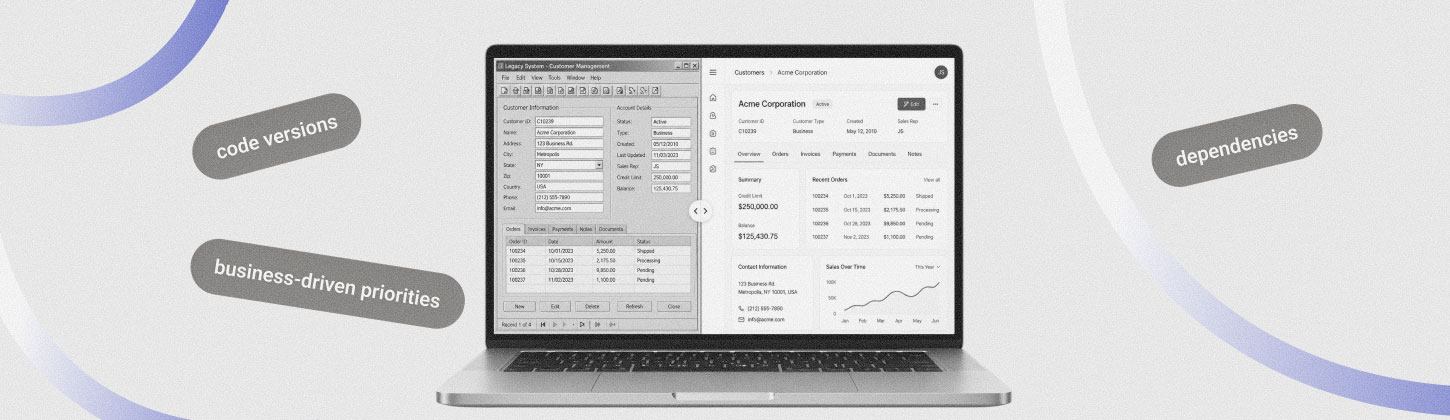
Over extended periods, older software demands excessive engineering resources simply to maintain feature parity with market expectations. As operational needs expand, engineering teams accumulate layers of custom patches, external API adapters, and temporary database bridges over monolithic legacy codebases. These incremental additions turn core platforms into brittle networks of tightly coupled software logic. A minor modification in an administrative submodule can trigger unexpected downtime across client-facing interfaces, forcing developers to perform lengthy manual verification before every software release.
This technical friction directly damages corporate performance. Release cycles that ought to take days stretch into quarters, clearly showing how legacy systems hinder innovation. According to research by Deloitte, direct technical debt taxes absorb between 21% and 40% of total enterprise IT budgets. Elevating application modernization business agility requires shifting from perpetual software patching toward systematic refactoring. Exploring different legacy system modernization approaches gives teams a clearer roadmap for digital transformation.

Legacy systems often work fine during routine operations, but fail catastrophically under stress. A clear example was Southwest Airlines’ 2022 winter crisis, where an outdated 1990s crew scheduling system collapsed under force majeure, resulting in nearly $1 billion in losses. Organizations avoid modernization out of fear that it will be expensive and unpredictable, yet the financial fallout of doing nothing is often drastically higher.
Why AI Productivity Claims Should Not Drive Modernization Decisions
A claim such as “AI will reduce the modernization effort by 30%” is just a hypothesis, not a complete AI application modernization business case.
The evidence on AI-assisted development is mixed and highly context-dependent. DORA’s 2025 research found positive relationships between AI use and individual productivity (more than 80% of tech experts report productivity increase), code quality (59% of respondents report positive impact), and documentation quality, while also warning that delivery stability and throughput can suffer without strong engineering practices. A 2025 METR randomized study of experienced developers working in mature repositories found that the developers completed tasks more slowly with the then-current AI tools, despite expecting a speedup. These studies point to the same practical conclusion: local measurement matters more than broad market claims.
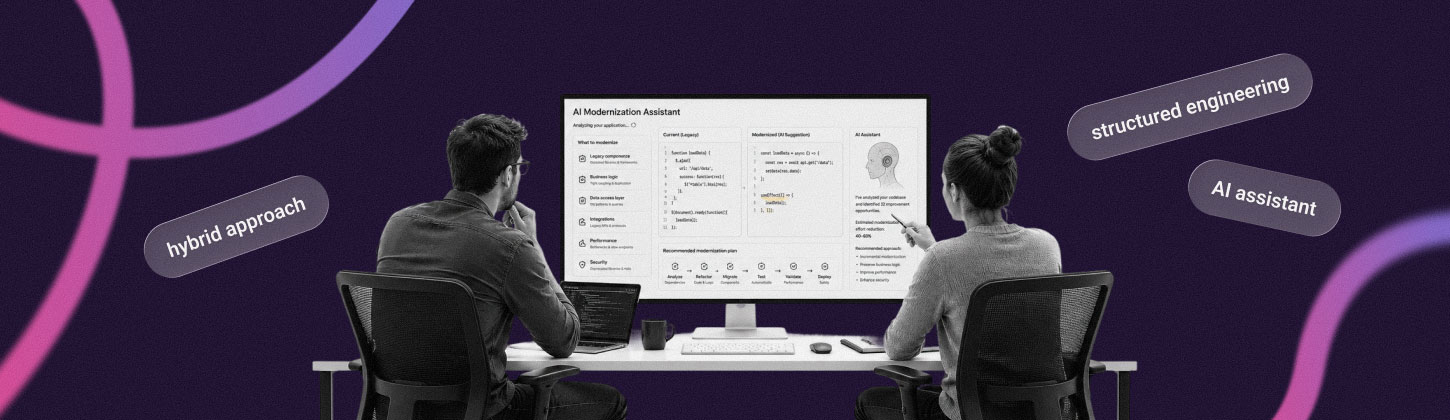
The relevant question is not whether AI makes developers faster in general. It is whether AI improves application modernization productivity for the specific activities that made the original proposal financially unattractive. Understanding how AI-assisted application modernization works helps identify where AI adds measurable value and where it adds overhead. AI may reduce the cost of dependency mapping, documentation recovery, test creation, and repeatable transformations. If those activities materially affected the original estimate, the ROI of legacy system modernization may have changed.
How AI Changes the Economics of Application Modernization
The financial model for evaluating application modernization ROI remains the same: initial investment, delivery duration, operating cost, delivery risk, and expected application modernization business value. AI changes the assumptions within that model rather than replacing the calculation itself.
| Original assumption | What needs to be re-estimated |
| Codebase discovery requires extensive manual analysis | Time and cost to map system dependencies, recover documentation, and identify behavior |
| Test creation makes refactoring too expensive | Engineering effort to establish reliable unit, integration, and contract tests |
| Repetitive migration work consumes scarce engineering capacity | Effort for repeatable, bounded transformations across legacy applications |
| Delivery risk is too uncertain to price | Whether better code understanding and test coverage narrow the uncertainty |
| Value arrives only near the end of the program | Whether smaller phases can produce value earlier |
The argument is not that AI makes every modernization project cheaper. But if it may improve the economics of selected activities enough to justify a new estimate and reduce overall legacy modernization risk.
Validate Application Modernization Assumptions with a Pilot
Before reopening the full proposal, test a small, representative work package during your initial discovery phase:
- Mapping dependencies in a contained legacy module;
- Recovering technical documentation from code and operational records;
- Creating contract tests for a legacy integration;
- Generating and validating test coverage before refactoring a service;
- Migrating a repeatable set of components with stable interfaces.
Measure total engineering effort from work start to production-ready completion.
| Measure | Include |
| Delivery effort | Engineering, QA, architecture, product, and operations time |
| AI overhead | Licenses, training, context preparation, and tool evaluation |
| Verification | Code review, test failures, security checks, remediation, and rework |
| Quality | Escaped defects, rollbacks, change failure rate, and test coverage |
| Delivery flow | Cycle time, completed work, and lead time to deployment |
This gives an evidence-based approach for CTOs evaluating how to calculate ROI on application modernization.
Recalculating Application Modernization ROI
A modernization business case moves forward when the expected legacy modernization ROI meets or exceeds the organization’s investment threshold, regardless of reductions in delivery effort alone.The calculation should be explicit:
Modernization ROI = (Risk-adjusted Financial Benefits – Total Modernization Investment) / Total Modernization Investment
For a large program, use discounted cash flow and net present value rather than a simple ROI percentage. The principle is the same: compare the cost of the program with the financial value it is expected to create over time.
Define Application Modernization Benefits in Financial Terms
Only include what can be evidenced and owned by the business.
| Benefit category | CFO-ready evidence |
| Reduced run cost | Retired licenses, infrastructure, support contracts, or datacenter spend |
| Lower maintenance cost | Historical engineering and support effort that can be avoided or redeployed |
| Avoided risk cost | Historical incident frequency x financial impact x credible reduction in likelihood |
| Earlier benefit realization | Value brought forward because phased delivery reaches a usable outcome sooner |
| Revenue or margin upside | A validated commercial forecast tied to capabilities the legacy system prevents |
“Developer hours saved” is not automatically a financial return. It becomes tangible application modernization business outcomes only when the organization can avoid spending, retire a cost, or convert released capacity into funded work with measurable value.
Which Application Modernization Costs Can AI Actually Reduce
AI should affect only the lines it has demonstrated it can change. For example, the original modernization case may include:
| Original estimate | AI-tested revision |
| Manual discovery and documentation recovery | Reduced only if the pilot proves faster, reliable analysis |
| Test creation before refactoring | Reduced only after validated test coverage is produced |
| Repetitive component migration | Reduced only for stable, repeatable transformations |
| Code review, security, and remediation | Increased if AI-generated output requires more verification |
| Tool, training, and partner costs | Added as direct investment costs |
Assume the original proposal required a $1.25 million investment and was expected to produce $300,000 in annual, validated savings for five years. At a 10% discount rate, those benefits of application modernization have a present value of approximately $1.13 million. The proposal has a negative NPV of about $113,000 before risk contingency, so rejecting it is rational.
A pilot then shows that AI-assisted codebase analysis, test recovery, and bounded migration reduce the estimated program cost by $180,000. It also identifies $45,000 in tool, training, and additional review costs.
The revised investment is $1.12 million. The present value of the benefits remains $1.14 million. The NPV is now slightly positive before contingency.
AI can strengthen a proposal enough to move it above the organization’s investment threshold when the AI application modernization business outcomes are supported by hard evidence.
Assess Application Modernization ROI Across Scenarios
The final case should include conservative, expected, and downside scenarios. This prevents a narrow AI productivity assumption from carrying the entire ROI case.
- Conservative: AI does not produce a net delivery gain after review and rework.
- Expected: Pilot results reduce specific work packages and improve the program’s NPV.
- Downside: Verification, security, or partner onboarding costs erode the expected gain.
The leadership team can then assess whether verified changes in cost, risk, and delivery timelines produce an acceptable return on investment, rather than relying on assumptions about AI-driven savings.
Choose the Right Delivery Model for Application Modernization
The delivery model is a core part of the modernization strategy.
Internal teams bring advantages that are difficult to replicate: knowledge of production behavior, undocumented exceptions, business priorities, security requirements, and the history behind technical choices. They can make decisions faster because they already understand the legacy system and do not need to transfer critical context to a new team.
An external modernization team offering specialized application modernization services can add value when conditions require dedicated capacity. They bring specialist experience in discovery, test recovery, migration sequencing, or independent technical assessment of inherited assumptions.
| In-house delivery is stronger when | External support is stronger when |
| Business rules are undocumented and depend on long-held internal knowledge | Internal teams lack capacity for a time-bound modernization phase |
| The system is highly sensitive or requires deep domain and security context | The work is bounded, repeatable, and has clear acceptance criteria |
| Architecture decisions require continuous product and operational input | Specialized modernization, testing, or migration experience is missing internally |
| The team can commit sustained capacity without harming critical product work | An independent assessment would help validate scope, sequencing, or delivery risk |
The most credible model is often a combination. Internal teams retain architectural authority, business rule validation, and production accountability. Leveraging professional AI-assisted software development capabilities from external partners supports defined work where dedicated capacity or relevant experience can reduce cost, duration, or uncertainty.
Where AI Works Best in Legacy Application Modernization
AI is most useful where work is bounded, repetitive, and verifiable:
- Stable APIs and well-defined interfaces;
- Repetitive framework or language migrations;
- Modules with existing tests or observable behavior;
- Documentation and dependency recovery;
- Test scaffolding that engineers can validate.
It is less likely to reduce legacy system modernization risk and cost in:
- Highly coupled monoliths with undocumented business rules;
- Shared databases with hidden dependencies;
- Systems with little automated test coverage;
- Regulated or security-critical workflows without rigorous verification;
- Areas where stakeholders disagree on intended behavior.
Understanding these limits drives true application modernization operational efficiency without applying blanket productivity assumptions to the entire modernization portfolio.
Why AI-Assisted Application Modernization Requires Strong Verification
Generated code can be incorrect, incomplete, insecure, or inconsistent with local conventions. Faster implementation is not a financial gain if code review, testing, security validation, and defect remediation absorb the saved time.
Every AI-assisted change needs human ownership, automated testing, code review, dependency validation, and security controls. AI output should be incorporated into established engineering practices, not trusted by default.
Conclusion: When AI Makes the Application Modernization Business Case Worth Revisiting
A rejected modernization proposal needs a revised estimate that shows:
- Which assumptions made the original business case fail;
- Which assumptions AI has demonstrably changed;
- How to reduce risk in legacy system modernization so the revised cost and duration meet the investment threshold.
The strongest message to leadership is:
AI improves the case in specific areas, leaves others unchanged, and gives us a narrower, lower-risk program to evaluate.
AI may not change the need for modernization. However, demonstrating realistic AI application modernization ROI may change whether the organization can now afford to act on it. If you want to evaluate your legacy platforms, contact us to discuss your modernization priorities.